
Parking a Fisker Ocean: Keep AUTOOL EM Support Supervised

Parking a Fisker Ocean for a period of non-use calls for a storage plan, not an automatic assumption that any powerful charger can stay connected. Fisker’s current storage guidance should set the vehicle-side plan. AUTOOL EM equipment may be evaluated for an attended 12 V charging or support session, but its operating instructions do not make it an unattended storage maintainer.
On this page
Choose the storage plan before leaving the vehicle
Start with the questions that determine responsibility. How long might the Ocean remain parked? Is the return date firm? Who can inspect it? What does the current owner information require for the high-voltage and 12 V batteries? Has the auxiliary battery been replaced, and does its label still identify a compatible charging path?
The original Ocean technical information identifies a 12 V, 50 Ah AGM auxiliary battery, but a replacement may differ. Read the fitted label rather than relying on the original specification. Also record recent low-voltage warnings, unusual wake behavior, service work, or software events so a later problem is not mistaken for an ordinary storage effect.
Do not invent a universal number of days after which charging becomes necessary. Parking environment, battery condition, vehicle state, access, and current OEM instructions all matter. When the duration or battery identity is uncertain, arrange a qualified inspection instead of guessing.
Separate one supervised session from unattended maintenance
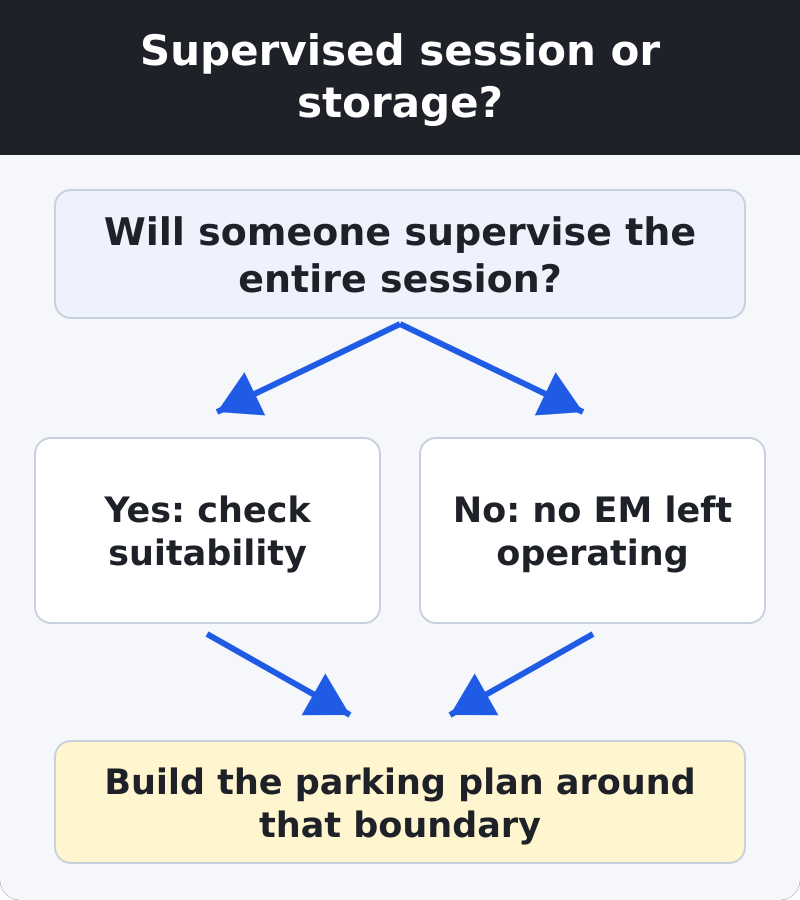
A supervised session has a responsible person present to confirm the battery, choose the documented mode, watch the equipment and connection, respond to warnings, and end the task normally. An unattended-maintenance plan relies on equipment and a vehicle/battery procedure specifically suitable for remaining connected without that observation.
The current EM355 manual, page 4, EM365 manual, page 4, and EM385 manual, page 4 all say powered operation must not be left unattended. That boundary applies even though Fisker’s 12 V battery guidance allows a trickle charger when needed. A vehicle-level allowance does not override the operating restriction of the particular charger being considered.
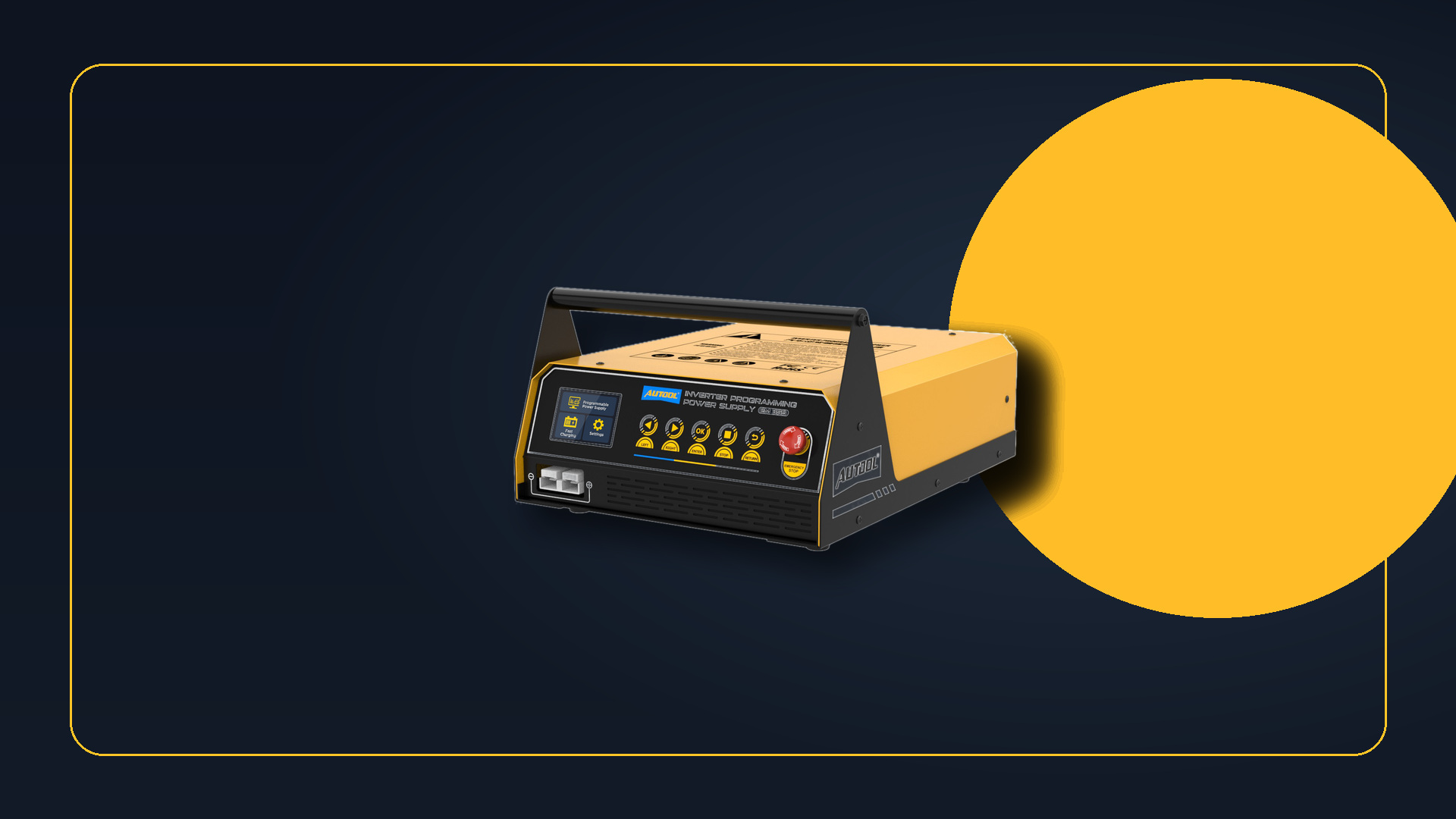
For a simple attended AGM task, the AUTOOL EM355 offers charging and service-power functions in a physical-control format. It belongs only on the supervised branch, after the fitted battery and current procedure have been checked.
Define the attended session before selecting equipment
Write down the purpose before choosing a mode: is this a battery-charging session, a separately documented service-power task, or a condition that first needs diagnosis? Confirm the fitted battery chemistry, approved connection method, correct 110 V or 220 V equipment version, grounded mains supply, observer, planned end point, and stop conditions.
Where a workshop wants a dedicated display-oriented workflow, the AUTOOL EM365 adds a named vehicle-display mode alongside its charging and programming-support functions. That can be practical during attended work, but it does not make the unit a hands-off tender or diagnose why a battery became low.
For a workshop that also needs separately adjustable equipment power, the AUTOOL EM385 adds that function and touch controls. Its extra modes do not expand the Ocean connection to the traction battery, and they do not remove the supervision requirement.
If the actual need is unattended maintenance, choose equipment specifically suited to that duty and permitted by the current battery and vehicle instructions, or arrange professional storage support. Keeping existing suitable equipment is also a valid choice; an EM purchase is not required to follow Fisker’s storage guidance.
Prepare the return without assuming battery health
Before the planned return, record the vehicle’s visible condition and any messages before changing its state. Inspect accessible cables and the parking area for damage or anything abnormal. If the vehicle does not respond normally, avoid repeated wake attempts or improvised low-voltage recovery and arrange appropriate support.
A successful wake-up or completed charging cycle proves only that the vehicle reached that observed state. It does not prove battery capacity, rule out a recurring drain, confirm module health, or show that the storage plan was ideal. Preserve the observations and have the battery and vehicle assessed when warnings return.
Use a go, verify, or hand-off restart card
Go: the current instructions are available, the fitted battery identity is known, the vehicle presents no unexplained warning, and the planned return steps are clear.
Verify: the vehicle wakes but its recent history, battery condition, or storage behavior remains uncertain. Record what happened and obtain the appropriate battery or vehicle checks.
Hand off: the battery label is unclear, warnings persist, the vehicle behaves abnormally, or the procedure and responsible next step are unknown.
If supervised AUTOOL equipment is selected only after those checks, enter coupon code HCM6E4GZ at checkout and verify acceptance and the final total before paying.






Comments 0
Questions, fixes, and real-world diagnostic notes from readers.
Be the first to share a diagnostic result or ask a follow-up question.