
Peugeot 206 Stalls at Idle With No Codes: Watch What Falls Before the Engine Stops

Quick answer: The order of events matters: loss of fuel pressure before the stall is different from electrical power switching off after the engine has stopped. Compare the supporting supply with delivery during the fault, not only after it.
Delivery and electrical support need to be observed as separate quantities. An AUTOOL DM301 can support passive low-voltage checks at suitable test points; it is not a fuel-pressure gauge or a substitute for a properly coordinated event capture. Fuel-system testing belongs with an equipped repairer.

In this guide
Keep the sequence in the complaint
Write the complaint as an event sequence: the car idles, something changes, the engine stops, and it either restarts readily or does not. Include the approximate circumstances from normal use, such as whether the engine was already warm. Do not add a model year from the publication date of an old case.
A car that restarts quickly can still create a serious traffic risk. Arrange a safe repair or recovery plan rather than driving until it stalls again. Your account of the sequence can help the workshop decide how to investigate under controlled conditions. It does not need to include a home fuel-pressure test to be useful. Record what you experienced, not a guessed component failure.
No codes does not mean there is no failed delivery
Fault memory is one source of evidence. If it is empty, the physical complaint still needs an explanation. A scan report cannot by itself establish that every required delivery or support condition remained adequate throughout the event.
Ask what the workshop intends to observe while the fault develops and why those observations could distinguish the leading causes. For this type of question, a value sampled only after the engine has stopped may miss the important change. The absence of a warning should not turn a reproducible stall into a no-fault-found conclusion without describing the limits of the assessment.
That also does not mean scan data has no value. The useful approach combines what it can show with independent measurements where the question requires them.
In the Professional Motor Mechanic published case, the Peugeot stalled after idling, restarted promptly and stored no faults. The report describes fuel pressure falling while pump voltage remained steady, followed by electrical shutoff after the stall. Replacing the pump resolved the complaint. The article does not identify the exact engine or publish a modern vehicle-specific test procedure.
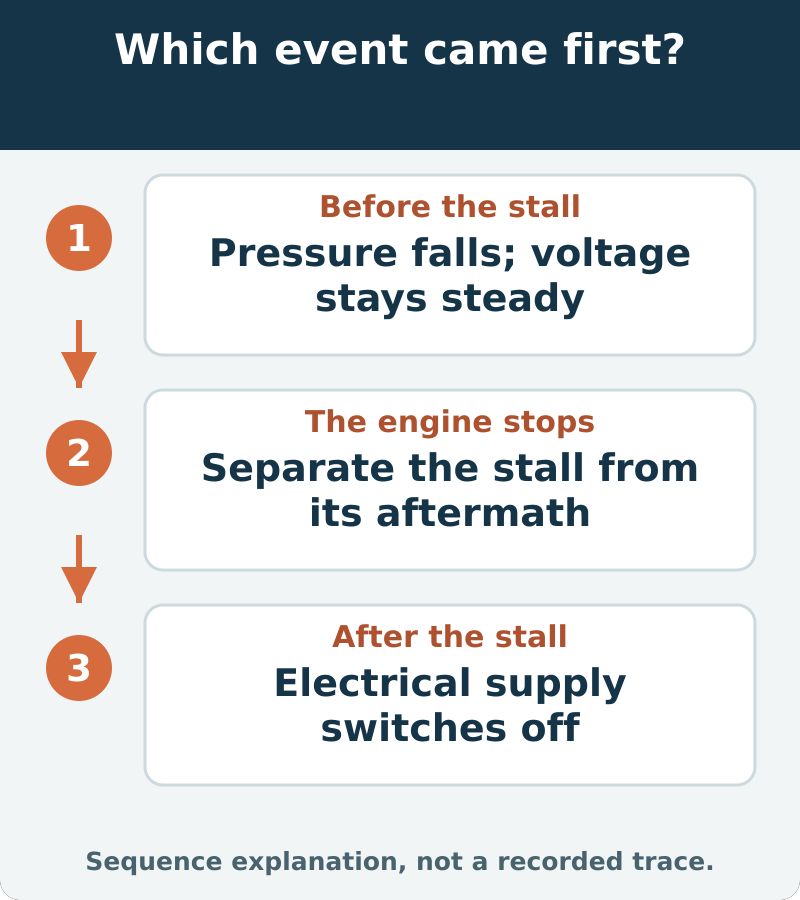
Compare the moments before and after the stall
The key distinction is whether a change precedes the stall or follows it. An electrical output seen off after the engine has stopped may be a consequence of the shutdown, rather than the event that began it. Interpreting the final state as the initiating fault can send the repair in the wrong direction.
Ask for a plain-language timeline: which quantity changed first, what the engine was doing then and when the electrical supply changed. The observations need a shared time reference or another defensible way to establish order. Two unrelated snapshots are weaker evidence than a coordinated capture.
The diagram below is an explanation of that reasoning, not a recorded trace or a specification for every Peugeot 206.
What steady voltage leaves unanswered
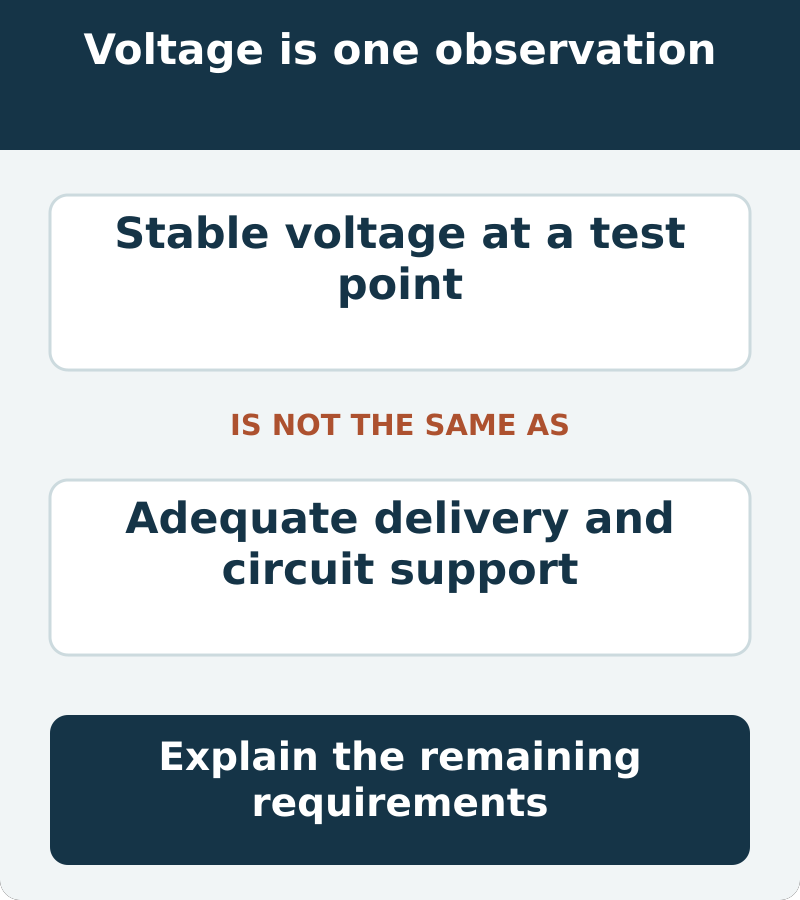
A voltage reading is meaningful only with its measurement points and conditions. A stable reading at one location does not prove that the whole circuit can deliver the required current, nor does it identify every possible cause of inadequate fuel delivery.
If a pump is proposed, ask how the electrical support and delivery findings fit together, and what other restrictions or supply conditions were considered for that vehicle. Do not turn the historical sequence into a universal pump-condemnation rule.
Also distinguish an appropriately measured supply from an improvised meter connection. Connecting a current input incorrectly can create a short circuit. The owner-facing decision is whether the diagnosis explains the event; carrying out electrical and fuel measurements safely requires the correct method and equipment.
Ask for a safe plan to capture the event
Intermittent faults benefit from an agreed capture plan. Ask whether the workshop can investigate the reported idle behavior in a controlled setting, what measurements it needs and what happens if the fault does not appear during the allotted time. A limited diagnostic session can still produce useful findings without promising a guaranteed reproduction.
Do not ask someone to monitor handheld equipment while driving, or open fuel lines to watch for flow. Fuel containment, pressure-rated equipment and safe working conditions are part of the professional task, not optional extras.
If the event remains uncaptured, keep that uncertainty on the report. An estimate based on a suspected cause should be distinguishable from one supported by the actual sequence during the failure.
Return to the original idle condition
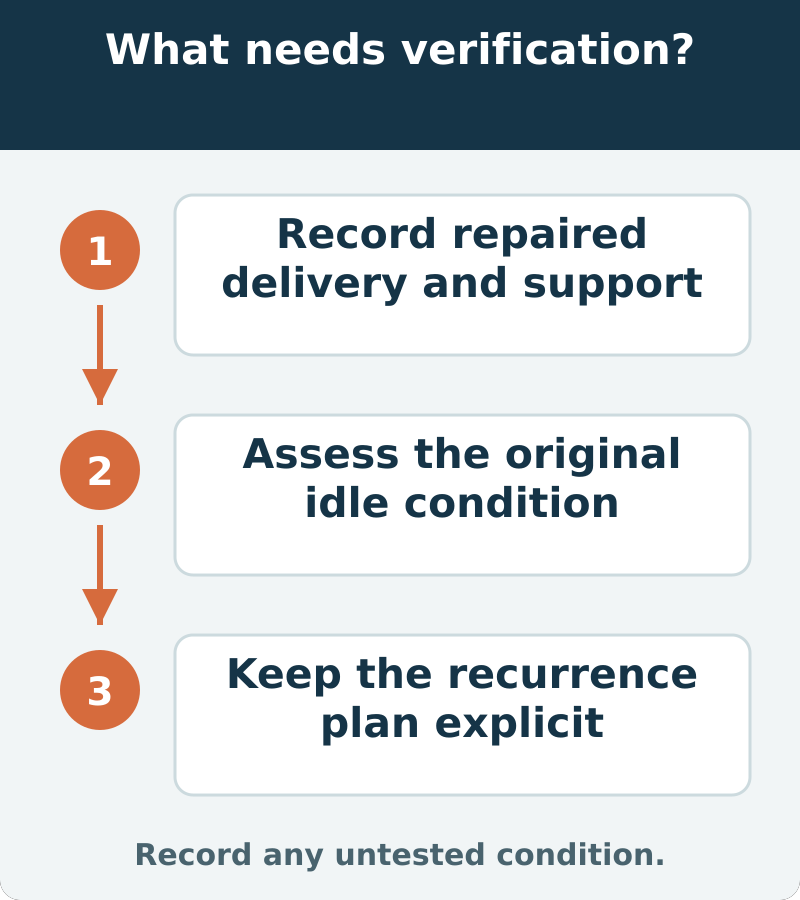
After work is completed, ask whether the original idle condition was included in the assessment and whether the relevant observations remained satisfactory through it. A quick restart alone is not a strong result when the car already restarted readily before repair.
The job record should identify the finding that justified the work and the conditions used for the final check. If the event was intermittent, ask what follow-up is appropriate should it recur; a single successful check should not be described as a long-term guarantee.
The transferable lesson is chronological, not a replacement list. Establish what failed before the engine stopped, separate it from normal shutdown consequences and confirm that the repair addresses the original sequence. That is useful even when another car ultimately has a different cause.








Comments 0
Questions, fixes, and real-world diagnostic notes from readers.
Be the first to share a diagnostic result or ask a follow-up question.