
2018 Mercedes GLC300 Stops Normally but Struggles to Restart: Look at the Cranking Event

Quick answer: Separate an unavailable stop/start feature from a failed restart. Abnormal cranking during both automatic and manual starts points beyond the feature’s enable settings.
An unreliable restart can leave the vehicle stranded in traffic. Arrange a safe assessment; do not wait at repeated junctions to reproduce the failure or treat disabling a feature as a completed repair.
Recording electrical support during the failed event helps separate supply trouble from starter response. A meter such as the AUTOOL DM301 can support passive voltage checks; it must not be inserted in series with starter current.

In this guide
Did it decline to stop or fail to restart?
These complaints sound similar in a booking note—“ECO does not work”—but they describe very different experiences. In one, the engine keeps running when an automatic stop was expected. In the other, it stops and then fails to resume normal running. The second complaint deserves particular attention to the actual restart event.
Describe what happened in sequence. Was the engine still running? Did cranking begin? Was it brief, slow, noisy or absent? Did a manual start behave differently afterward? Those observations help the technician distinguish a feature-permission question from a starting-system failure without assuming that every stop/start complaint belongs to the same component.
Compare the two ways the engine starts
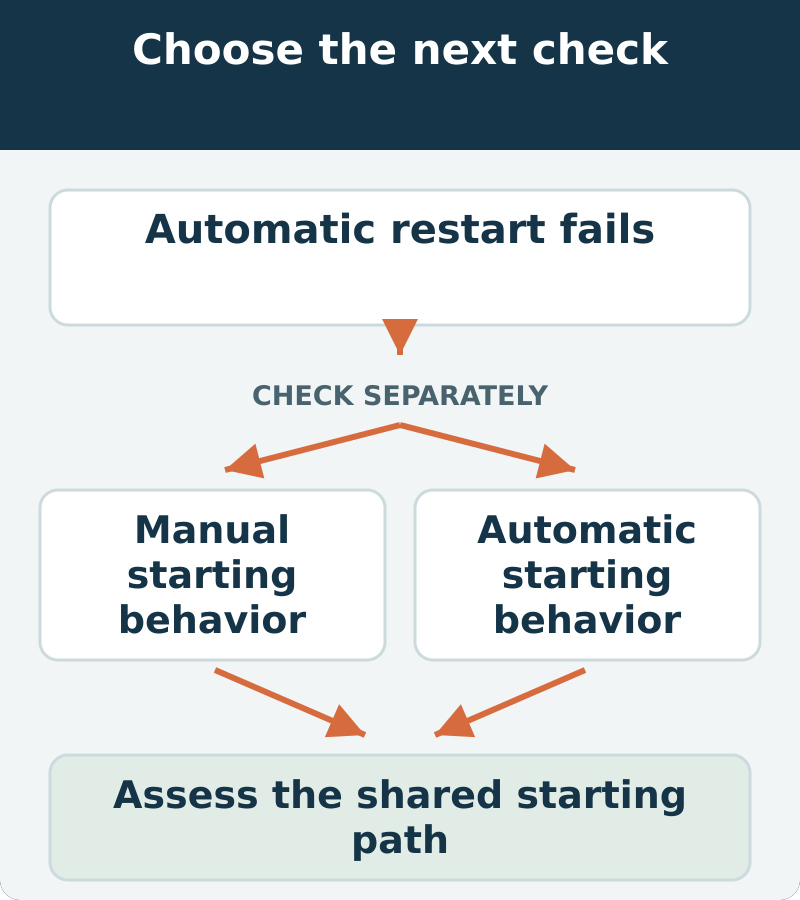
In ALLDATA’s GLC300 case, the 2018 vehicle stopped in ECO mode but sometimes failed to restart; manual starting also involved partial cranking. Battery and connection checks passed, and a substitute voltage converter did not help. A corroded, noisy starter was replaced, after which both modes operated normally and the code did not return.
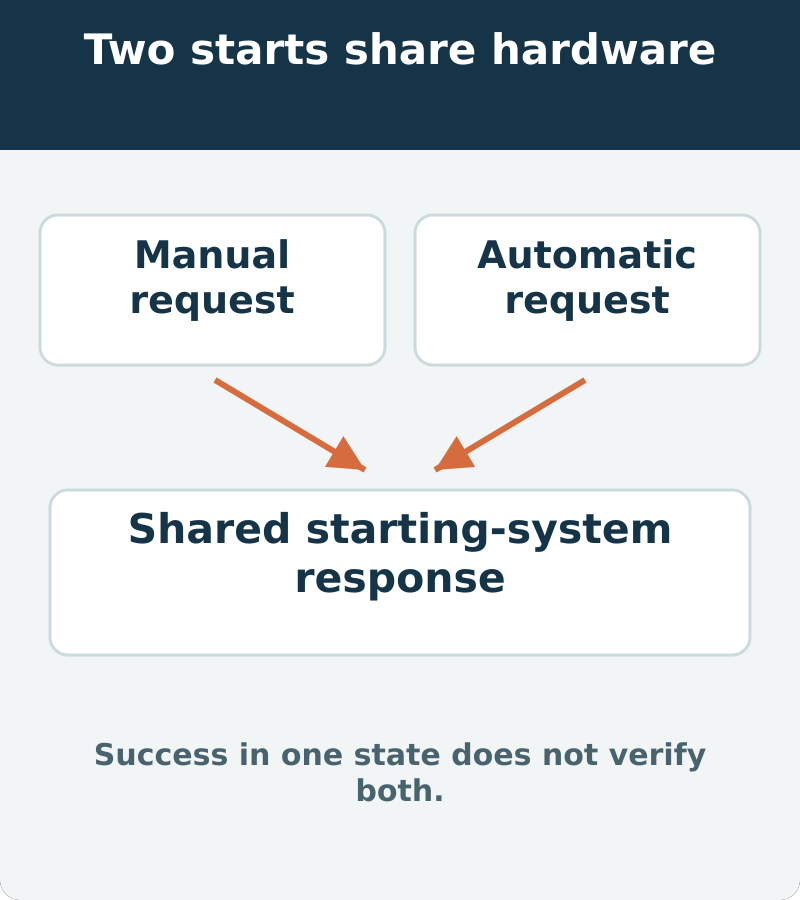
The comparison matters because the driver’s label may emphasize one feature while the physical starting event is abnormal in more than one mode. A shared symptom encourages investigation of shared requirements. It does not erase mode-specific control differences, but it helps prevent the diagnosis from remaining confined to an enable setting while an obvious cranking problem goes unexplained.
What the unsuccessful converter test contributed
A component substitution that leaves the complaint unchanged can still provide useful information when the application and test conditions are appropriate. It should reduce unnecessary repetition, not disappear from the repair history as though nothing was learned. The next technician needs to know exactly what was tried and what remained the same.
However, an unchanged result does not prove every aspect of the substituted component’s surrounding circuit is healthy. Ask how the comparison was interpreted and what observation redirected the work. The goal is a progressively narrower explanation, not a growing list of replacements in which each unsuccessful part is followed by the next familiar name.
Corrosion needs an electrical and mechanical check
Visible corrosion deserves attention, but a photograph alone cannot quantify the effect on an electrical path or show how a starter behaves under demand. Likewise, an unusual sound points toward a mechanical question without identifying every internal cause. These observations become stronger when linked to the failed operating event and the relevant functional checks.
The workshop should explain what makes the starter the supported repair target on your vehicle. That may involve separate assessment of its supply, command and response according to the service information. Avoid improvised relay bypasses or loose bench operation. A starting system can move the vehicle or create high-current hazards while the person testing it is focused on a small measurement.
Plan the repair around reliable starting
The owner’s objective is dependable starting, not simply removal of an ECO warning. Make that objective explicit on the work order. If a proposed repair addresses one mode only, ask how the abnormal behavior in the other mode will be evaluated and whether a separate concern remains.
Also establish how the vehicle will be moved and tested safely while the complaint is unresolved. A car that starts once in the bay may still be unsuitable for collection if the original intermittent failure has not been meaningfully assessed. The handover should distinguish a confirmed result from a condition the shop could not reproduce, with a clear plan for the latter.
Verify both modes without waiting in traffic
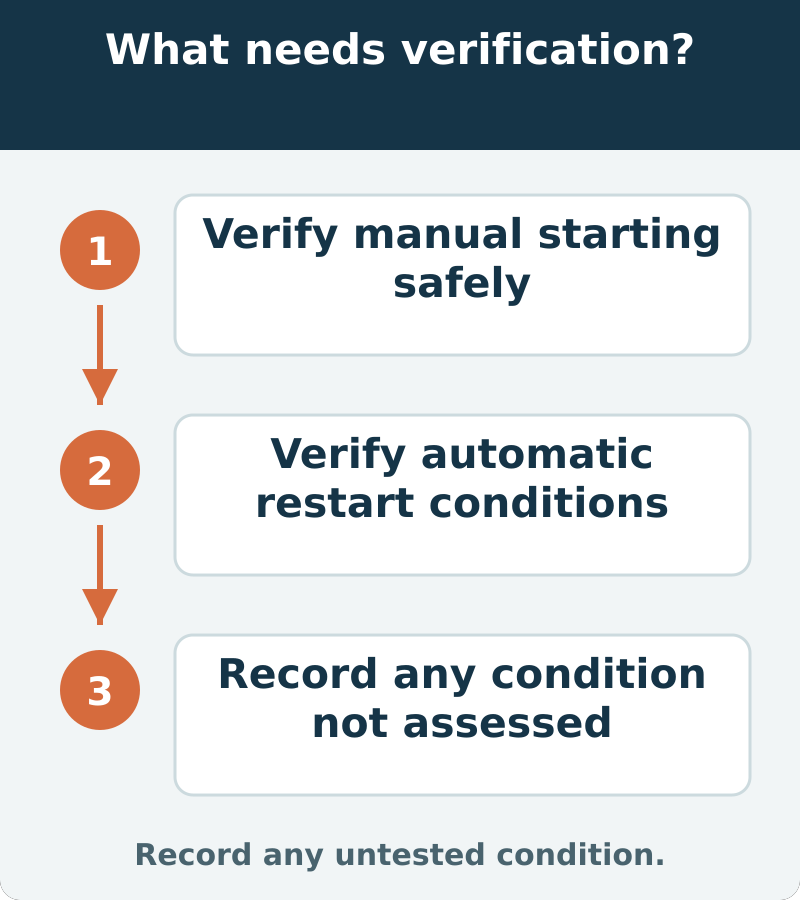
The technician should use the permitted service evaluation to check normal starting and the relevant automatic restart operation. The test needs to address the conditions and behavior originally recorded, together with fault status and any required setup after the repair. Ordinary traffic is not a controlled test environment for a vehicle that may fail to restart.
At collection, request the results for both modes and any remaining limitations. If abnormal cranking returns, stop safely and report the sequence rather than repeatedly attempting starts. A completed repair should leave a clear answer to the question the owner actually cares about: can the engine start reliably when the vehicle asks it to?










Comments 0
Questions, fixes, and real-world diagnostic notes from readers.
Be the first to share a diagnostic result or ask a follow-up question.