
2006 Dodge Ram 2500 Smokes Only at Steady Cruise After Injector Work: Verify the Parts

Quick answer: A no-start repair introduced a different symptom. In this Ram, replacement injectors with mismatched nozzle identification were followed by cruise smoke; correct application parts resolved it.
A truck that starts again can still come back with a new complaint. When smoke appears only after injector work, separate the old no-start from the new operating problem. “The repair worked” and “the truck now needs another investigation” can both be true.
Begin by documenting the installed application and whatever identification is safely accessible. Where access is awkward, an articulating camera such as the AUTOOL SVB308 can help record a visible part marking with the engine disabled and cool. It cannot see through an assembled engine or establish an injector’s calibration.
This case concerns a 2006 Ram 2500 with the 5.9L diesel and manual transmission. Smoke, abnormal rattle or poor running needs professional assessment. Do not loosen common-rail connections, unplug injectors for a public-road experiment or continue driving to create a larger smoke cloud.
In this guide
- Separate the old no-start from the new smoke
- Use the driving condition as a discriminator
- What did the part-number comparison contribute?
- Document what is visible before ordering
- Keep injector isolation inside a controlled professional test
- What belongs in an application check?
- Close both complaints on the final drive
Separate the old no-start from the new smoke
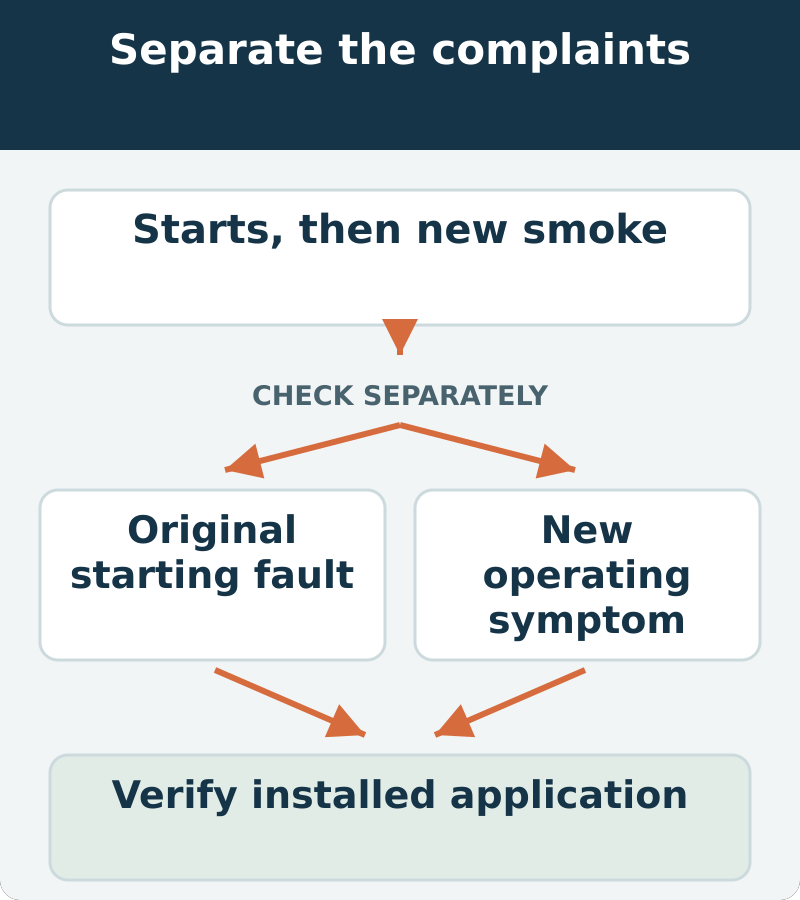
Make two entries in the repair history. The first describes the original starting problem and the work that restored starting. The second describes the new symptom, when it first appeared and the conditions in which it is absent.
This separation avoids a blame-filled shortcut. A new symptom after repair warrants investigation, but timing alone does not prove careless work or a defective supplied part. The task is to identify what changed and which controlled comparison can explain its effect.
Use the driving condition as a discriminator
In ALLDATA’s Ram case, two replacement injectors resolved a no-start. White, blue-tinted smoke and rattle then appeared at steady cruise, rather than at idle, acceleration or deceleration. Further substitutions were unsuccessful. Comparing injector nozzle identification revealed a mismatch; correctly matched replacements resolved the new complaint.
The source’s identifiers are not reproduced as a universal parts guide. Correct application must be established for the actual engine and supplied injector assembly.
What did the part-number comparison contribute?
It introduced an independent question: are the installed parts appropriate for the application? That differs from asking whether the engine now starts or whether an individual component produces some response during testing.
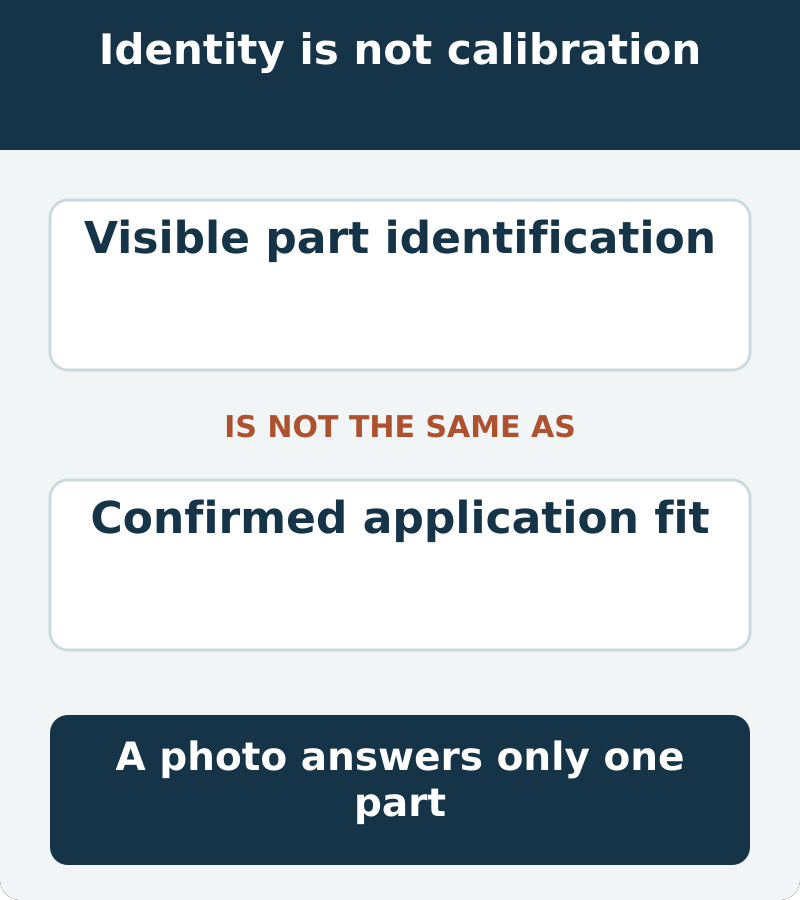
A useful comparison includes the complete assembly identification, supplier records and the vehicle’s confirmed configuration. Do not assume a short stamped number, a similar connector or a catalog photograph establishes equivalence. If numbers differ, ask the supplier to explain the relationship rather than immediately declare either item wrong.
The point is to resolve application evidence before repeating substitutions that do not address it.
Document what is visible before ordering
Retain invoices, boxes, labels and any identification from removed components. Ask the shop to document which positions received which parts and whether further substitutions changed that arrangement. This gives the supplier and technician a common record.
Photographs are useful only when their limits are clear. A visible marking may help identify a component, but an inaccessible nozzle cannot be inspected without the proper access procedure. A camera image is not a bench flow report, an internal-condition assessment or proof that calibration matches the engine.
Keep injector isolation inside a controlled professional test
Some diagnostic methods require specialized equipment and conditions. A short repair anecdote is not a safe operating procedure for disabling cylinders or driving with disconnected components. Ask the shop which approved method is appropriate and how it will protect the vehicle and people around it.
The driver should not watch scan data or manipulate connectors during a road test. If the complaint cannot be assessed safely on the road, the technician should choose an appropriate controlled setting or explain the remaining limitation.
Smoke color is descriptive evidence, not a complete diagnosis. Preserve it alongside operating conditions and the other findings instead of treating color alone as a verdict about fuel, coolant or oil.
What belongs in an application check?
Before authorizing replacement, ask for the exact vehicle and engine identification used for the lookup, the full number supplied and the reason the proposed replacement is the correct application. Any required coding, setup or related parts should come from the applicable service information.
If the supplied assembly is rebuilt or remanufactured, ask how its identity and specification are documented. That is a request for traceability, not a claim that one supply category is inherently unreliable. A brand comparison cannot replace verification of the actual parts in the truck.
Close both complaints on the final drive
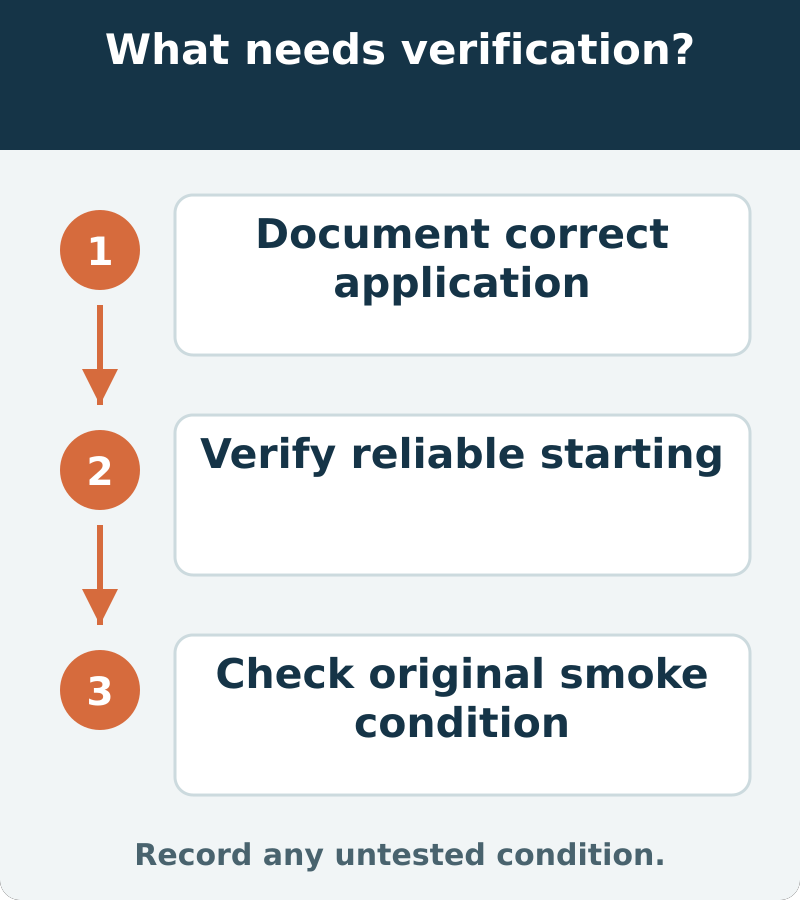
The acceptance record should cover reliable starting and the operating condition that produced the new smoke, using a safe test plan. Confirm that the relevant warning or abnormal behavior does not return and record any condition that could not be tested.
A useful final invoice explains both outcomes. It should not stop at “starts now” when the owner’s second complaint was what happened after the truck was already moving.






Comments 0
Questions, fixes, and real-world diagnostic notes from readers.
Be the first to share a diagnostic result or ask a follow-up question.