
2013 Buick Verano Wipers Run With the Key Off: The Wiring Survived Three Wrong Turns

Quick answer: Replacing the motor, switch and body module did not stop these wipers. A corroded wire in the front bumper harness was the remaining fault path.
The key comes out, the car is parked—and the wipers move again. A switch that appears to be off and a motor that is still moving are telling different parts of the story. Treating either one as the whole system can make an electrical complaint expensive very quickly.
Following an intermittent control path may require voltage or waveform observation. A circuit instrument such as the AUTOOL DM303 provides those measurement options; identifying the wire and interpreting the result still require the correct vehicle information. It is not a substitute for manufacturer scan functions.
Keep hands and tools away from the wiper mechanism whenever it could operate unexpectedly. This case concerns a 2013 Verano 2.4L. Its wiring description should not be used as a pinout for a different Buick, or even for an unverified configuration of the same model.
In this guide
- The key was out. The diagnosis was not over.
- A short case history with an important missing result
- Follow requests, feedback and motion separately
- Capture the failure before unplugging anything
- Trace the damaged section, not an imagined pin number
- Repair the wire and its protection
- Close the wiper complaint and battery complaint separately
The key was out. The diagnosis was not over.
“Ignition off” is a driver action, not a complete description of every electrical state in a modern vehicle. A useful investigation separates the switch request, the controller’s interpretation and the mechanism’s actual motion.
For the owner, the most valuable record is often the sequence: when the key was removed, whether a door was opened, whether the vehicle was locked and how long it took for movement to begin. Record these observations from a safe distance. Do not reach into the linkage to see whether it will stop.
A short case history with an important missing result
ALLDATA reported random key-off wiping and an overnight dead-battery complaint. Substituting the motor and switch, followed by BCM replacement, had not resolved the problem. A corroded wire described as part of the LIN path was found in the front bumper harness. A splice repair restored normal wiper operation and the off state.
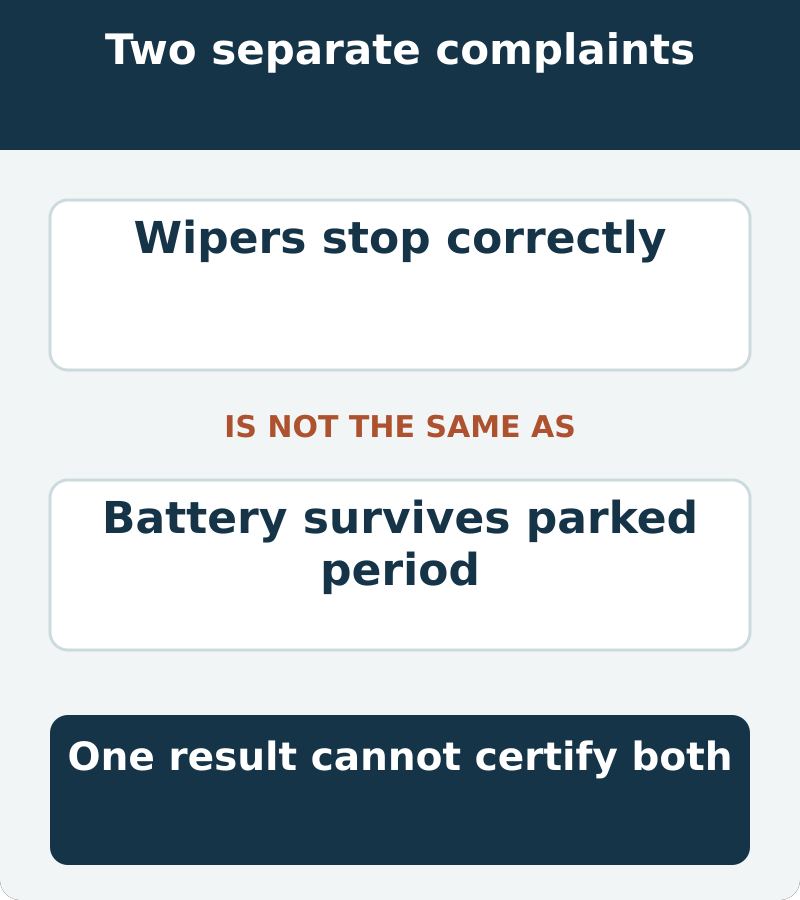
The report does not document an overnight current test. We therefore cannot turn its successful wiper result into a measured battery-drain repair.
Follow requests, feedback and motion separately
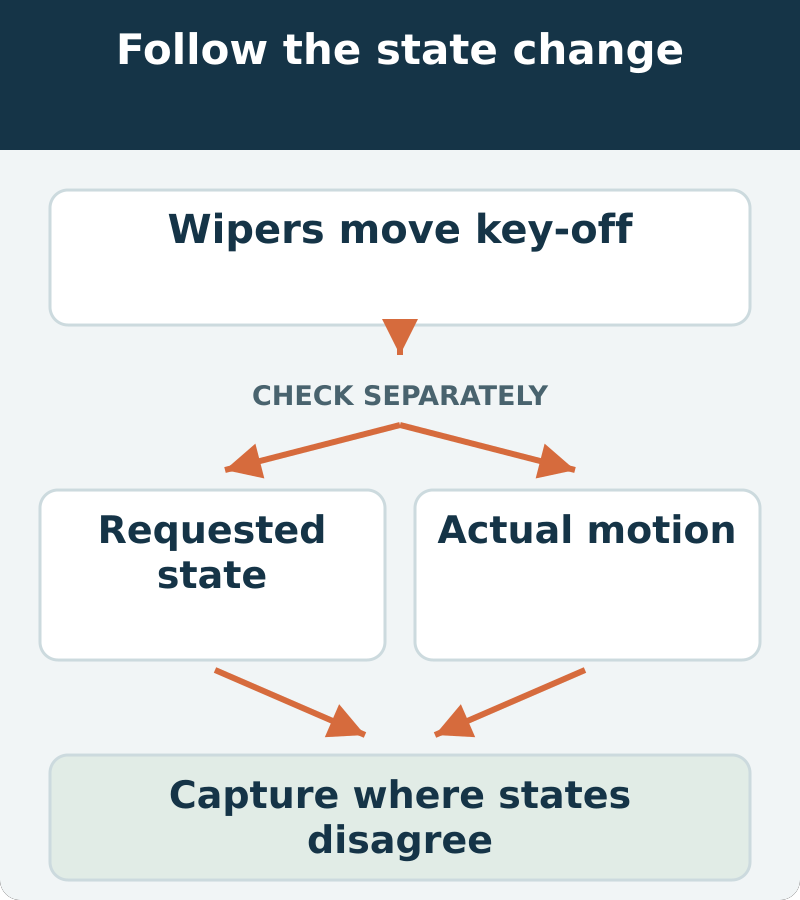
A technician can organize the observations into a small state record rather than a list of suspect parts. What was requested? What did the relevant controller report? What moved? At what point did those observations disagree?
Not every value will be available on every scan tool. A missing data field should be recorded as unavailable, not assumed normal. Likewise, a stationary mechanism during a brief workshop visit does not contradict an owner’s credible intermittent complaint; it may simply mean the fault is absent at that moment.
Capture the failure before unplugging anything
Moving connectors or interrupting power can change the condition being investigated. When safe and practical, preserve the original scan information and symptom sequence first. The goal is not to keep a failing vehicle operating indefinitely; it is to avoid losing the only evidence that distinguishes the event.
Agree with the shop on how long it can observe the car and what conditions it will reproduce. A time-stamped owner video of unexpected movement can help explain the complaint, but it cannot by itself identify a failed network wire or controller.
Trace the damaged section, not an imagined pin number
Use the VIN-appropriate diagram to establish the actual communication and power paths. An abbreviated case report may describe where damage was found without supplying the connector views, terminal identifiers or full network architecture needed to work safely.
Follow approved probing methods. An unidentified low-voltage communication line is not a place to apply battery power, a heavy load or a speculative jumper. If a waveform is captured, record the measurement point and test condition alongside it. A trace detached from that context is difficult for another technician to evaluate.
Repair the wire and its protection
Once a damaged section is established, the repair should address the conductor and the way the harness is supported and protected. Ask what the inspection found around the damage: poor routing, compromised protection or another condition requiring attention. Do not invent a water-entry cause just because corrosion is present.
The service method should govern splice construction, sealing and placement. Simply wrapping a visibly damaged section does not establish that electrical integrity has been restored. Conversely, a localized, properly specified harness repair may be more appropriate than replacing an unrelated module.
Close the wiper complaint and battery complaint separately
For the wipers, verify normal commanded operation, parking and the key-off condition that caused concern. Keep the mechanism clear during testing and describe how long the observation lasted.
For the battery complaint, request its own assessment: battery condition and an appropriate key-off consumption investigation, allowing for the vehicle’s normal state changes. Repeated discharge may leave a battery needing attention even after the original electrical cause is corrected.
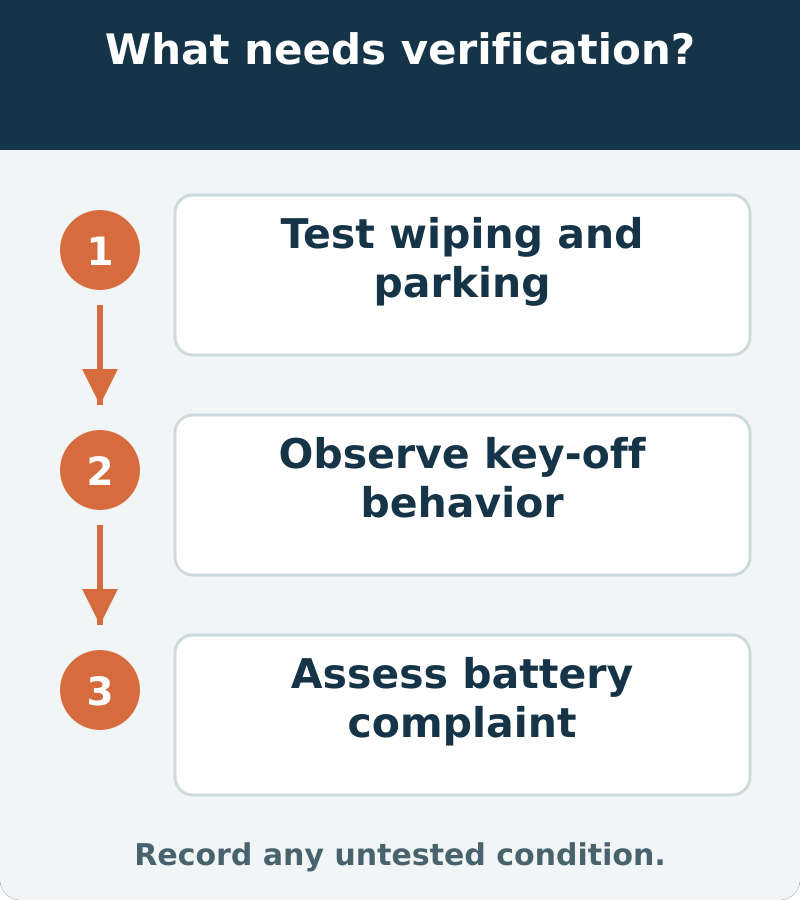
The handoff should say which complaint was verified, under which conditions, and which remains open. That is a clearer finish than letting “wipers fixed” stand in for “everything that happened overnight has been explained.”







Comments 0
Questions, fixes, and real-world diagnostic notes from readers.
Be the first to share a diagnostic result or ask a follow-up question.