
2007 Buick Lucerne Kept Overheating With No External Leak: Combustion Gas Exposed the Head Gasket

Holds Pressure, Still Overheats? Test For Gas
Quick answer: The absence of an external leak did not clear the engine. Bubbles during a controlled warm-up and a positive combustion-gas test justified teardown, where the head gasket was found leaking between cylinders three and five; repair passed the road test. This article follows one documented vehicle. It explains the evidence chain, not a universal failure rate or a direction to replace the same part on every similar car. Stop whenever the test would involve overheated brakes, high current, moving parts, refrigerant handling or an uncontrolled road condition.
A vacuum-capable cooling-system tester and filler such as AUTOOL SC301 Cooling System Tester and Filler can check sealing and reduce trapped air during the refill stage after the engine is cold and the adapter fits. It cannot identify combustion gas, prove a head gasket, set a universal test vacuum for every reservoir, or make opening a hot cooling system safe.
The Lucerne lost coolant pressure without producing an external drip. That negative result did not end the leak search; bubbles and a combustion-gas test moved it across the boundary between cooling system and cylinders.
Quick answer: The absence of an external leak did not clear the engine. Bubbles during a controlled warm-up and a positive combustion-gas test justified teardown, where the head gasket was found leaking between cylinders three and five; repair passed the road test.
In this guide
Do not open the system hot
Never remove the Lucerne’s reservoir cap while hot. Verify the warning with scan temperature, heater output, coolant level when cold and evidence of boil-over. Stop the test if temperature climbs unexpectedly; repeated overheating can turn a diagnosable leak into engine damage. Preserve the original condition before changing it. The first observation is the control sample against which every later test must be compared.
Confirm temperature and coolant level
The cooling system was full, the fans operated and multiple thermostats had already been tried. Those facts reduced several common branches but did not clear circulation, trapped air or combustion-gas entry. Replacing the thermostat again would add little information. Use service information for the exact engine, build date and options. A correct method on the wrong terminal can create a precise but useless result.
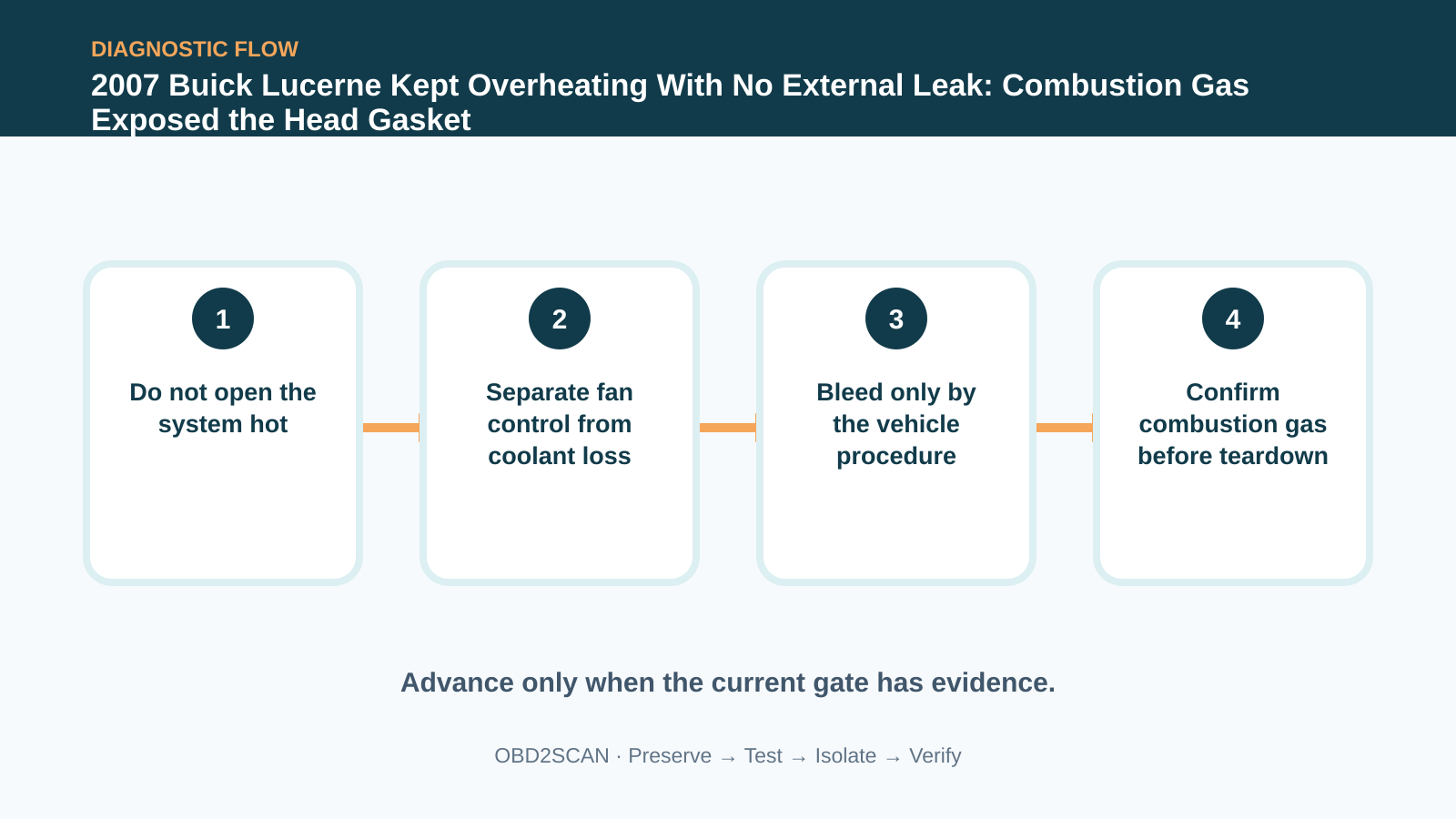
Separate fan control from coolant loss
A cold pressure test showed no external leak. That answers whether the system lost pressure through an accessible path under the applied test condition. It does not reproduce high cylinder pressure, combustion temperature or a leak that flows mainly from a cylinder into coolant while running. Treat prior work as evidence, not blame. A repair that made no change can narrow the case when its installation and test conditions are verified.
Understand what a pressure hold excludes
Bleed the system only by the model-specific procedure. In the documented case the front was raised so the reservoir became the high point, heat was set to full hot and engine speed was controlled while temperature was watched. Do not copy these details to a different vehicle without its service information. At this stage, separate what was observed from what is inferred. The observation should remain true even if the current theory is later rejected.
| Observation | What it supports | What it does not prove |
|---|---|---|
| Cooling system holds pressure | No leak appeared under that test | Head gasket is good |
| Bubbles appear during warm-up | Gas is entering or air is purging | Teardown is justified |
| Block test detects combustion gas | Cylinder gas reaches coolant | The exact crack location is known |
| Gasket repair passes road load | Head gasket was causal here | Every overheat is a gasket |
Bleed only by the vehicle procedure
Bubbles in the reservoir are an observation, not a verdict. Residual air can purge after service, while a continuous gas stream under load may be combustion. Use a compatible block-test fluid and sample from the proper vapor space without drawing coolant into the tester. This is the decision point in the documented case. Its value comes from changing one bounded condition while leaving the rest of the system intact.
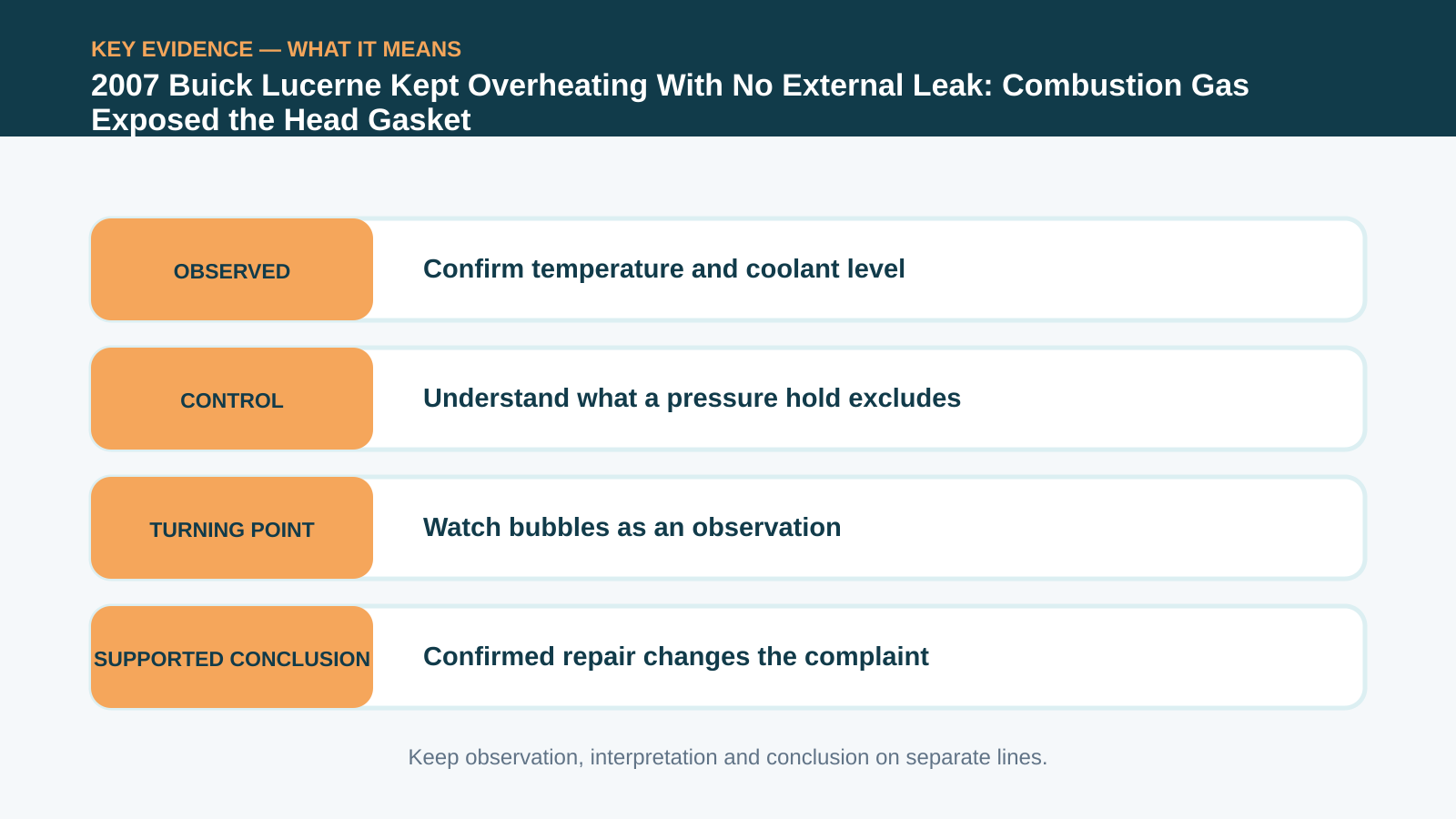
Watch bubbles as an observation
The block test indicated combustion gas. That result justified mechanical inspection because it connected the running overheat to cylinder pressure. It still could not distinguish a head gasket from a cracked head or block until the engine was opened and the sealing surfaces were evaluated. A confirmed component still needs a repair that restores sealing, support, torque, routing or terminal fit—the physical conditions that keep the fault from returning.
Confirm combustion gas before teardown
Teardown found a gasket leak between cylinders three and five. Check head and block flatness, threads and cooling passages, and follow the correct torque sequence and fastener policy. Refill with the specified coolant and remove air without assuming the new gasket solves every prior cooling concern. Reassemble protective covers and retainers before declaring success. A diagnostic shortcut must not become the next failure mechanism.
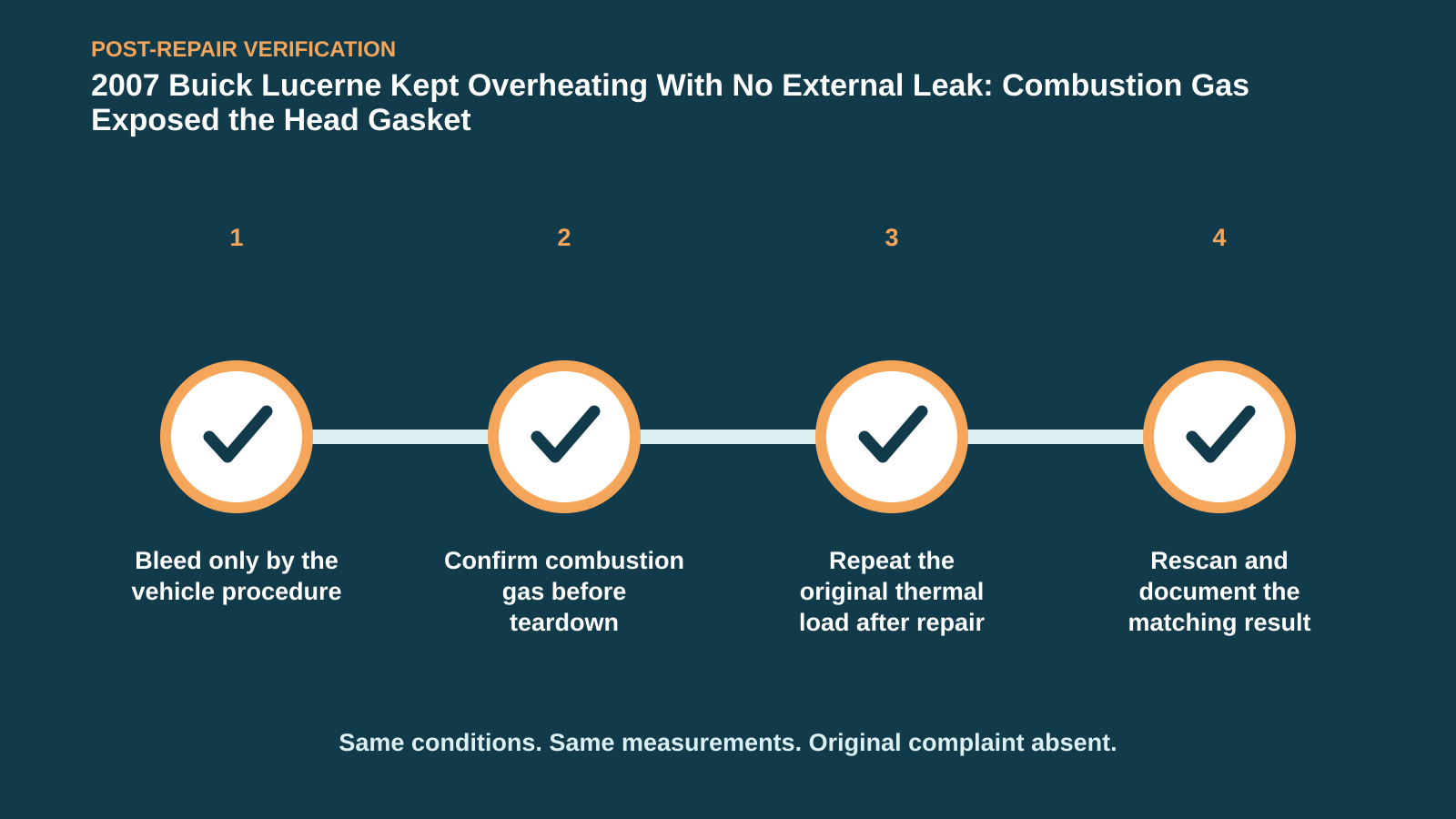
Repeat the original thermal load after repair
Verification must recreate full operating temperature and the load that previously overheated the car while monitoring data. Confirm stable temperature, heater output, fan response, fluid level after cool-down and no continuing bubbles or contamination. A clean pressure hold in the bay is only one part of closure. Use the customer’s original complaint as the final specification. A cleared code, quiet bay or one good key cycle is not equivalent to reproducing and passing that condition.
If you are bringing a similar symptom to a shop, arrive with the useful conditions rather than a requested part: whether the vehicle was cold or hot, the exact speed or switch position, which warning lamps appeared, what changed after a restart, and a chronological list of earlier repairs. A short video can preserve an intermittent sound or lamp pattern, but record it only while parked or with a passenger handling the camera. Ask the technician to retain the pre-repair scan and measurements, explain the test that separated the failed path from the alternatives, and show how the original complaint was repeated afterward.
For the owner or service adviser, a useful repair explanation has three parts: what was observed, why the decisive test narrowed the fault, and which original condition passed after the repair. It should also say what the test did not prove. That boundary prevents a memorable case from becoming an automatic parts recommendation.
The absence of an external leak did not clear the engine. Bubbles during a controlled warm-up and a positive combustion-gas test justified teardown, where the head gasket was found leaking between cylinders three and five; repair passed the road test. The reusable lesson is narrower and more valuable: Use two tests that answer different questions—external sealing and gas entry—to show why one negative result never cancelled the overheating complaint.








Comments 0
Questions, fixes, and real-world diagnostic notes from readers.
Be the first to share a diagnostic result or ask a follow-up question.