
2016 Lincoln MKX Bogged After Slowing: The Transmission Needed Its Adaptive Strategy Relearned

Bogs After Slowing, But No Codes?
<strong>Quick answer:</strong> With no codes and acceptable fluid condition, the next controlled step was the Ford adaptive-strategy reset and relearn—not a transmission replacement. The same slow-then-accelerate condition shifted correctly afterward. This article follows one documented vehicle. It explains the evidence chain, not a universal failure rate or a direction to replace the same part on every similar car. Stop whenever the test would involve overheated brakes, high current, moving parts, refrigerant handling or an uncontrolled road condition.
Before a relearn, fluid condition is one prerequisite worth documenting; an optical ATF condition tester such as AUTOOL AS505 Transmission Fluid Tester can add a bounded clarity and temperature observation where the fluid type and access method are compatible. It cannot measure fluid level, identify internal clutch wear, perform the adaptive reset, or turn an optical condition result into permission to service a sealed transmission.
The MKX drove normally until one repeatable maneuver: slow without stopping, then accelerate. It stayed in a high gear and bogged, yet the scan was clean and the fluid gave no immediate reason to condemn the transmission.
Quick answer: With no codes and acceptable fluid condition, the next controlled step was the Ford adaptive-strategy reset and relearn—not a transmission replacement. The same slow-then-accelerate condition shifted correctly afterward.
In this guide
Define the slow-then-accelerate event
Describe the event precisely: the MKX slowed but did not stop, stayed in a higher gear, then bogged when the driver accelerated. Compare it with acceleration after a full stop and with manual gear command where safe. A vague ‘hesitation’ could send diagnosis toward fuel or ignition instead of shift strategy. Preserve the original condition before changing it. The first observation is the control sample against which every later test must be compared.
Scan before changing learned values
Run a full-module scan and preserve gear command, input/output speed and throttle data if available. No DTCs were found in the case, but that only removed a recorded fault path. It did not show whether learned clutch/shift values were still appropriate. Use service information for the exact engine, build date and options. A correct method on the wrong terminal can create a precise but useless result.
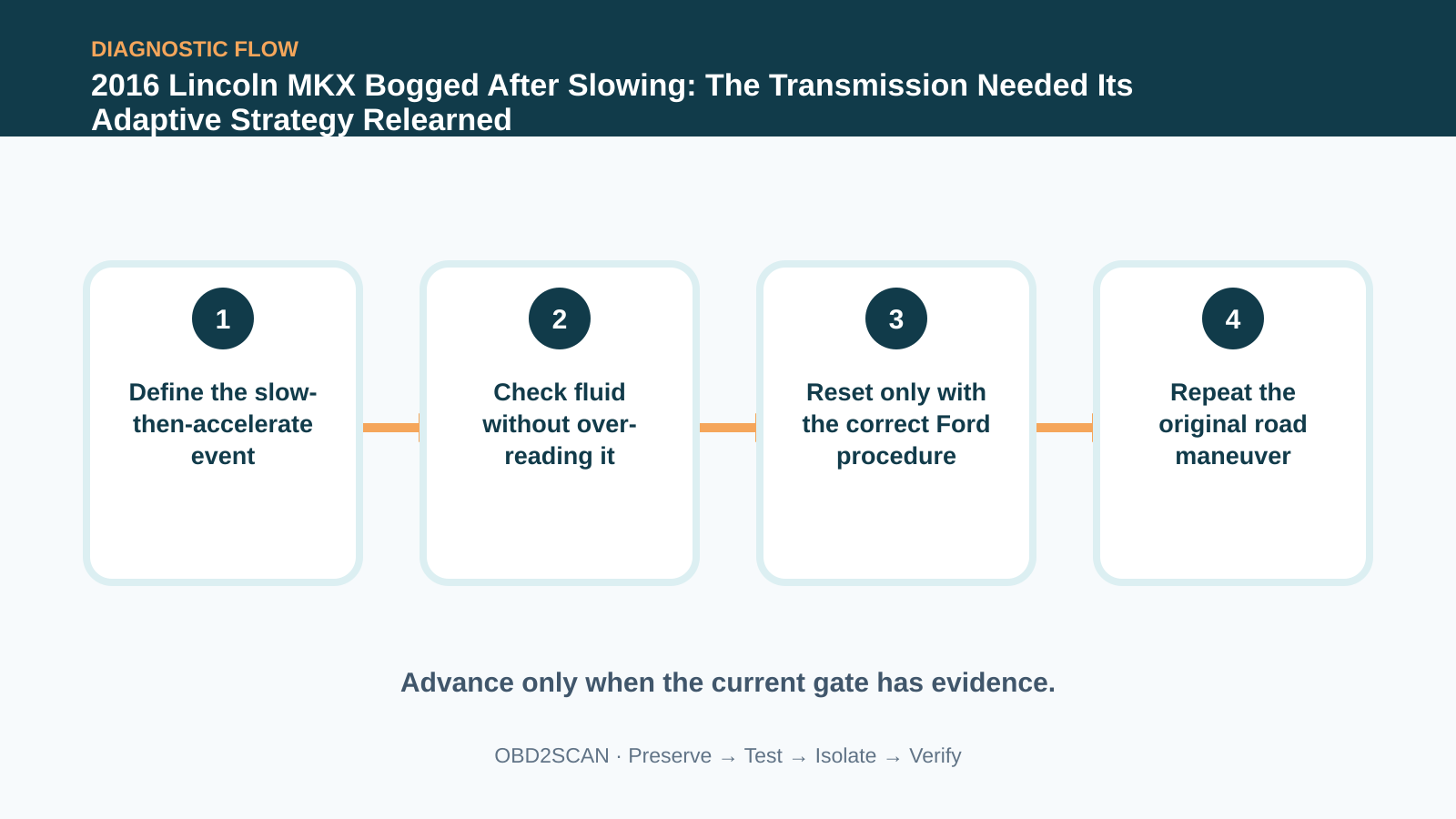
Check fluid without over-reading it
Fluid level and condition must be checked by the correct transmission procedure. Fluid appearance or an optical test can support a maintenance observation, but it cannot reveal every internal failure. In the documented MKX the fluid was in good condition, allowing the plan to proceed without making fluid service the cure. Treat prior work as evidence, not blame. A repair that made no change can narrow the case when its installation and test conditions are verified.
Decide whether a relearn is justified
An adaptive reset should follow service information and a reasoned diagnosis; it is not a universal first step for every poor shift. Record existing values when the platform allows, confirm stable battery voltage, check for calibration guidance, and explain that clearing learned data changes how the transmission will behave temporarily. At this stage, separate what was observed from what is inferred. The observation should remain true even if the current theory is later rejected.
| Observation | What it supports | What it does not prove |
|---|---|---|
| Bog after slowing without stop | Shift strategy or gear state matters | Engine fuel delivery is good |
| No DTCs | No recordable fault was found | Transmission hardware passes |
| Fluid condition acceptable | Obvious fluid-condition branch is lower | Fluid level and pressure are proved |
| Reset and relearn restore downshift | Adaptive state was causal here | Repeated resets replace diagnosis |
Reset only with the correct Ford procedure
Perform the specified Ford reset and relearn exactly. The road, temperature, throttle and shift sequence may matter, so a generic drive around the block is not interchangeable with the published routine. Stop for slip, overheating, severe engagement or any unsafe response. This is the decision point in the documented case. Its value comes from changing one bounded condition while leaving the rest of the system intact.
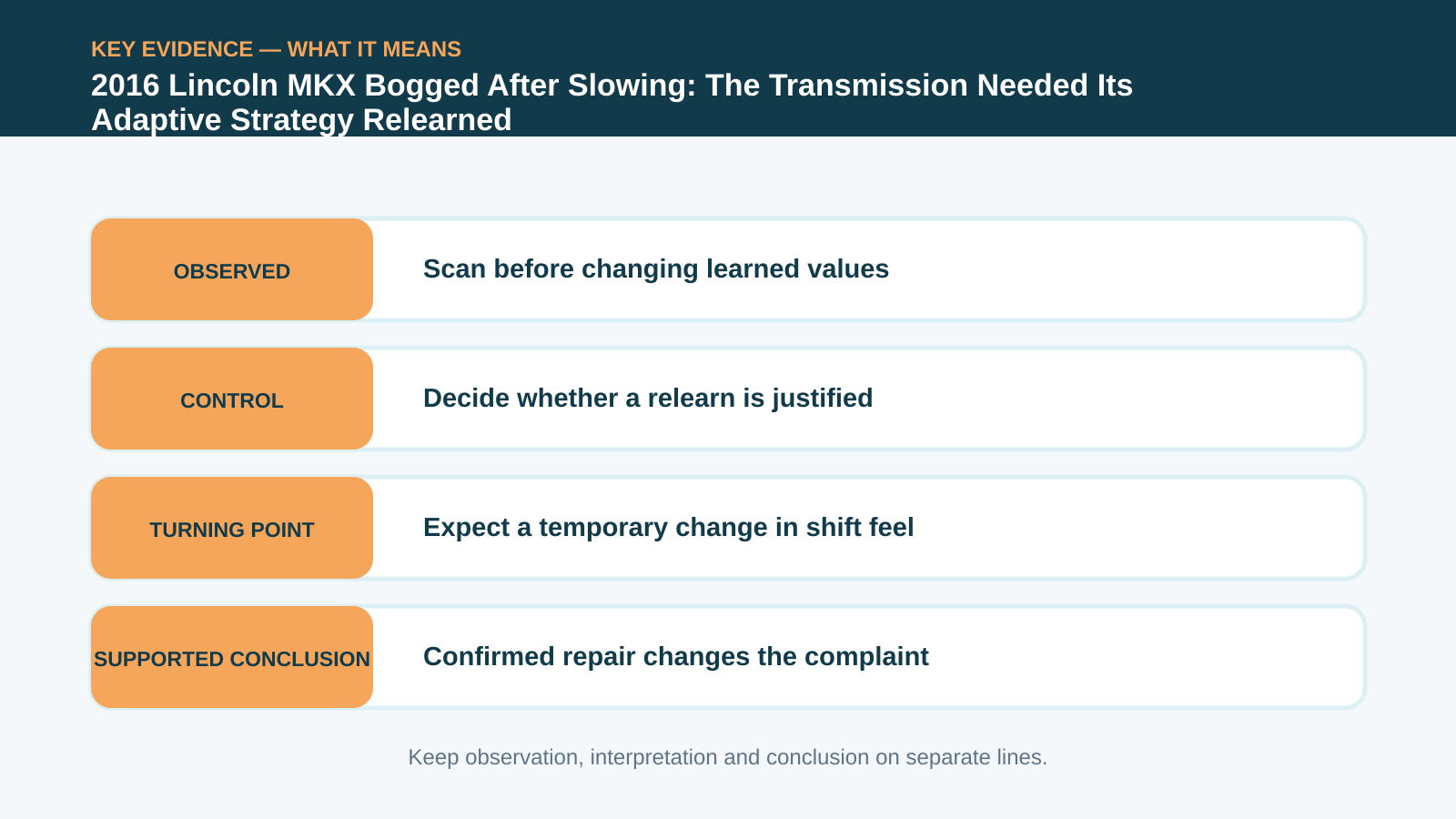
Expect a temporary change in shift feel
During relearning, shifts may be firmer than normal for a period. That expected behavior should not be hidden from the owner, but neither should it excuse flare, bang or new warnings. Document which changes are part of adaptation and which require the case to be reopened. A confirmed component still needs a repair that restores sealing, support, torque, routing or terminal fit—the physical conditions that keep the fault from returning.
Repeat the original road maneuver
Repeat the original slow-without-stopping maneuver at the same safe speed and load. Watch commanded versus achieved gear and engine response, then rescan. In this case the transmission downshifted correctly after the reset and relearn. Reassemble protective covers and retainers before declaring success. A diagnostic shortcut must not become the next failure mechanism.
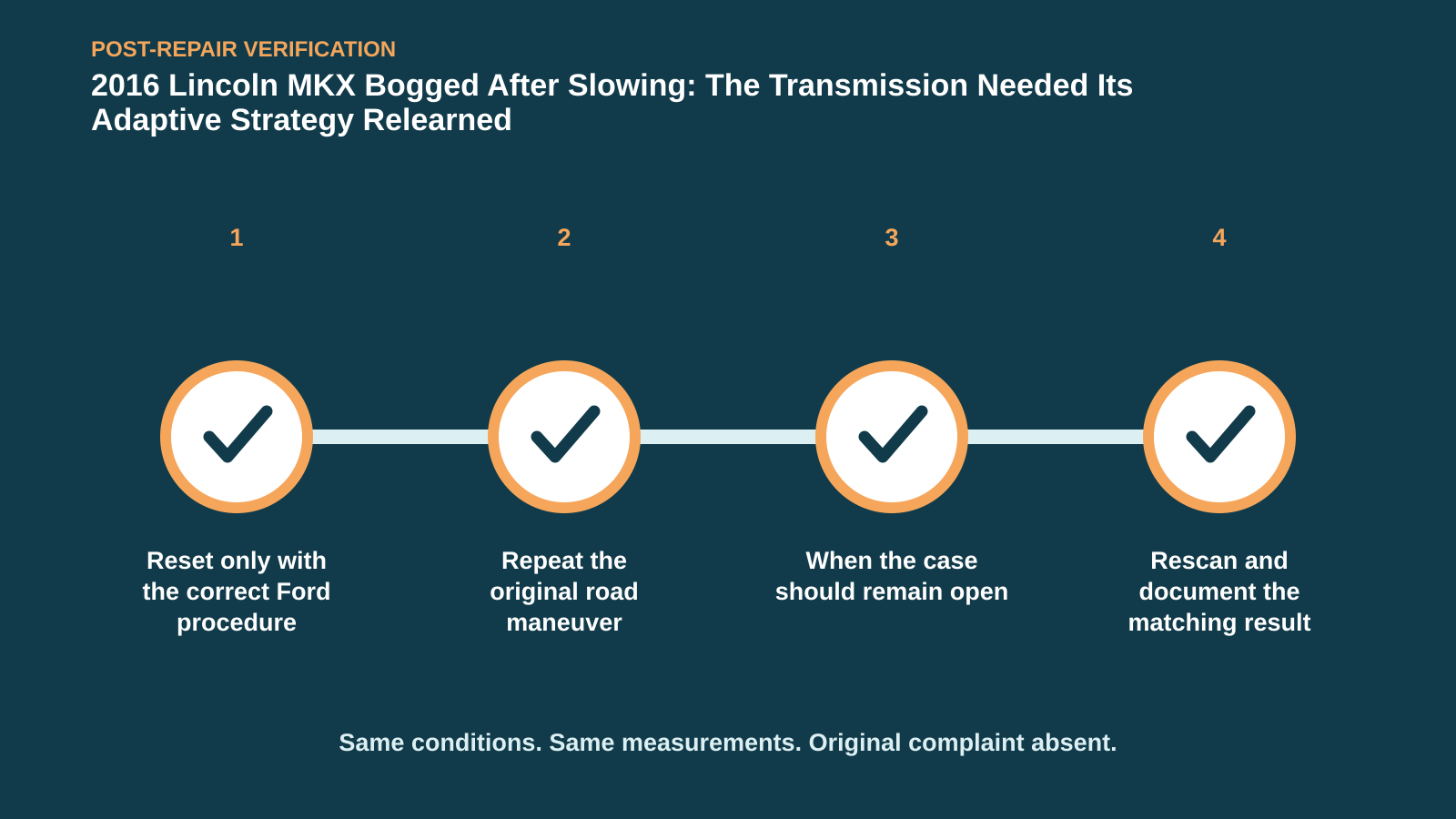
When the case should remain open
If the symptom returns, do not repeat resets indefinitely. Reopen fluid level/temperature, calibration, speed-sensor plausibility, solenoid control and internal hydraulic/mechanical branches. A successful relearn is meaningful evidence for this MKX, not proof that all no-code bogging is adaptive memory. Use the customer’s original complaint as the final specification. A cleared code, quiet bay or one good key cycle is not equivalent to reproducing and passing that condition.
If you are bringing a similar symptom to a shop, arrive with the useful conditions rather than a requested part: whether the vehicle was cold or hot, the exact speed or switch position, which warning lamps appeared, what changed after a restart, and a chronological list of earlier repairs. A short video can preserve an intermittent sound or lamp pattern, but record it only while parked or with a passenger handling the camera. Ask the technician to retain the pre-repair scan and measurements, explain the test that separated the failed path from the alternatives, and show how the original complaint was repeated afterward.
For the owner or service adviser, a useful repair explanation has three parts: what was observed, why the decisive test narrowed the fault, and which original condition passed after the repair. It should also say what the test did not prove. That boundary prevents a memorable case from becoming an automatic parts recommendation.
With no codes and acceptable fluid condition, the next controlled step was the Ford adaptive-strategy reset and relearn—not a transmission replacement. The same slow-then-accelerate condition shifted correctly afterward. The reusable lesson is narrower and more valuable: Use the road condition as the chapter spine and explain why a relearn is both a diagnostic intervention and a repair that requires exact verification.



Comments 0
Questions, fixes, and real-world diagnostic notes from readers.
Be the first to share a diagnostic result or ask a follow-up question.