
2013 Nissan Versa Kept Running After Key-Off: The Voltage Was Feeding Back Through One Connector

Engine Runs After Key-Off?
The Versa did not run on randomly. It ran for four or five measured seconds after key-off, and its ignition voltage decayed on the same schedule. That timing made the unwanted power traceable.
When this diagnostic path reaches a measurement question, the useful machine type is one that answers only that question. For that supporting role, the AUTOOL DM301 Circuit Tester is one practical option. A multifunction meter can track bounded residual voltage on identified fuse and connector circuits. It cannot identify an unknown back-feed without diagrams, replace a current-limited method, or make connector piercing acceptable.
<strong>Quick answer:</strong> The engine was not ignoring the key; an unintended corroded bridge briefly back-fed ignition circuits. Repairing E21/B12 removed the residual voltage and delay. This article follows one documented vehicle. It explains the evidence chain, not a universal failure rate or a direction to replace the same part on every similar car. Stop whenever the test would involve overheated brakes, high current, moving parts, refrigerant handling or an uncontrolled road condition.
Quick answer: The engine was not ignoring the key; an unintended corroded bridge briefly back-fed ignition circuits. Repairing E21/B12 removed the residual voltage and delay.

In this guide
- Time the shutdown delay before touching fuses
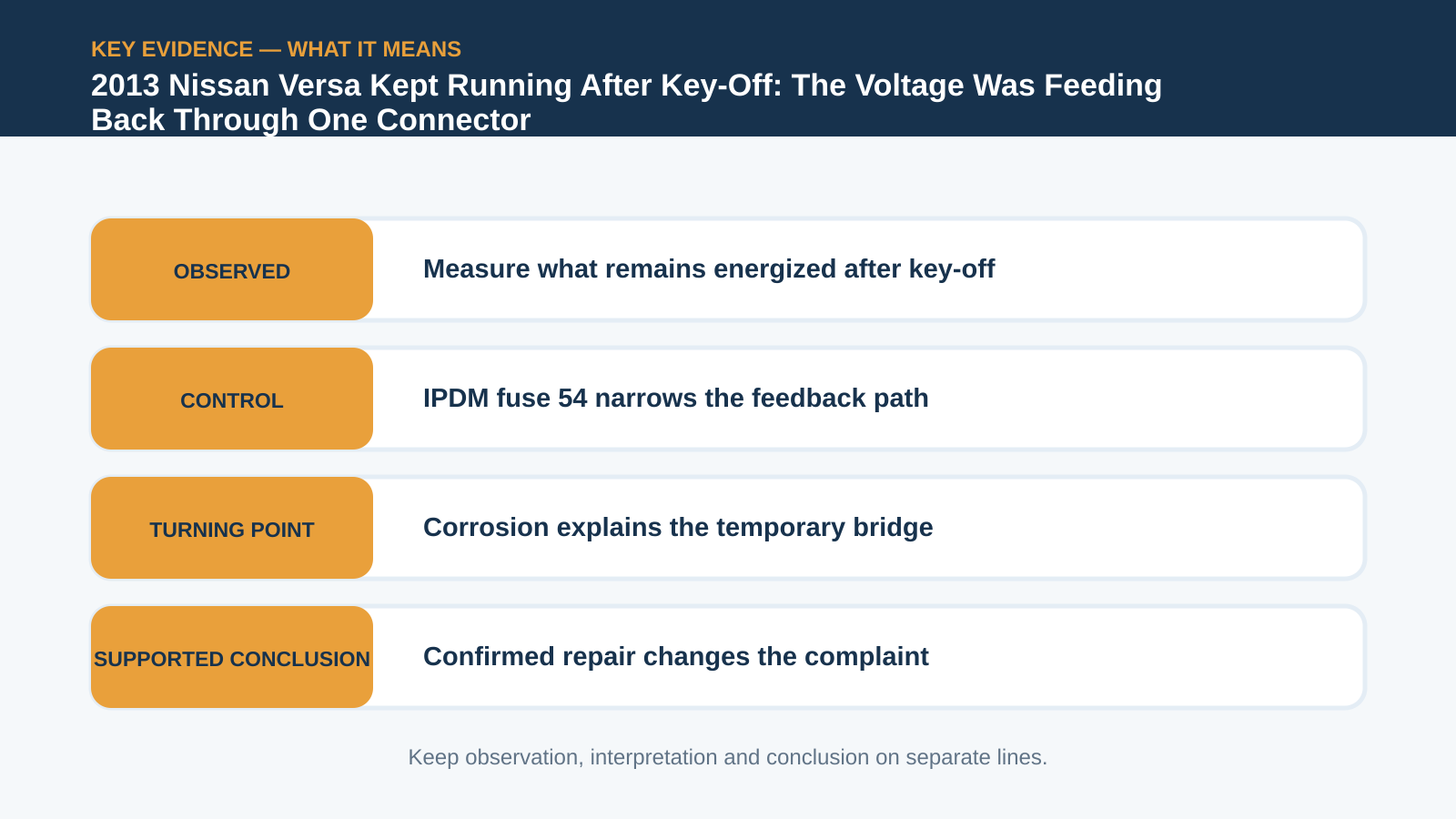
- Measure what remains energized after key-off
- Use fuse removal as branch isolation
- IPDM fuse 54 narrows the feedback path
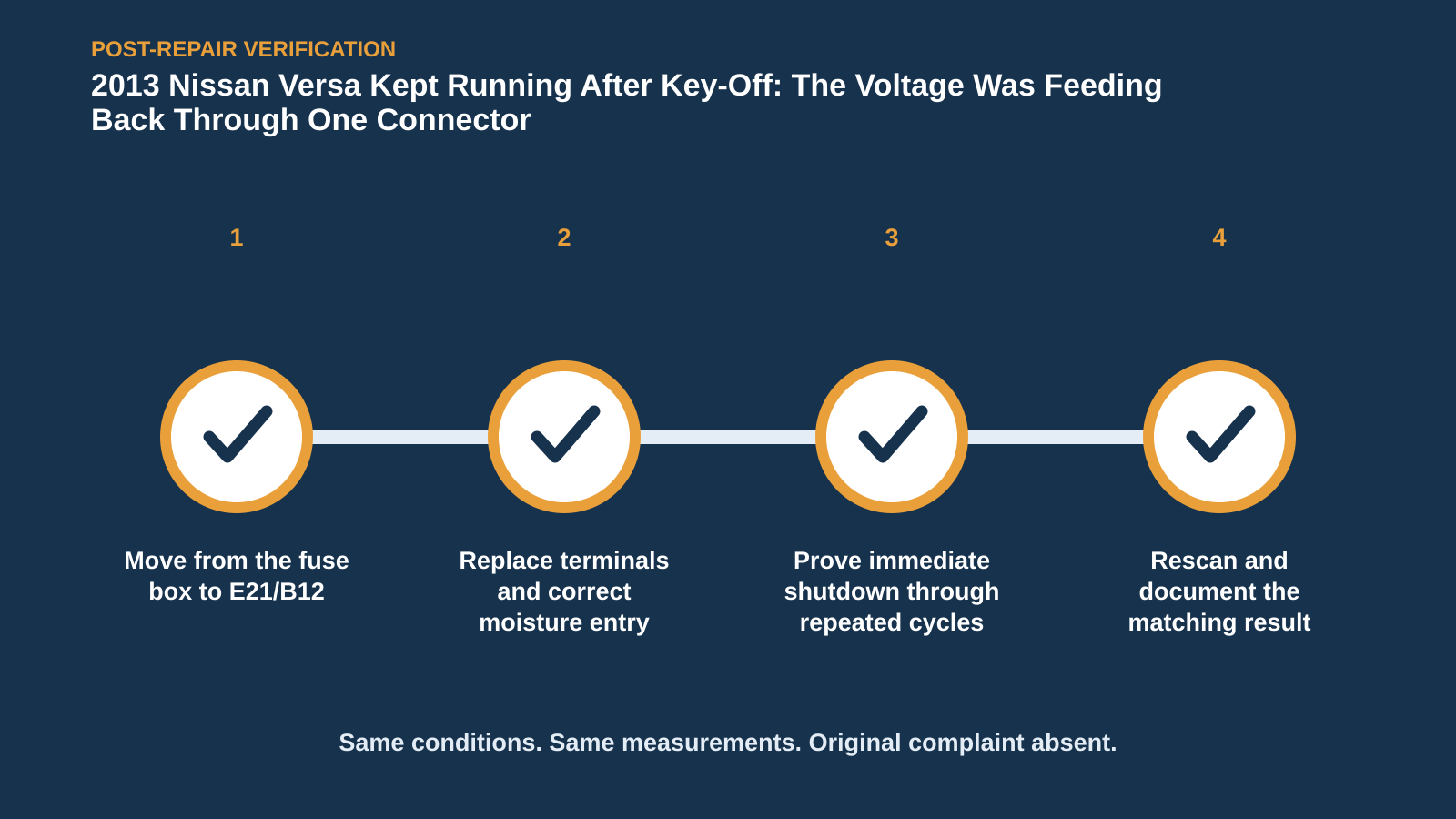
- Move from the fuse box to E21/B12
- Corrosion explains the temporary bridge
- Replace terminals and correct moisture entry
- Prove immediate shutdown through repeated cycles
Time the shutdown delay before touching fuses
Time the symptom with a stopwatch: this Versa continued running four to five seconds after the key was switched off. Note which lamps, relays and accessories remain active. A consistent decay interval suggests stored or back-fed electrical energy rather than a mechanical diesel-like run-on guess. Preserve the original condition before changing it. The first observation is the control sample against which every later test must be compared.
Measure what remains energized after key-off
Measure the identified ignition fuse voltage before, during and after key-off without disturbing the circuit. Six to seven volts lingered briefly where it should have fallen promptly. Record the decay curve and meter reference; a high-impedance reading can reveal a back-feed without showing how much current it can deliver. Use service information for the exact engine, build date and options. A correct method on the wrong terminal can create a precise but useless result.
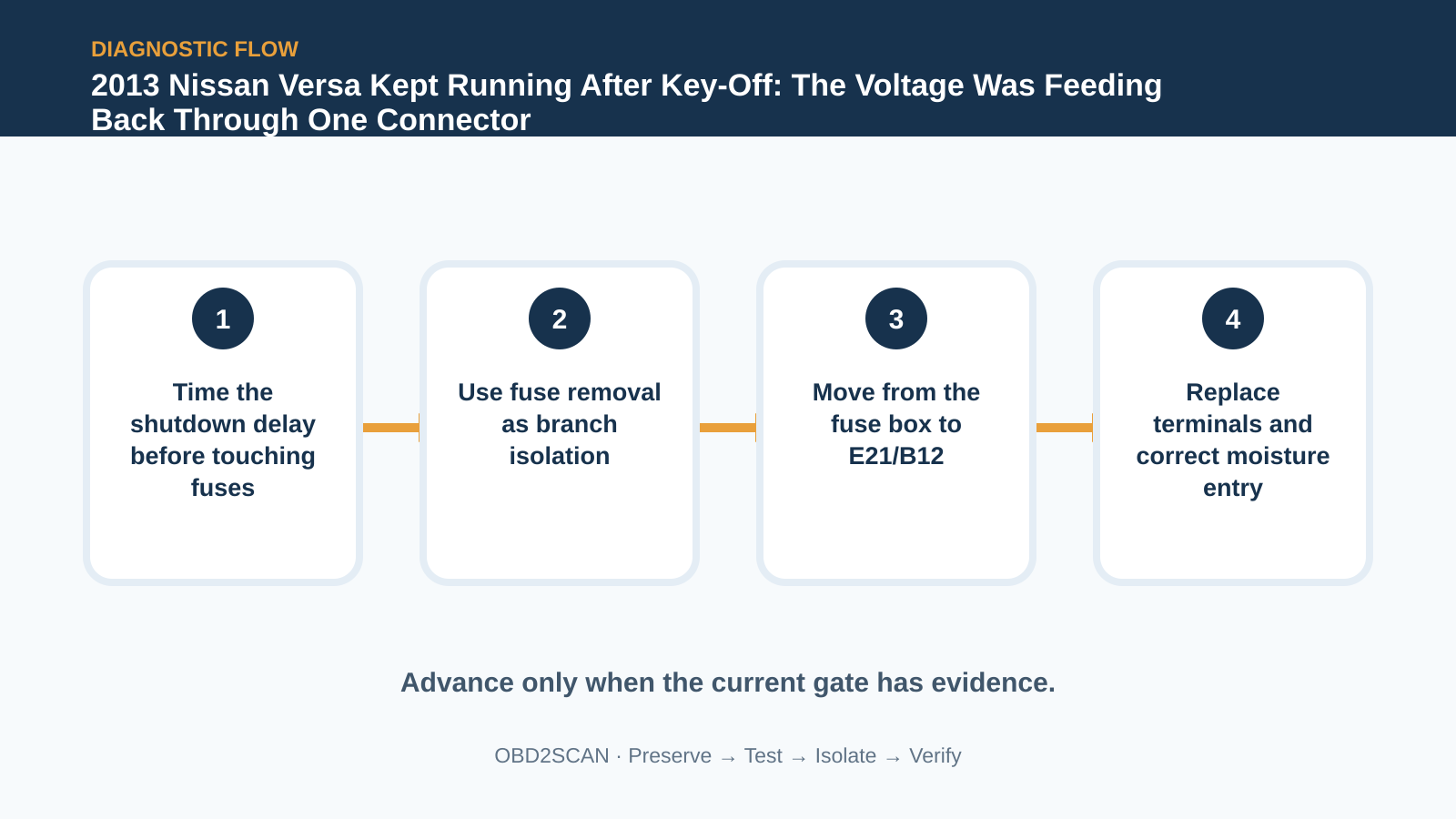
Use fuse removal as branch isolation
Remove only diagram-selected fuses in a planned order and restore each before the next test. When one removal eliminates the residual voltage, the protected branch becomes the next map. Random fuse pulling can wake modules, reset evidence and turn one clear path into several self-created symptoms. Treat prior work as evidence, not blame. A repair that made no change can narrow the case when its installation and test conditions are verified.
IPDM fuse 54 narrows the feedback path
IPDM fuse 54 changed the delayed shutdown in the documented car. Trace its downstream destinations and connector transitions rather than assuming the intelligent power module is bad. A fuse identifies a circuit boundary; it does not name the component on the far side. At this stage, separate what was observed from what is inferred. The observation should remain true even if the current theory is later rejected.
| Observation | What it supports | What it does not prove |
|---|---|---|
| Engine runs 4–5 seconds | Ignition remains energized | Mechanical run-on is proved |
| Fuses retain 6–7 V | Back-feed is plausible | Current capacity is known |
| Fuse 54 removes delay | Its branch contains cause | IPDM is failed |
| E21/B12 repair ends delay | Corroded bridge was causal | Moisture cannot return |
Move from the fuse box to E21/B12
The route led to the E21/B12 connector in the footwell. Inspect both halves for dampness, mineral trails, green copper and spread pins before separating them. Photograph cavity positions because multiple similar conductors can make later terminal replacement error-prone. This is the decision point in the documented case. Its value comes from changing one bounded condition while leaving the rest of the system intact.
Corrosion explains the temporary bridge
Corrosion had bridged terminals and fed voltage into the ignition circuit after key-off. Replace damaged terminals or connector housings by Nissan procedure, match wire construction and restore seals. Merely cleaning visible green material may leave weak contact or conductive residue inside the housing. A confirmed component still needs a repair that restores sealing, support, torque, routing or terminal fit—the physical conditions that keep the fault from returning.
Replace terminals and correct moisture entry
Find why the connector became wet—door seal, cowl drain, heater case or prior repair—and correct that path. Dry padding fully and support the loom. An electrical splice that remains under wet carpet is a delayed repeat failure, not a finished repair. Reassemble protective covers and retainers before declaring success. A diagnostic shortcut must not become the next failure mechanism.
Prove immediate shutdown through repeated cycles
Cycle the key repeatedly hot and cold while graphing the same fuse voltage. It should drop as specified and the engine should stop immediately. Operate adjacent footwell circuits and complete a full scan so the repair has not traded delayed shutdown for a connector-pin mistake. Use the customer’s original complaint as the final specification. A cleared code, quiet bay or one good key cycle is not equivalent to reproducing and passing that condition.
If you are bringing a similar symptom to a shop, arrive with the useful conditions rather than a requested part: whether the vehicle was cold or hot, the exact speed or switch position, which warning lamps appeared, what changed after a restart, and a chronological list of earlier repairs. A short video can preserve an intermittent sound or lamp pattern, but record it only while parked or with a passenger handling the camera. Ask the technician to retain the pre-repair scan and measurements, explain the test that separated the failed path from the alternatives, and show how the original complaint was repeated afterward.
For the owner or service adviser, a useful repair explanation has three parts: what was observed, why the decisive test narrowed the fault, and which original condition passed after the repair. It should also say what the test did not prove. That boundary prevents a memorable case from becoming an automatic parts recommendation.
The engine was not ignoring the key; an unintended corroded bridge briefly back-fed ignition circuits. Repairing E21/B12 removed the residual voltage and delay. The reusable lesson is narrower and more valuable: Follow the decaying voltage through fuse and connector boundaries so the corroded bridge feels inevitable, not lucky.









Comments 0
Questions, fixes, and real-world diagnostic notes from readers.
Be the first to share a diagnostic result or ask a follow-up question.