
Corvette Z06 P06E9 and Hot No-Crank? Inspect the Starter Connector and Drain Hose

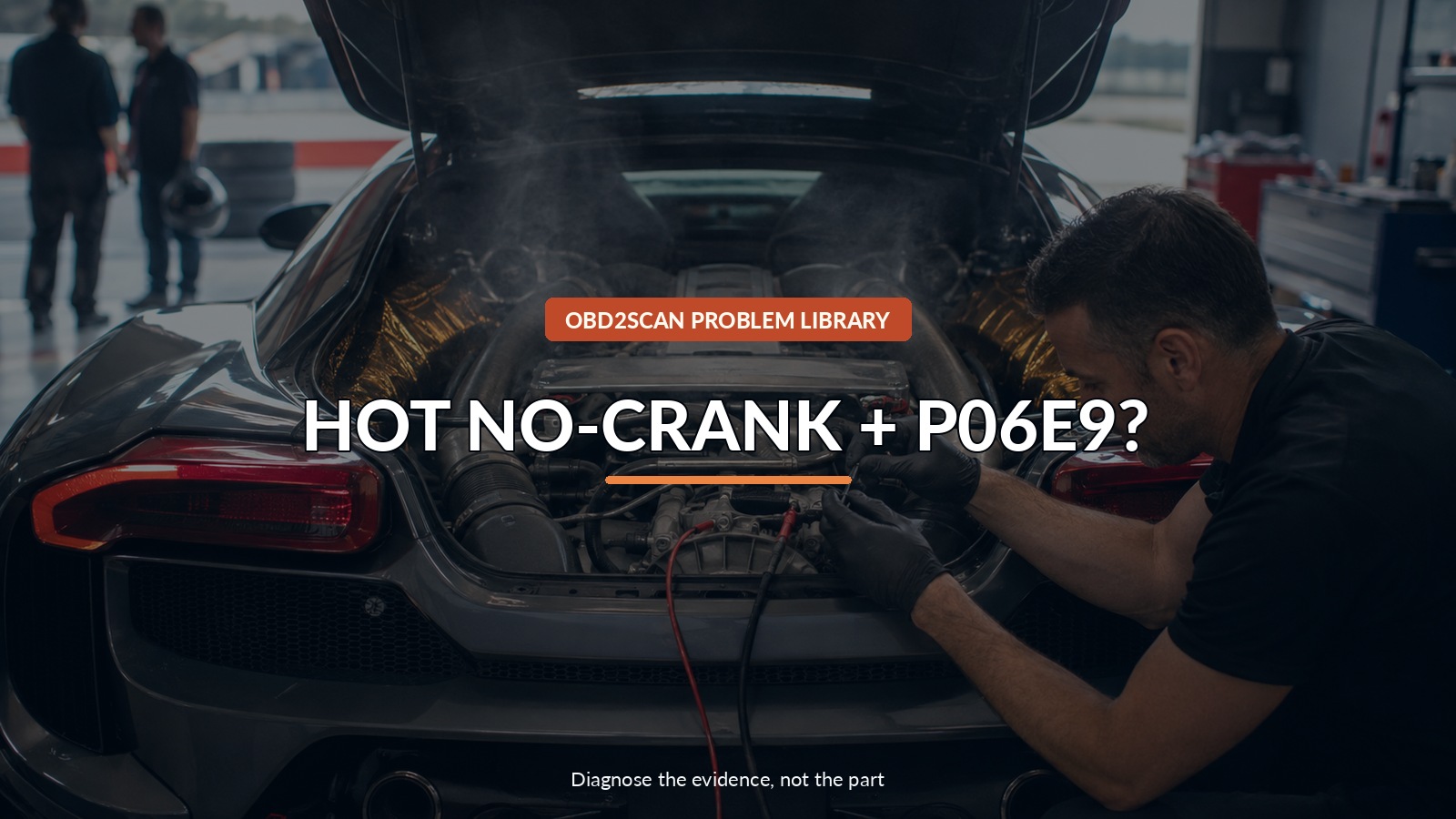
Hot No-Crank + P06E9?
If the engine will not crank, do not keep cycling the start request. Record coolant temperature, time since shutdown and whether the car just completed a track session. GM’s PIC6662 gives two starter-area branches: inspect the X2-1 solenoid terminal for poor tension or heat damage, then inspect the starter’s drain tube for a kink, restriction, separation or other water-management problem. Access requires intake-manifold removal; if neither branch has evidence, the engine must also be checked for mechanical binding.
Once the start-command path has been identified, a graphing circuit meter can capture voltage drop or a control waveform during the brief failure window. An AUTOOL DM303 can support those accessible low-voltage checks without assuming the starter itself is guilty. DM303 can support a qualified technician’s voltage-drop, resistance and waveform checks on an identified starter-control circuit using correct access and loading; it cannot reach the hidden starter without disassembly, judge terminal tension, inspect the drain tube, crank a mechanically bound engine safely or replace GM’s service information.
Hot no-crank complaints disappear quickly, so the first ten minutes often matter more than an hour of cold testing. GM’s current path splits beneath the intake manifold: one branch is electrical resistance at a single terminal, and the other is the starter’s unusual water-management hose.
Quick answer: Preserve the hot-soak failure, P06E9 and start-circuit evidence, then inspect the hidden starter’s X2-1 terminal and drain hose before parts.
In this guide
- Capture the hot-soak story before the car cools
- Save P06E9 and the full scan
- Test the battery and start request first
- Access the starter only through the service procedure
- Inspect X2-1 for tension and heat damage
- Trace the starter drain hose end to end
- Rule out a mechanically bound engine
- Heat-soak and restart after the actual repair
Capture the hot-soak story before the car cools
Before the Corvette cools, write down the conditions that created the failure. Note coolant temperature if available, outside temperature, time and distance since the last start, length of the hot soak and whether the car had just completed a track session. Record whether there was silence, one click, repeated clicks or normal cranking without a start. GM says the condition is especially associated with a very warm engine and asks technicians to question the customer about track use. Do not keep pressing Start in an attempt to improve the recording; repeated requests can change heat, battery state and the evidence.
Save P06E9 and the full scan
Save P06E9 and the complete module scan before clearing. Capture its status and freeze-frame data, plus any low-voltage, communication or immobilizer codes. A phone video showing the cluster, sound and start request can tie the driver’s description to the scan. P06E9 supports a starter-performance investigation, but it does not choose between GM’s two physical branches or rule out a weak battery, control problem or bound engine. If the car starts after cooling, document the recovery time. An intermittent code without the hot-soak story is much less useful than the two records together.
Test the battery and start request first
Prove the ordinary start prerequisites before removing the intake manifold. Test the 12-volt battery after correct charging, inspect primary cable connections and use the wiring diagram to determine whether the start request and solenoid control reach the accessible points. Compare voltage drop on supply and ground during the failed request when it can be done safely. A battery that holds open-circuit voltage may still collapse under load. Conversely, a healthy battery and valid command do not prove an internally mounted starter is defective. These checks preserve a rational starting point before labor-intensive access.
| Hot no-crank evidence | Next branch |
|---|---|
| Low battery or excessive main-cable drop | Correct low-voltage supply before hidden-starter access |
| Valid command + damaged/loose X2-1 terminal | Repair the confirmed connector fault |
| X2-1 sound + drain hose kinked, blocked or detached | Restore the water-management path |
| Both starter-area paths normal | Check for mechanical binding and continue SI diagnosis |
Access the starter only through the service procedure
PIC6662 identifies 2023–2027 Corvette Z06 models with the LT6 engine and M1M transmission. The starter sits inside the intake-manifold area, so inspection requires intake-manifold removal using current service information. Allow the engine to cool, disable power and fuel systems as specified, protect every open intake passage and renew the required gaskets. This is not a roadside connector wiggle. Photograph routing and connector position during access because prior starter replacement or disturbed hoses can be part of the history. Keep loose hardware completely out of the exposed engine.
Inspect X2-1 for tension and heat damage
At the starter, inspect connector X2 cavity 1, the single-pin solenoid terminal. GM warns that poor terminal tension can create excessive resistance, preventing the solenoid from being powered. Look for discoloration, softened or deformed plastic, carbon tracking, looseness and heat damage on both mating sides. Use the specified terminal-tension method; do not spread or squeeze a terminal by guess and then treat the altered fit as evidence. If damage is confirmed, the bulletin directs a terminated-lead repair. Complete the splice, sealing and support exactly as instructed, away from heat and strain.
Trace the starter drain hose end to end
If the electrical connection is sound, follow the drain hose from the starter housing through the small bore in the engine block. GM shows an older straight white or opaque style and a newer black S-curved style. Either can be relevant. Look for a kink at the housing, pinching, blockage, separation or any other water-management problem, and verify that water can flow out by the approved method. Do not force high-pressure air toward the starter or assume hose color is a pass/fail criterion. The question is whether the installed route remains connected, open and able to drain.
Rule out a mechanically bound engine
If neither connector nor drain path explains the condition, GM says not to overlook a physical engine problem. A qualified technician should follow the manual to attempt rotation by hand in the correct direction and configuration. Disconnect power and prevent an unexpected start. Resistance from compression and accessories must be interpreted properly; a breaker bar is not permission to force a seized assembly. Stop if rotation is abnormal. A mechanically bound engine changes the risk and repair path completely, and repeated starter replacement will not free it.
Heat-soak and restart after the actual repair
Verify the actual branch repaired, not merely a cold start after reassembly. Restore every intake connection, support the battery and scan for codes, then reproduce a comparable hot soak with temperature and timing recorded. Confirm consistent crank speed through several approved restarts, inspect for intake leaks and make sure the starter drain remains correctly routed. If the fault returns, compare the new failure with the original command and voltage records rather than reopening parts blindly. The final repair order should name terminal damage, hose restriction/separation or mechanical cause—not simply ‘replaced starter for P06E9.’
A Z06 that restarts after cooling has not fixed itself; it has closed the best observation window. Preserve the heat-soak timeline, P06E9 and start-circuit behavior first. Then let inspection under the manifold choose between the solenoid terminal, drain hose and mechanical branch. That produces a repair the owner can understand and a hot-restart test that actually challenges the original fault.




Comments 0
Questions, fixes, and real-world diagnostic notes from readers.
Be the first to share a diagnostic result or ask a follow-up question.