
2021–2025 Pan America Cold-Start Idle Unstable? Check the ECM Update—and the Order

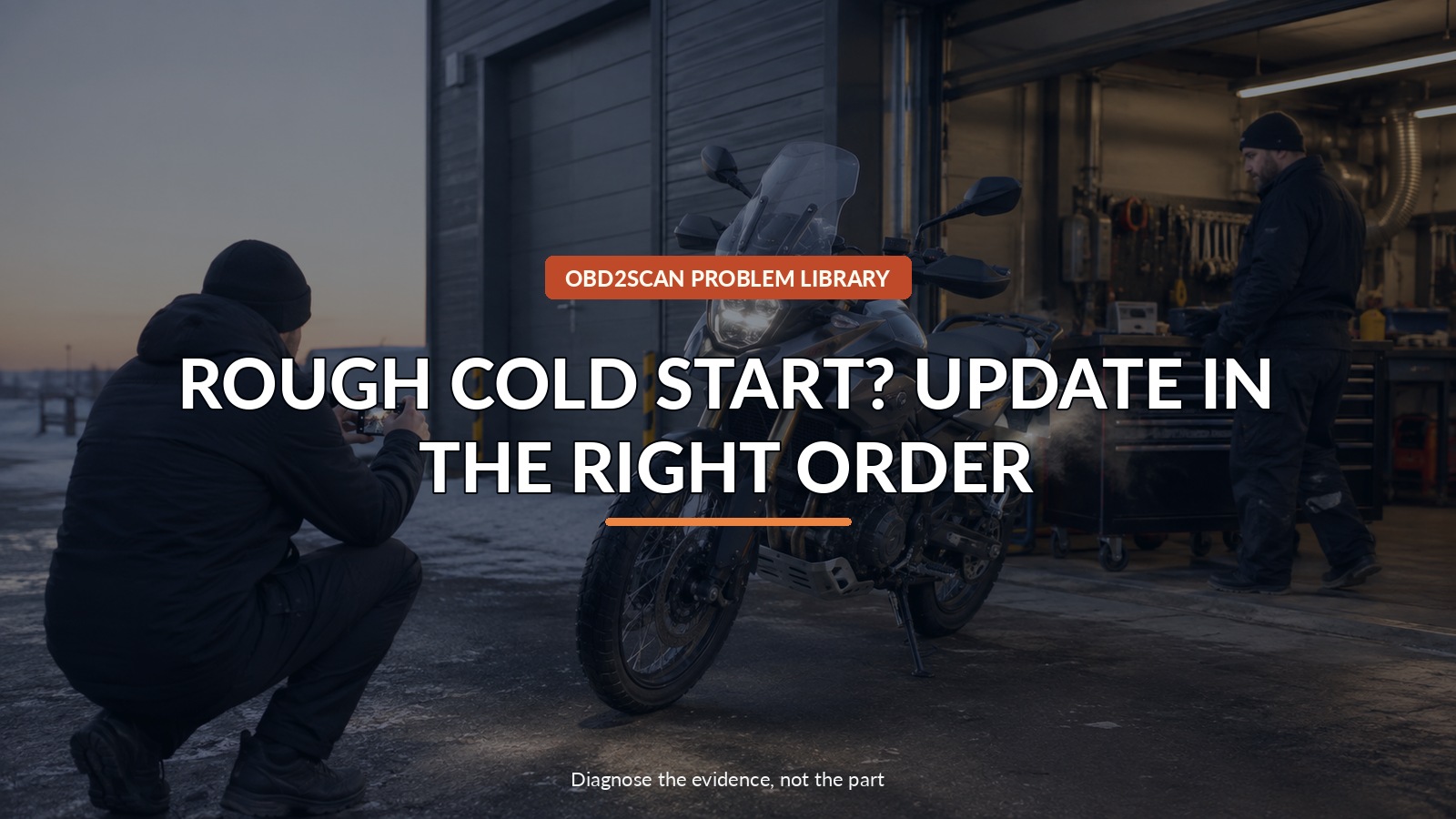
Rough Cold Start? Update In The Right Order
Capture one true cold start: ambient temperature, battery state, cranking time, initial rpm, stalls and quickshifter behavior after a gentle warm-up. Harley’s M1720 update targets cold-start idle stability and quickshifter function. For 2021–2024 models, the BCM must be updated before the ECM; 2025 models skip directly to the ECM step. This requires current Digital Technician II, stable vehicle/TL-3 power and post-flash relearn—not random resets.
Before scheduling dealer programming, an owner or independent shop may use a motorcycle-capable scanner such as the FXTUL M4-HD to preserve fault context and basic live behavior. FXTUL M4-HD can preserve supported Harley DTCs and live data before dealer programming when the exact model and connector are covered; it cannot install Harley calibrations, replace Digital Technician II or Techlink 3, enforce BCM-before-ECM order, maintain programming voltage, recover a locked module or complete the update campaign.
A cold Pan America that idles poorly or makes the quickshifter feel inconsistent can become perfectly normal after the engine warms. That is exactly why a short first-start video and the motorcycle’s current software levels are more valuable than a warm shop visit. Tell the story in two columns—first cold minute and fully warm ride—then let the dealer apply the model-year-specific programming order. Do not try to imitate a factory calibration with resets.
Quick answer: Record a true cold start, prove battery health and preserve software IDs before the model-year-specific BCM/ECM update order.
In this guide
- Capture one truly cold start
- Separate unstable idle from normal warm-up
- Record battery state and every stored code
- Confirm the exact Pan America model and year
- Check current DT II and module versions
- Update BCM before ECM on 2021–2024 models
- Support both the motorcycle and Techlink 3
- Relearn, restore quickshifter and verify next morning
Capture one truly cold start
On the first start after a true overnight soak, position the motorcycle securely in neutral and film the tachometer and sound for the first 60–90 seconds. Record ambient temperature, fuel age, battery voltage before start, number of start attempts and whether throttle input was needed. On a separate safe ride, note quickshifter behavior at steady engine temperature, gear, rpm, throttle opening and upshift versus downshift. Mount the camera or ask a helper; never hold a phone while riding.
Separate unstable idle from normal warm-up
Stop riding if the engine stalls in traffic, throttle response is unpredictable, the MIL flashes, oil-pressure warning remains on or shifting threatens control. Do not repeatedly blip the throttle on a cold engine to mask the complaint. Check basics that do not require hot contact: fuel quality, visible intake connections, battery terminal security and obvious damage. Chain adjustment, clutch function and linkage condition can affect shift feel independently, so record them rather than folding every rough shift into software.
Record battery state and every stored code
Harley-Davidson communication M1720 Rev. A covers specified 2021–2025 RA1250/RA1250S Pan America motorcycles and describes cold-start/idle and quickshifter refinements. Confirm VIN, model year, installed equipment and the latest dealer communication. An aftermarket tune, exhaust/intake change or different model may require a different baseline. A software update can improve the scoped behavior; it cannot repair low compression, contaminated fuel, a weak battery, damaged linkage or an electrical connection.
Confirm the exact Pan America model and year
Before programming, save all DTCs and their current/history status and document existing module software levels. Load-test or otherwise prove the battery, because low voltage can create starting complaints and interrupt a flash. Inspect charging performance, grounds and relevant connectors. Preserve aftermarket configuration details. Clearing codes or resetting adaptations before the dealer sees the cold-start record may remove context without changing the underlying calibration.
Check current DT II and module versions
The programming order changes by model year. For 2021–2024 motorcycles, Harley instructs the dealer to update the BCM first and then the ECM. For 2025 motorcycles, the ECM update is the stated path. The bulletin calls for Digital Technician II version 26.5.2 or later at the time of publication. The technician should check today’s version and available calibrations, because a saved article cannot guarantee the current file or supersession.
| Model year | Bulletin programming order | Proof to retain |
|---|---|---|
| 2021–2024 | BCM, then ECM | Both before/after identifiers |
| 2025 | ECM | ECM before/after identifier |
| Any covered year | Complete prompted setup/relearn | Successful routine record |
| Symptom remains | Resume mechanical/electrical diagnosis | Cold video and repeat DTC data |
Update BCM before ECM on 2021–2024 models
Stable power is part of the repair. Use the Harley-approved motorcycle and technician-laptop power support identified in the communication, keep connections secure and do not operate switches or accessories during programming. A generic charger or running another vehicle nearby is not a safe substitute. If communication drops, follow Harley recovery rather than cycling modules at random. Record before/after calibration identifiers so a later complaint can establish whether the intended update actually installed.
Support both the motorcycle and Techlink 3
Complete every prompted setup and relearn in Digital Technician II, then allow the motorcycle to return to a genuine cold-soak state before judging idle quality. Warm-engine smoothness does not test the original complaint. For quickshifter verification, use a safe route and follow operating instructions for rpm, load and shift direction. Do not chase perfect feel with unsafe repeated acceleration. Compare the same rider inputs and note whether any DTC returns.
Relearn, restore quickshifter and verify next morning
If the cold idle or shifting complaint remains, separate the two columns again. Persistent cold instability can lead to fuel, air, sensor, mechanical and battery checks; persistent shift quality can lead to linkage, clutch, transmission and quickshifter-sensor diagnosis. Provide the dealer with the video, temperatures, DTCs and software identifiers. Do not request the same update a second time without evidence that it failed or a newer calibration exists.
A warm motorcycle cannot testify about its first cold minute. Capture that minute, prove the battery, preserve codes and let the correct dealer software sequence address the scoped behavior. Then repeat the same cold start and a controlled quickshifter check. The before/after pair is what separates a useful calibration from a hopeful reset.




Comments 0
Questions, fixes, and real-world diagnostic notes from readers.
Be the first to share a diagnostic result or ask a follow-up question.