
2025 Ranger Soft Brake Pedal After Start With U3012:68? Park It, Then Check Software Scope

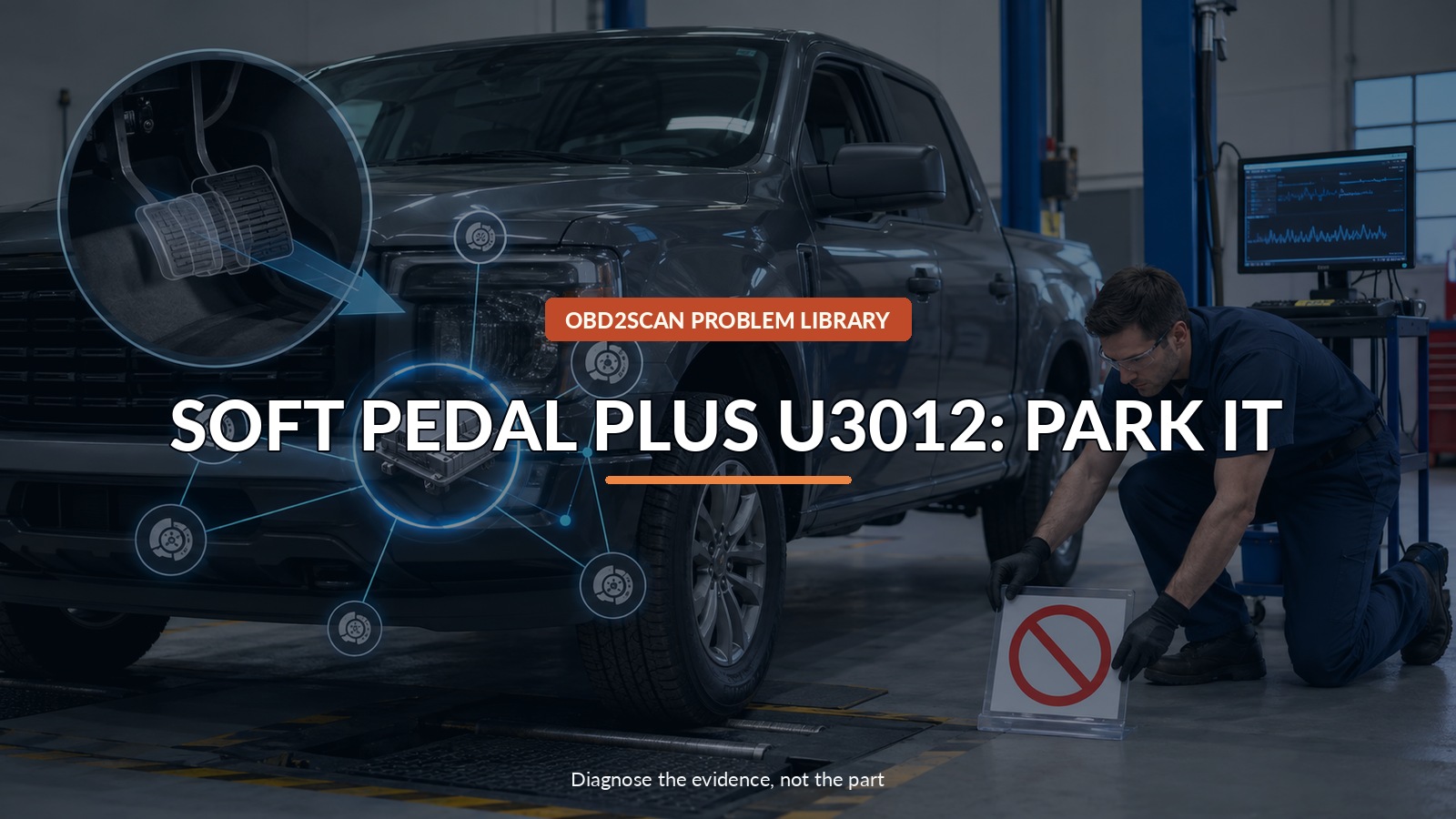
Soft Pedal Plus U3012: Park It
Do not road-test a Ranger with an unexpectedly soft pedal or red brake warning; arrange inspection, save U3012:68 from the ABS module, confirm the engine-specific June 2025 build fence, and let Ford’s latest FDRS software branch run before invasive hydraulic testing. A software bulletin does not reduce the safety significance of a soft brake pedal. Stop and keep the truck off the road before checking the build fence and software branch.
The useful tool category here is a professional hydraulic pressure comparison performed only after the software path leaves a physical brake question, but only after the safe test point and question are clear. The AUTOOL PT660 is one practical route for that bounded measurement. PT660 can compare hydraulic pressure at approved points if a trained technician still has a mechanical/hydraulic concern after the software path; it cannot diagnose CAN communication, reprogram ABS, make an unsafe pedal roadworthy, or prove the bulletin applies.
The sequence is safety, code preservation, production fence, software, then hydraulics if needed. Reversing it can open brake lines for a fault Ford attributes to communication inside the ABS module.
Quick answer: Do not road-test a soft-pedal Ranger; preserve U3012:68, verify the engine-specific June 2025 build fence, and run Ford’s FDRS branch first.
In this guide
- Decide that the truck will not be road-tested
- Save U3012:68 from the ABS module
- Match the engine to the correct June build fence
- Separate internal CAN logic from hydraulic feel
- Reprogram before opening brake lines
- Use hydraulic pressure only for a remaining physical question
- Reopen normal diagnostics if the code or feel returns
- Verify warnings, pedal, codes, and a controlled stationary start
Decide that the truck will not be road-tested
Do not road-test a truck with an unexpectedly soft pedal, red brake warning, obvious fluid leak, or pedal that approaches the floor. Secure it, use wheel chocks, and arrange towing or on-site professional inspection. Photograph every warning and message before cycling the ignition repeatedly. Record whether the pedal changes after startup, with the engine off, or after several stationary applications. Do not pump the pedal until it feels better and then drive; temporary feel can hide a serious hydraulic or control condition.
Save U3012:68 from the ABS module
Save a full vehicle scan and confirm that U3012:68 is stored in the ABS module. Record current/history status, freeze frame or event data, low-voltage history, software part numbers, and every related network or brake code. The suffix matters; a generic U3012 description from another module is not the same gate. Do not clear it for a quick restart experiment. The before-report is what lets the shop compare the software state and prove whether the condition returned.
Match the engine to the correct June build fence
Ford splits the production fence by engine. Ranger 2.3L and 2.7L EcoBoost trucks are covered when built on or before June 12, 2025. Ranger Raptor 3.0L vehicles are covered when built on or before June 18, 2025. Confirm VIN, engine, and build record through current Ford information—not the sale date. A later truck, a different engine, or a different ABS code needs normal diagnostics even if the pedal description sounds identical.
Separate internal CAN logic from hydraulic feel
SSM 54101 says the symptom may result from a controller-area-network communication concern within the ABS module and directs reprogramming with the latest FDRS software. CAN communication can change pump/valve control and warning behavior without proving air entered the hydraulic system. At the same time, software scope does not erase visible leakage, low fluid, damaged hoses, base-brake wear, or prior repair. Inspect safety basics while preserving the distinct software branch.
| Evidence | Bulletin fit | What it cannot prove |
|---|---|---|
| Soft pedal after startup | Named symptom | Hydraulic leak versus control state |
| U3012:68 in ABS | Required code context | That software alone fixes the vehicle |
| Correct engine/build date | Opens SSM scope | Recall or warranty coverage |
| Normal pedal after FDRS update | Supports resolution | Absence of every base-brake fault |
Reprogram before opening brake lines
Connect approved battery support and FDRS, confirm the correct module and available software, and complete the update without voltage loss, cable interruption, or premature ignition cycles. Save the successful programming log and post-update scan. Do not use a generic code reader to imitate module reprogramming, and do not assume clearing adaptations is equivalent. If programming fails, keep the truck stationary and follow Ford recovery instructions rather than repeatedly attempting starts or disconnecting the battery.
Use hydraulic pressure only for a remaining physical question
If pedal feel remains abnormal after the software branch, return to the WSM base-brake and ABS hydraulic diagnosis. A trained technician may compare pressure at approved points to separate master-cylinder input, ABS hydraulic behavior, line restriction, trapped air, and caliper output. Use the specified fittings, limits, bleed sequence, and containment. Opening a pressurized brake circuit introduces air and fluid risk. One equal pressure snapshot does not prove the brakes are safe under all conditions.
Reopen normal diagnostics if the code or feel returns
A returning U3012:68 needs a fresh saved report, software identity check, connector/power/ground/network evidence, and Ford direction. A soft pedal without the returning code deserves ordinary hydraulic diagnosis rather than another programming attempt. Conversely, a code without the pedal may still need the scoped update but should not be used to invent a hydraulic repair. Keep code state, pedal state, and vehicle eligibility as three separate rows on the work order.
Verify warnings, pedal, codes, and a controlled stationary start
Start verification while stationary: repeated engine-off applications, startup transition, warning-lamp self-check, pedal reserve, fluid level, and leakage inspection. Confirm the ABS scan is clean after the specified routines. Only a qualified technician should perform a controlled road verification in a safe area after stationary checks pass. Test the original startup condition more than once. The result is a consistently safe pedal, normal warnings, documented current software, no leaks, and no returning U3012:68.
The best article answer is not ‘update it’ but ‘park it, then see whether the exact software fence fits.’ That order respects both Ford’s technical direction and the real human consequence of guessing wrong about a brake pedal.



Comments 0
Questions, fixes, and real-world diagnostic notes from readers.
Be the first to share a diagnostic result or ask a follow-up question.