
Mazda CX-90/CX-70 Fuel Gauge Lies Below One-Quarter? Add Fuel Before Guessing

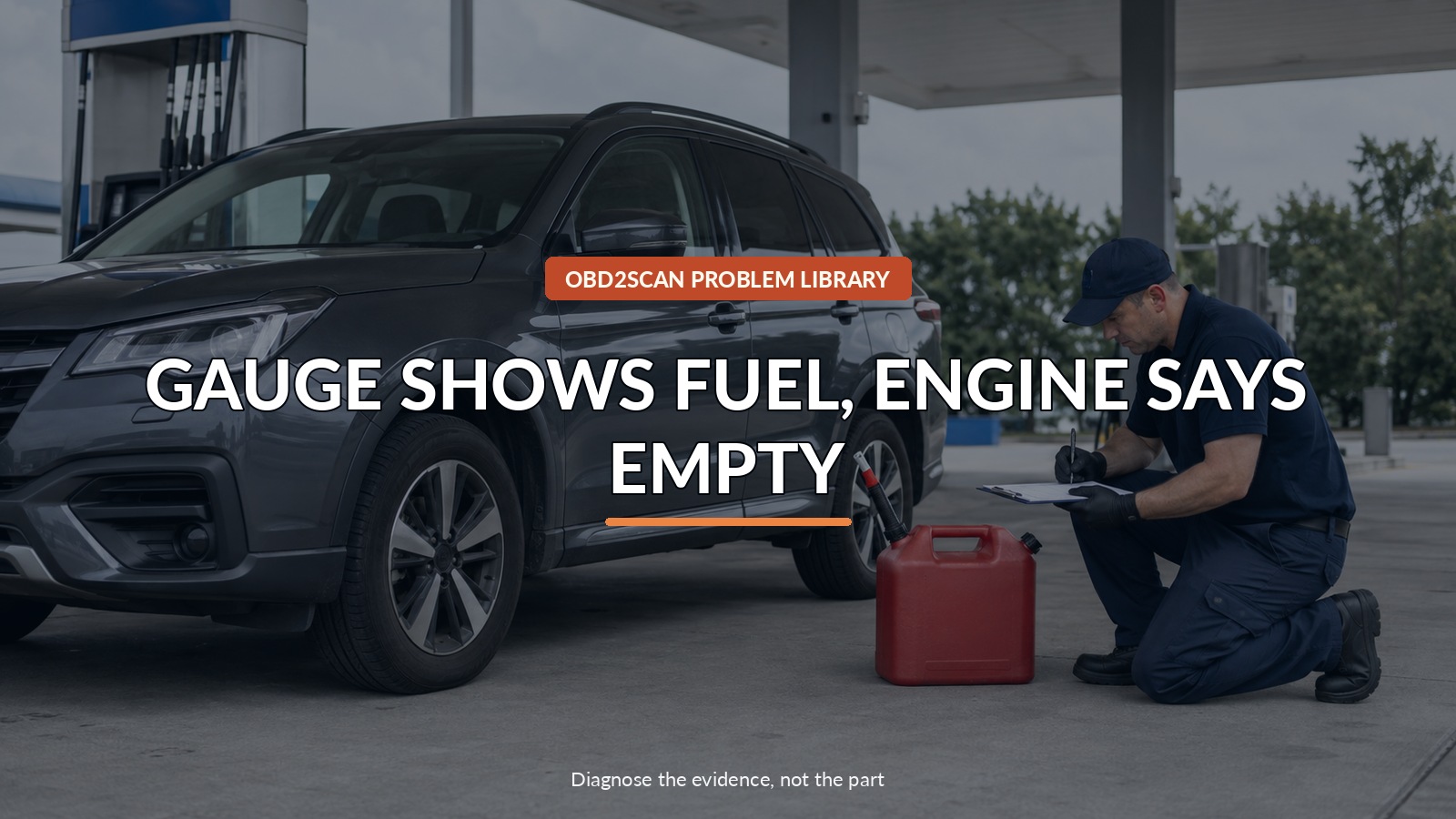
Gauge Shows Fuel, Engine Says Empty
If the engine will not start while the gauge claims fuel, move to safety and add the correct fuel from an approved container; if it starts, record that decisive event, then let a Mazda technician drain the tank as specified and use MDARS—197–203 ohms closes the TSB, outside it opens the fuel-tank branch. First solve whether the vehicle is effectively out of fuel; a safe fuel-addition result then becomes strong shop evidence.
The useful tool category here is a correctly adapted low-pressure fuel gauge used only if a no-start remains after fuel is safely added, but only after the safe test point and question are clear. The AUTOOL PT635 is one practical route for that bounded measurement. PT635 can test compatible low-pressure fuel delivery at an approved service point if the engine still will not start after safe fuel addition; it cannot test the sub sender, display Mazda’s MDARS PID, make tank draining safe, or replace the 197–203 ohm gate.
Do not turn the roadside rescue into tank work. The resistance check in Mazda’s bulletin happens only after a controlled, repeated fuel-draining procedure using dealer tooling.
Quick answer: If a CX-90/CX-70 will not start while showing fuel, add fuel safely and record the result before Mazda’s drained-tank MDARS resistance gate.
In this guide
- Solve the stranded-driver question first
- Record what one safe fuel addition changes
- Keep the gauge, DTE, and P0462 on one timeline
- Confirm the H3T model fence
- Drain only through Mazda’s controlled procedure
- Let 197–203 ohms close the bulletin
- Test delivery only if the no-start remains
- Verify the gauge through real fuel-level change
Solve the stranded-driver question first
Move the vehicle out of traffic if possible, switch on hazards, avoid repeated cranking, and do not work beside moving lanes. If the gauge shows fuel but the engine will not start, add the correct fuel from an approved container according to the owner’s manual and local safety rules. Keep ignition sources away and clean spills immediately. Record the displayed level and distance-to-empty before adding, the amount added, and whether the first controlled restart succeeds. Arrange recovery if the location or procedure is unsafe.
Record what one safe fuel addition changes
A start immediately after adding fuel is a high-value event, but write it precisely: amount added, previous indicated level, DTE, terrain angle, ambient temperature, and cranking behavior. Save P0462:00 and the full scan before clearing. If the engine still does not start, stop repeated attempts and keep ordinary no-start branches open. The added fuel does not prove pressure, spark, authorization, or mechanical condition; it simply removes one uncertainty when the amount and result are known.
Keep the gauge, DTE, and P0462 on one timeline
Put gauge level, DTE, P0462 status, odometer, known fill quantities, and trip distance on one timeline. The bulletin describes a rapid drop below one-quarter, inaccurate DTE, a possible low-input code, and a no-start that reverses after adding fuel. Photograph the cluster safely at each refuel rather than relying on memory. Sloped parking and fuel movement can change the display temporarily, so repeat observations on level ground when possible. Never deliberately run the tank dry to reproduce the condition.
| Observation | Meaningful next question | Not yet proven |
|---|---|---|
| Starts after approved fuel is added | Was indicated fuel inaccurate? | Failed sub sender |
| P0462:00 stored | What does MDARS show after draining? | Empty tank or bad pump |
| Gauge drops rapidly below 1/4 | Is behavior repeatable with known fill amounts? | Exact remaining volume |
| Still no-starts with verified fuel | Is low-side delivery present at the approved point? | Sender fault as the cause |
Confirm the H3T model fence
This service information is for 2024–2025 CX-90 H3T and 2025 CX-70 H3T inline-six applications. Confirm the VIN, powertrain, software status, prior tank/sender work, and latest Mazda information. Similar gauge behavior on a plug-in hybrid or another model requires its own diagnostic path. The bulletin is not a recall notice and does not promise coverage. VIN lookup and the service department determine current campaign or warranty status separately.
Drain only through Mazda’s controlled procedure
Mazda has the technician drain fuel, remove the pump-relay jumper, wait five minutes, reconnect, and repeat until the staged sequence is complete. That controlled state makes the sub-sender resistance meaningful. Gasoline handling, ventilation, static control, correct containers, vehicle lifting, and hybrid/fuel-system safety put this outside roadside or driveway work. Do not jumper relays, open the tank, or improvise a drain hose. Deliver the fuel-addition timeline and let the shop create the specified test state.
Let 197–203 ohms close the bulletin
With the procedure complete, Mazda reads BCM PID FUEL_GAUGE_RES_SUB in MDARS. A value from 197 to 203 ohms means this service information does not apply and normal MGSS troubleshooting resumes. A value outside that band opens the next bulletin step, which is fuel-tank replacement for the listed H3T vehicle. The number is not a universal sender specification, and a handheld resistance check at an unknown fuel level does not recreate Mazda’s drained-tank condition.
Test delivery only if the no-start remains
If the engine remains a no-start after a known amount of correct fuel is added, a trained technician can test low-pressure delivery at the specified port and conditions. Record prime, cranking, and residual behavior against Mazda specifications while controlling fire risk. Never connect a generic gauge to a direct-injection high-pressure rail. Pressure evidence answers whether fuel is delivered; it does not test the gauge sender or explain a P0462 circuit by itself. Scan data, power supply, immobilizer, and mechanical checks may also be needed.
Verify the gauge through real fuel-level change
After the approved repair, begin with a known fuel quantity on level ground. Compare cluster level, DTE trend, trip distance, and actual refill amount through the region below one-quarter where the complaint appeared. Confirm P0462:00 does not return and that hot/cold starts remain normal. Do not call the repair verified after one full-tank reading, because many senders look believable near full. The meaningful test is a stable, plausible descent and warning behavior through the original low-level range.
The most human-centered diagnosis solves the immediate safety problem first and preserves what changed. Adding fuel safely may restore mobility; only Mazda’s controlled resistance state decides whether the bulletin’s tank branch is justified.







Comments 0
Questions, fixes, and real-world diagnostic notes from readers.
Be the first to share a diagnostic result or ask a follow-up question.