
2019–2021 Bentley Bentayga P2450? Test Wiring and Leaks Before the Pump

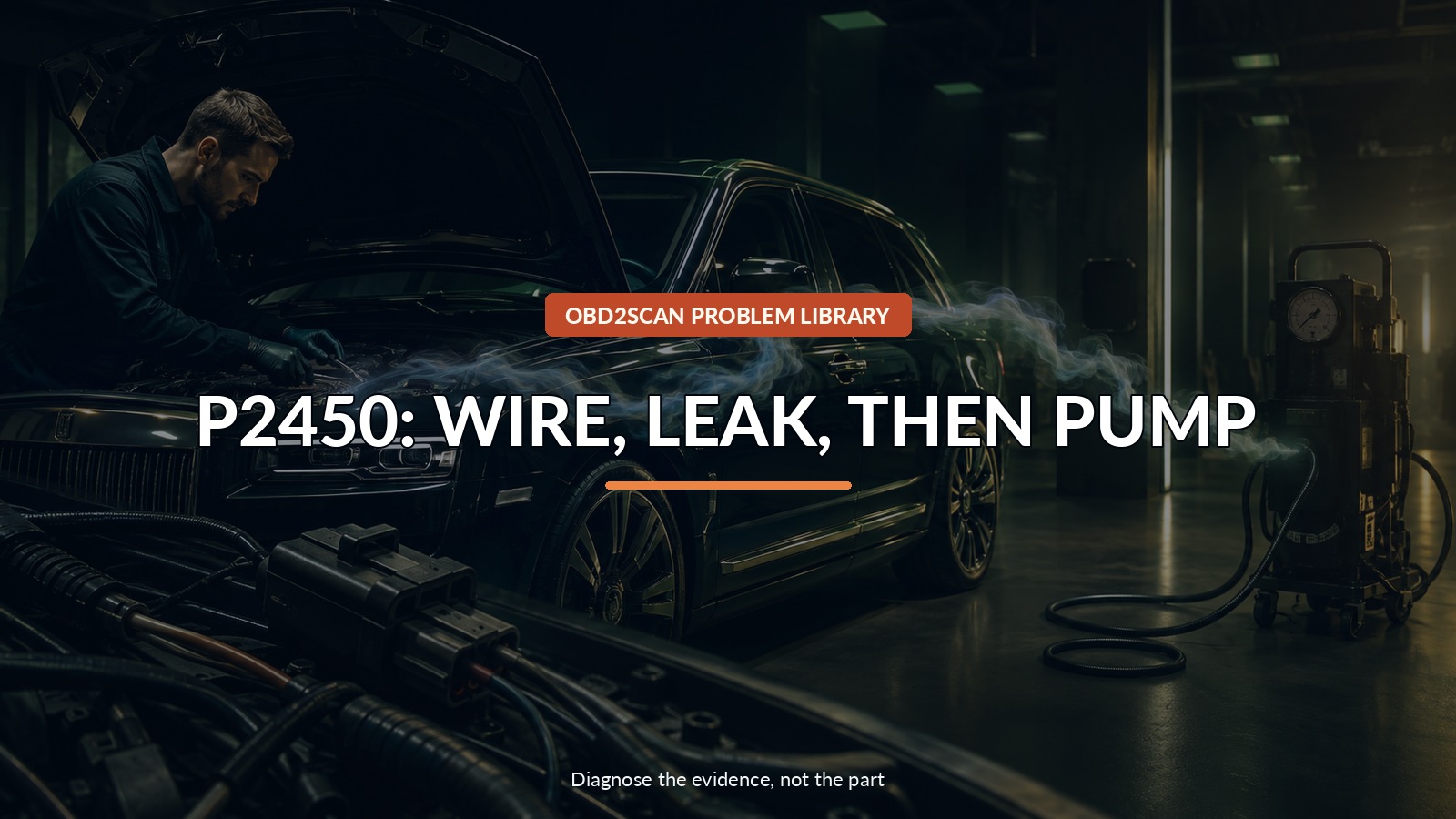
P2450: Wire, Leak, Then Pump
P245000 looks like a component verdict: EVAP System Switching Valve “A” Performance/Stuck Open. On a 2019–2021 Bentayga V8 Kovomo with symptom code 11952, Bentley TPI 2063657/2 makes it a queue instead. Test leak-detection-pump wiring first, test the vapor system for leaks second, and reach pump replacement only if neither earlier gate finds a fault.
The second gate needs smoke that can reveal a small escape point under the approved low-pressure setup. The AUTOOL SDT203 EVAP smoke machine is one possible source of visible smoke and flow/pressure context. It cannot test wiring integrity, command every EVAP valve, identify an internal pump fault, or justify full machine output on a low-pressure vapor system.
Picture three doors labeled only by evidence: wire, leak, pump. If the first opens, do not walk through the third.
Quick answer: Match P245000 with symptom code 11952, close the wiring gate, then close the smoke-leak gate before reaching leak-detection-pump replacement.
In this guide
- Match the full fault identity
- Close the wiring door first
- Open the smoke door only after circuit integrity
- Look for system leaks without overpressure
- Reach the pump only when both gates pass
- Inspect the removed pump for impact evidence
- Reject the sequence when symptom code or vehicle differs
- Verify event memory and leak-system behavior
Match the full fault identity
Save a complete scan before clearing event memory. Confirm P245000, whether it is intermittent or static, and the accompanying symptom code 11952. Record freeze frame, fuel level, ambient temperature, refueling history, MIL timing, prior EVAP work, underbody impact, battery condition, and any companion electrical or emissions codes.
The TPI covers 2019–2021 Bentayga V8 Kovomo sales types in the listed markets. Confirm VIN, engine/market, software, vapor-system configuration, and current Bentley repair information. A generic P2450 translation on another vehicle does not inherit this wiring-smoke-pump sequence.
Fuel vapor is extremely flammable. If liquid fuel, tank damage, or a strong uncontrolled odor is present, stop and move the vehicle to a qualified fuel-system facility. Eliminate ignition sources and follow the repair manual’s fuel-system precautions.
Close the wiring door first
Use the correct wiring diagram to identify leak-detection-pump supply, ground, control, and connector paths. Inspect routing, pin fit, corrosion, water, impact, repair splices, and harness tension. Save connector images before cleaning or terminal movement.
Static continuity alone may miss a high-resistance or intermittent connection. A trained technician should use the Bentley-specified integrity checks, appropriate loaded measurement, terminal adapters, and module-safe probing. Do not inject power into an unknown control wire or back-probe in a way that spreads terminals.
If a circuit fault is found, repair it and repeat the original event/functional test. The queue stops here unless the code or system result persists with verified wiring.
Open the smoke door only after circuit integrity
When wiring and connectors pass, prepare the leak-detection system exactly as the repair manual specifies. Identify the connection, isolate or command valves as required, and use pressure suitable for Bentley’s vapor system. Verify the smoke machine, hose, adapter, and cap do not leak before interpreting the vehicle.
Introduce smoke gradually and allow time for a small leak to become visible. Search service connections, hoses, canister, tank and pump seals, filler route, purge/vent paths, and impact-prone underbody areas. Use a bright cool light and film where smoke first emerges, not where it later collects.
Look for system leaks without overpressure
More smoke pressure can distort seals, open valves, or damage the system. The smoke machine’s maximum specification is not a vehicle test setting. Current Bentley information controls the limit and valve state. Never substitute shop air or oxygen.
| Gate result | Next move | What remains unproved |
|---|---|---|
| Wiring fault found | Repair circuit and retest | Pump failure |
| Wiring passes; smoke leak found | Repair the localized leak | Internal pump failure |
| Wiring passes; no leak under valid test | Continue to pump branch | Pump failure until functional checks complete |
| Setup will not hold | Correct equipment/connection | Any vehicle part |
A leak near the pump body may be a hose, seal, impact crack, or pump housing. Preserve location before choosing the repair.
Reach the pump only when both gates pass
Bentley directs leak-detection-pump replacement when the wiring integrity check and smoke leak check find no fault. Current guided functions and repair information still control activation, plausibility, removal, installation, coding/adaptation, and part selection.
Do not replace the pump because its name appears in a code translation. The control unit may be reporting that system pressure or switching behavior did not match expectation. Wiring and a physical leak can create that same performance story without an internal pump defect.
Inspect the removed pump for impact evidence
The TPI specifically asks technicians to inspect an extracted leak-detection pump for impact damage and provide photographs through the Bentley query process. Before discarding or cleaning the part, photograph the mounting orientation, shields, surrounding underbody, connector, hose nipples, housing, and any strike mark.
Impact evidence can explain why a new component is needed and whether protection or adjacent parts require attention. Absence of visible impact does not prove an internal electrical or pneumatic fault. Keep physical images beside the scan, wiring, and smoke records.
Reject the sequence when symptom code or vehicle differs
If symptom code 11952 is absent, vehicle scope differs, or another DTC dominates, return to the current guided plan. Similarly, if smoke testing cannot be validated because valves cannot be controlled or equipment leaks, do not treat “no smoke seen” as a pass.
Purge-flow faults, filler sealing, tank pressure sensors, wiring supply, software, fuel saturation, or monitor enable conditions may require different paths. The disciplined response to an out-of-scope case is not to borrow the last two steps from a nearby bulletin.
Verify event memory and leak-system behavior
After repair, restore every vapor hose, electrical connector, retainer, shield, and cap. Repeat the circuit or smoke test that originally failed, then run the Bentley guided function and monitor procedure under valid fuel-level and ambient conditions. Save the after-scan and all readiness states.
The case closes when the repaired circuit or leak system passes, no vapor or liquid fuel escapes, P245000/11952 does not return after its monitor, and no new fault appears. A cleared MIL with the EVAP monitor incomplete is only an interim state.



Comments 0
Questions, fixes, and real-world diagnostic notes from readers.
Be the first to share a diagnostic result or ask a follow-up question.