
Ford 1.5L EcoBoost Low Coolant and White Smoke on Cold Start: Read the Pattern

1.5 Ecoboost: Cold Smoke
On a bulletin-scoped Ford 1.5L EcoBoost, low coolant plus white exhaust smoke or roughness during the first cold start deserves a documented diagnosis. It does not, by itself, prove coolant intrusion or authorize engine replacement. Stop driving if the engine overheats, preserve the cold-start event, rule out visible external loss, and check VIN and build date against Ford TSB 19-2375.
When the evidence points inside a cylinder, a small articulating camera can let a qualified technician inspect through an approved access point before larger disassembly. The MRCARTOOL N220 inspection camera is one compact route for recording reachable surfaces. A picture cannot identify a liquid, prove its source, establish bulletin eligibility, or make a hot cooling system safe.
The best evidence may exist for only a minute each morning. Treat the first cold start as a scheduled observation, not a warm-up before diagnosis.
Quick answer: Preserve the first cold start, confirm actual coolant loss and exact TSB 19-2375 scope, then build cylinder evidence before assuming coolant intrusion.
In this guide
Save the first cold start
Begin with the engine completely cold and coolant level checked only by the owner-manual method. Do not open a hot or pressurized reservoir. Mark or photograph the cold level on several mornings under similar conditions; one glance at a translucent tank is easy to misread.
Position the vehicle outdoors and away from people. Start once and record:
- ambient temperature and overnight soak time;
- time from start to visible exhaust;
- whether vapor disperses quickly or hangs in the air;
- odor, if it can be observed without breathing exhaust;
- idle quality and how many seconds roughness lasts;
- warning lamps and exact messages;
- when the exhaust becomes clear; and
- whether the coolant level has actually fallen over days.
Normal condensation is common in cold weather. Persistent dense smoke, a sweet odor, recurring roughness, and measurable coolant loss increase the value of an internal-leak branch, but the pattern must still be tested.
If the temperature warning appears, the gauge rises abnormally, coolant vents, or the engine runs severely rough, shut it down. Do not keep recreating a damaging event for a better video.
Check whether the Ford bulletin can apply
Ford TSB 19-2375 names certain 2014–2019 Fusion and 2017–2019 Escape vehicles equipped with the 1.5L EcoBoost and built within specified date ranges. It associates coolant consumption, white exhaust smoke, and rough running with possible codes including P0300 through P0304, P0316, and P0217.
That is an applicability fence, not a diagnosis for every 1.5L Ford. Record the VIN, door-label production date, exact engine, model, and mileage. A registration year cannot substitute for the build date. Ask a Ford service source to verify whether the latest bulletin revision, warranty program, or campaign applies to that VIN.
If the vehicle, build, engine, symptom, or code pattern falls outside the document, return to the normal service-manual diagnosis. Do not stretch the bulletin because the repair described in it sounds familiar.
Separate external loss from an internal clue
Inspect the cold engine and undertray before washing anything. Look for dried coolant residue, wet hose joints, reservoir or cap evidence, radiator seams, thermostat housing, pump area, heater circuit, turbo cooling connections where fitted, and coolant tracks hidden by the splash shield.
Pressure testing belongs to a cool system, at the exact cap/system limit and with the correct adapter. A pressure drop can confirm that the sealed system is losing pressure; it does not name the path. External leaks may appear only under pressure, only hot, or only after shutdown.
Check the engine oil and transmission fluid only by the correct vehicle procedure. Milky residue under a cap during short-trip winter use is not the same as coolant confirmed in the sump. Likewise, a clean dipstick does not rule out cylinder-to-coolant leakage.
The heater, cabin odor, wet carpet, cowl area, and HVAC drain may open a heater-core or external-ingestion branch. Keep those clues separate from exhaust smoke.
Build a cylinder-specific case
Scan before clearing anything. Save current, pending, permanent, and history codes with freeze-frame data. During the first cold start, compare misfire counters, cylinder roughness, rpm, commanded fuel, coolant-temperature plausibility, and fuel-pressure data supported by the vehicle.
A single cylinder that misfires sharply when cold and then recovers deserves targeted follow-up. A random pattern can come from voltage, fuel quality, multiple ignition faults, air metering, or another shared cause. Swap tests should be performed only when safe and when they will preserve rather than contaminate evidence.
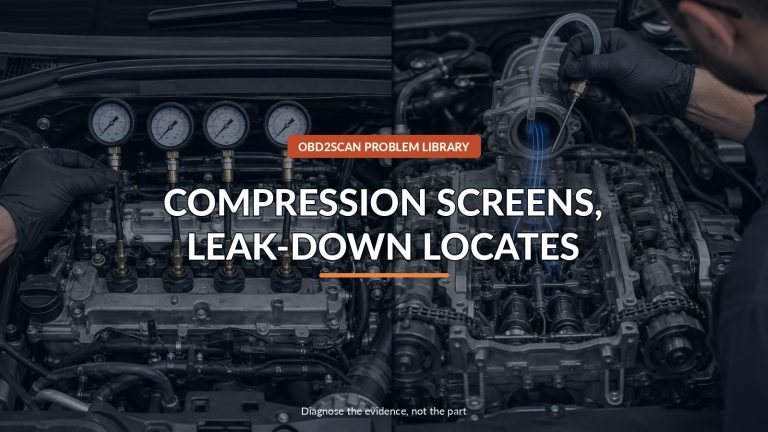
Remove spark plugs only by the service procedure after the engine is cool. Keep each plug labeled by cylinder. A steam-cleaned appearance, deposits, wetness, or unusual corrosion is a clue to compare with compression/leak-down, cooling-system behavior, and scan data—not a stand-alone verdict.
Inspect only after the branch earns access
Visual inspection becomes useful when the cold-start pattern, coolant trend, and cylinder evidence agree. The engine must be off, cool, secured, and protected from accidental cranking. Use an approved access path; never drill the intake or HVAC housing for a camera.
Capture an orientation image, then the piston crown, cylinder wall, plug well, or intake port as the service method permits. Compare neighboring cylinders under the same lighting. Liquid, an unusually clean surface, staining, or deposits may justify further testing, but the image cannot prove whether the fluid is coolant, fuel, oil, or condensation.
Remove the probe before any engine rotation or start. Account for the probe tip and accessories. If access approaches a moving component, hot turbo/exhaust part, fuel system, or high-pressure area, stop and use a qualified shop.
Do not let white smoke make the verdict
White exhaust on a cold day may be water vapor. Blue-white smoke can be oil. Unburned fuel from a misfire can smell sharp and look pale. Coolant entering a cylinder is one branch, not a color diagnosis.
Similarly, P0301 does not prove cylinder 1 is mechanically damaged; P0217 does not identify the leak; and a clean pressure test does not rule out a fault that appears only during a specific thermal state. The question is whether independent observations converge on the same path.
Verify coolant stability after repair
Ask the shop to record the VIN/build applicability check, cold level trend, external inspection, cold-start data, codes/freeze frames, cylinder evidence, pressure or leak-down results, and the exact repair. Preserve pre-repair photos beside post-repair results.
Verification should repeat the original condition after a full cold soak. The engine should start smoothly, the exhaust should behave normally for the weather, related misfire or over-temperature faults should not return, and the cold coolant level should remain stable through multiple heat cycles. Recheck for external residue and verify cabin heat and cooling operation.
The repair is not proven by one warm restart or by clearing a light. It is proven when the disappearing morning symptom fails to return and the fluid-loss record stays flat.




Comments 0
Questions, fixes, and real-world diagnostic notes from readers.
Be the first to share a diagnostic result or ask a follow-up question.