
Peak Amps Are Not a Session Plan: AUTOOL EM and Fisker Ocean Service

A power supply can have an impressive maximum-current figure and still be the wrong choice for a long service session. For Fisker Ocean work, the useful question is not simply “How many amps can it produce?” It is whether the supply can hold the voltage and meet the changing demand for the entire documented procedure, including warm-up, transient loads, heat buildup, and an orderly finish.
On this page
A service session has phases, not one amperage
Think of the job as a timeline. The vehicle begins in a defined state, the technician starts the task, electrical demand changes as systems become active, and the supply must remain within the procedure’s requirements until the work is complete. A brief load near the beginning does not describe the next half hour, and a quiet period does not rule out a later transient.
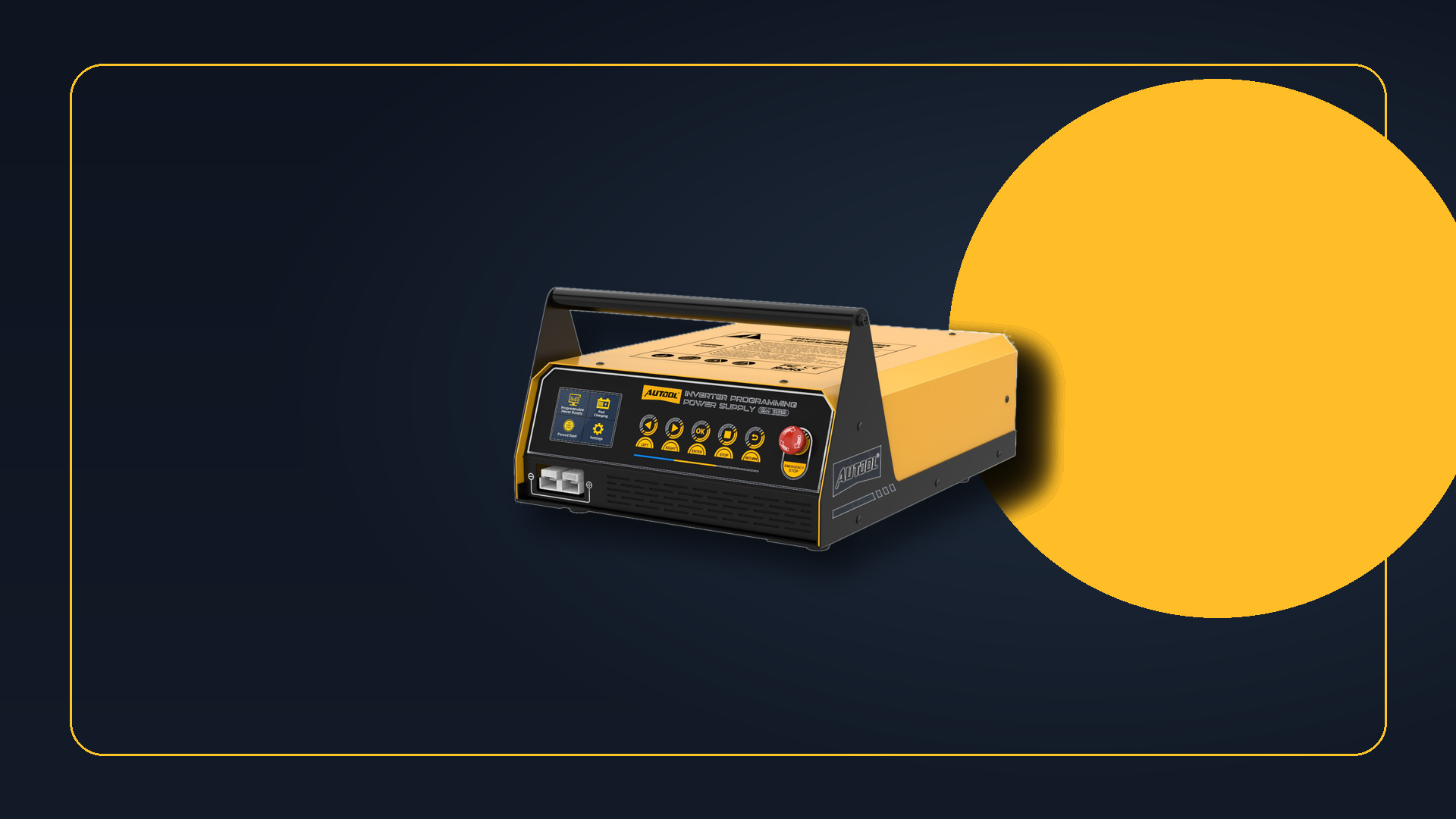
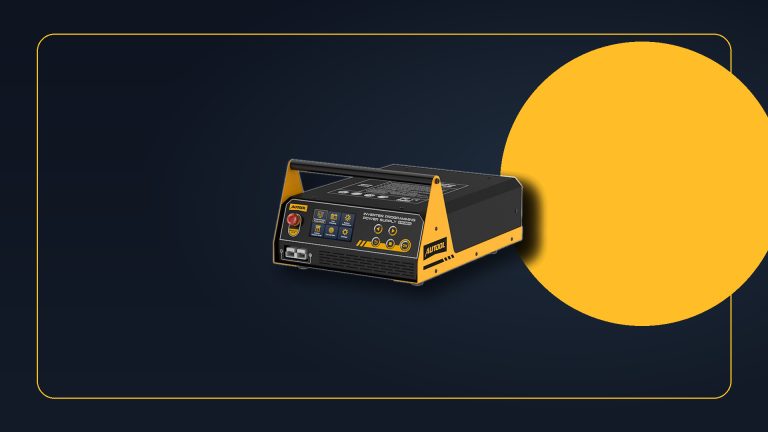
The AUTOOL EM355 illustrates this distinction clearly: its programming-support maximum is listed as 120 A for approximately three minutes in the current manual, page 19. That can be useful headroom in an appropriate low-voltage task, but it is not a 120 A continuous rating or proof that the unit fits an Ocean procedure.
A complete plan should identify five phases:
- the vehicle state before the work begins;
- initial demand as the session starts;
- the normal working load;
- short events that can raise demand; and
- the stable state required to finish safely.
The exact Ocean service instruction must define which states and loads are allowed. Do not invent a setup from a generic programming-power example.
Every EM session must remain supervised from connection through normal shutdown so the operator can respond to changing demand, warnings, or an interruption.
Translate labels into a duty question
Peak output is the highest documented short-duration capability. Sustained capability is what the supply can deliver over the relevant period and conditions. Peak duration says how long the exceptional output is available. Thermal reduction describes how available output can fall as the equipment heats. Full-session demand is the vehicle’s actual requirement from start to finish.
Those terms cannot be collapsed into one number. The AUTOOL EM365 lists a 150 A programming maximum for approximately three minutes, while the current manual, page 19 also describes reduced available output when the unit reaches its thermal limit. The useful feature is regulated low-voltage support with monitoring—not a promise that the peak remains available indefinitely.
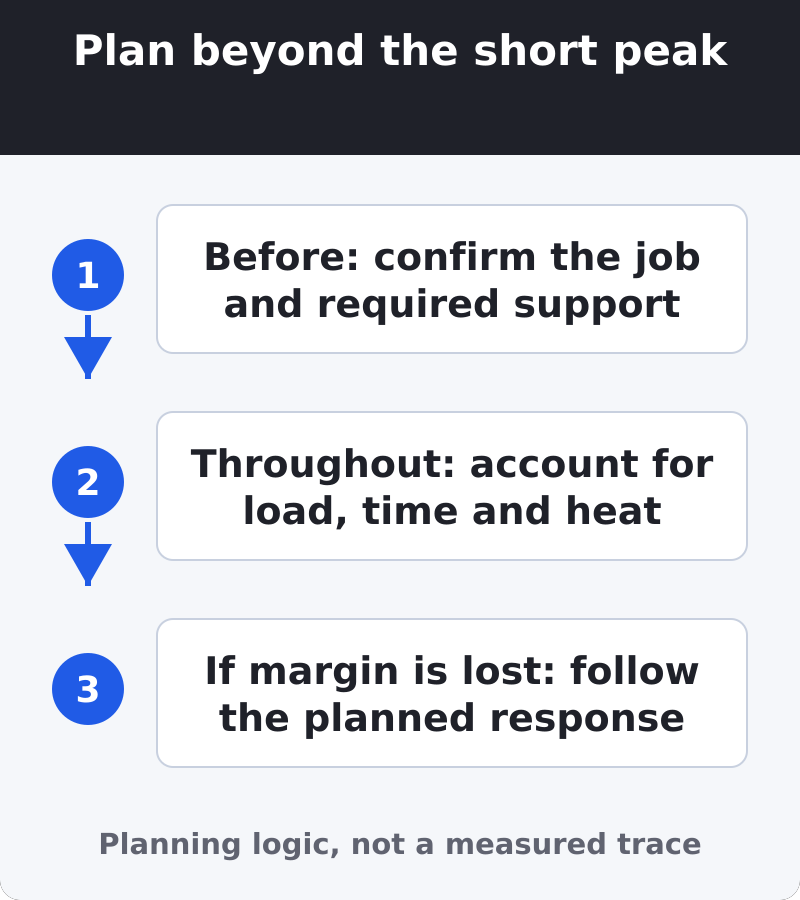
Read the diagram as a three-part decision sequence. Before the session, document the requirement and available margin. Throughout it, monitor the supply, vehicle state, elapsed time, and equipment condition. If margin is lost, follow the procedure’s stop or handoff rule rather than improvising. The diagram contains no measured Ocean values.
Stress-test the plan before the vehicle is connected
A short worksheet is more useful than a peak-current comparison. Record:
- the exact service procedure and revision;
- required support voltage and permitted variation;
- expected steady and transient demand;
- total duration and any phases that cannot be interrupted;
- ambient conditions, ventilation, cable condition, and connection losses;
- which vehicle loads the procedure permits the technician to control;
- how voltage, current, equipment temperature, and alerts will be watched; and
- the stop point if demand or equipment behavior leaves the documented range.
The AUTOOL EM385 combines programming support with a separate adjustable DC-supply function documented in the current manual, page 18. That flexibility can be valuable in a mixed workshop, but the selected function still has to meet the full-session requirement; its 150 A short-duration programming maximum is not a continuous-output guarantee.
Reduce avoidable vehicle loads only when the current procedure allows it. Switching a system off may lower demand, but changing vehicle state at the wrong time may also interrupt or invalidate the work. The service instruction, not a generic checklist, decides which actions are safe.
When the full-session requirement remains unknown
An unknown requirement is a stop condition, not an invitation to connect a supply and see what happens. Before approving equipment, the workshop needs a defensible answer for voltage, expected load, transient demand, duration, thermal margin, and the consequence of an interruption. It also needs to confirm the fitted 12 V battery, approved connection method, correct 110 V or 220 V unit, and a grounded mains circuit suitable for the delivered equipment.
If any of those inputs is missing, obtain the current Ocean procedure or use a workshop that can document the complete power plan. A charger mode should not be substituted for a regulated service-power mode simply because both operate on the low-voltage battery.
If one of these AUTOOL models is being considered after the job requirements are known, enter coupon code HCM6E4GZ at checkout and confirm that it is accepted and that the final total is correct before paying.
The sound decision is deliberately conservative: choose from the entire session, not from the largest number on the product page. Short-duration headroom is useful only when the supply also remains suitable through the longest, warmest, and least forgiving phase of the work.


Comments 0
Questions, fixes, and real-world diagnostic notes from readers.
Be the first to share a diagnostic result or ask a follow-up question.