
2009 Audi TTS P0300 With Smooth Running: What It Takes to Justify an ECU

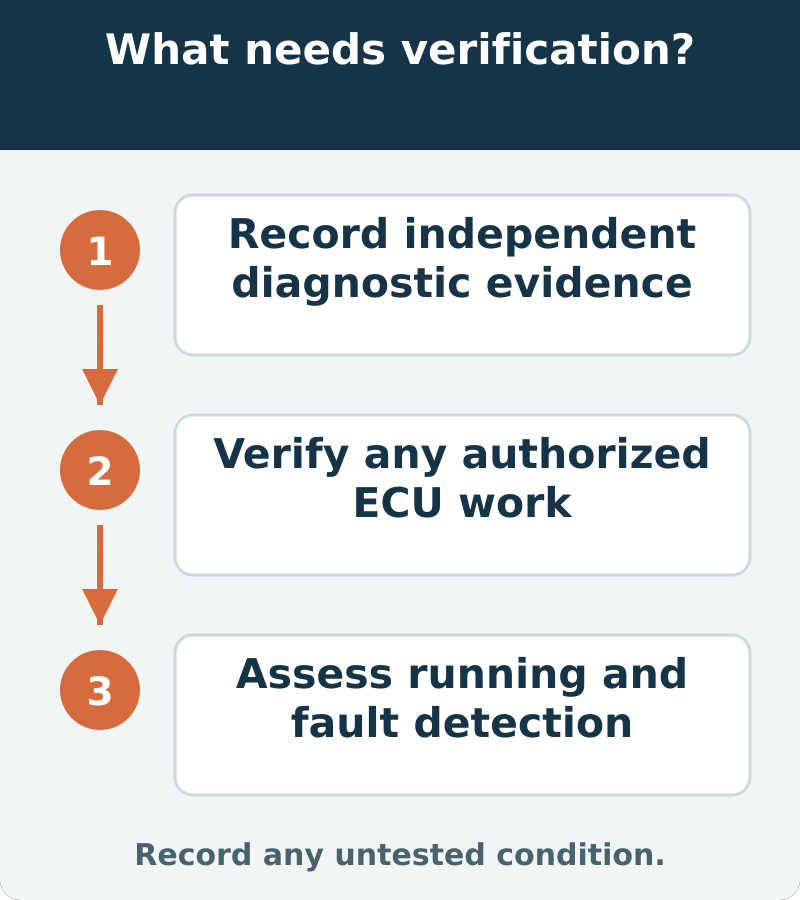
Quick answer: Smooth running does not rule out misfire, but a persistent mismatch between the warning and independent evidence deserves investigation. ECU replacement needs more than the absence of an obvious bad coil.
An ECU estimate deserves a higher standard than “we could not find a bad coil.” The supporting investigation includes its electrical requirements: a meter such as the AUTOOL DM301 can help with permitted passive supply checks. That limited role is not equivalent to the specialist signal, mechanical and substitution work behind this case.

In this guide
- A smooth engine is an observation, not a verdict
- What must be true before blaming the calculation
- The difference between a reassuring trace and a complete test
- Why the second vehicle strengthened the conclusion
- A replacement ECU has to match more than a plug
- Ask for the evidence that supports this car, not the anecdote
A smooth engine is an observation, not a verdict
An engine that feels smooth may still have a misfire that the driver does not notice. Do not dismiss a warning by ear, particularly a flashing malfunction indicator or a genuine operating concern. Obtain the appropriate assessment and safe-use advice.
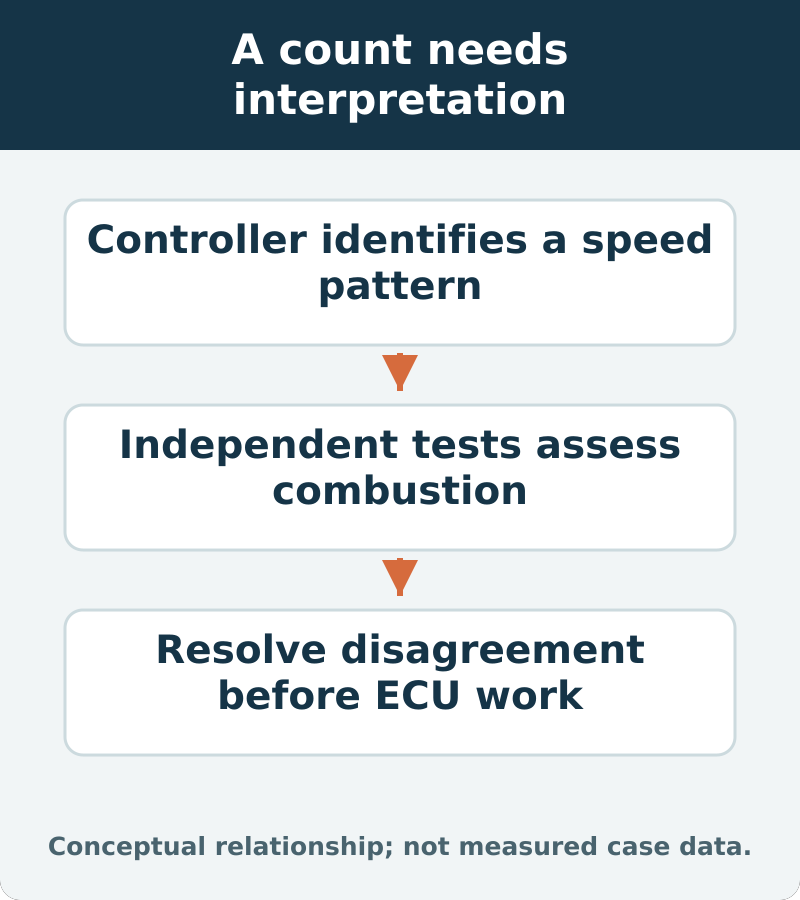
At the same time, a persistent disagreement between reported misfire information and independent observations is worth investigating. The right response is neither blind faith in one number nor a claim that the computer must be wrong. Ask which conditions produced the warning and what independent evidence was obtained. The task is to explain the mismatch, not select whichever observation makes the cheaper repair sound certain.
What must be true before blaming the calculation
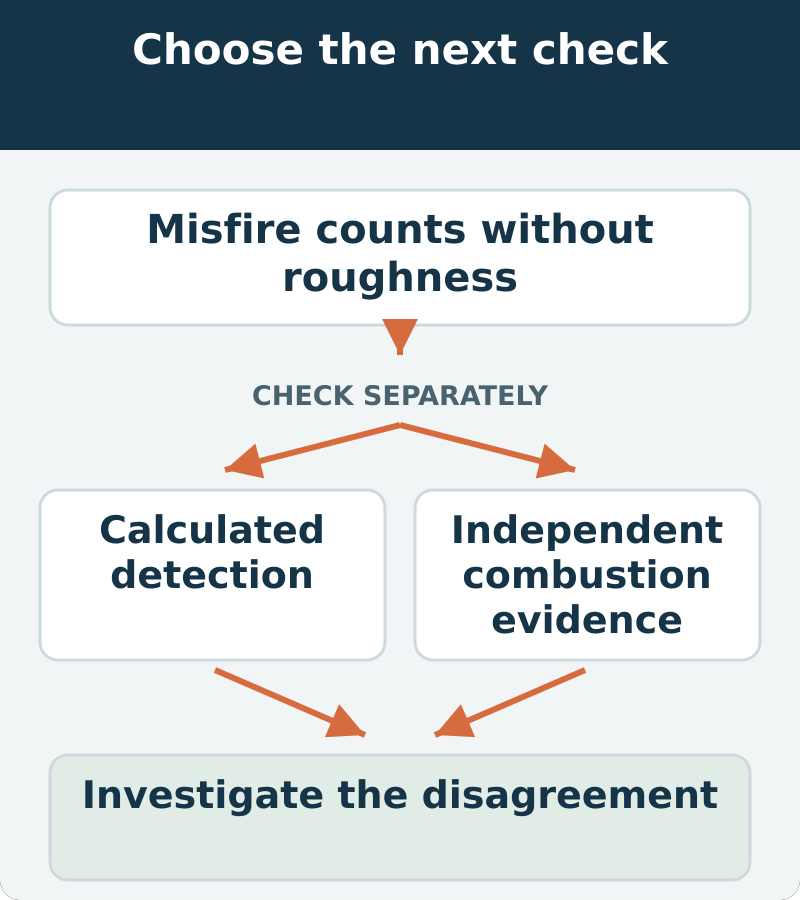
Before blaming the way a controller detects a condition, the repairer needs confidence in the inputs and relevant physical requirements. That includes understanding what the system uses and how the tests address the complaint. A parts list with several ignition items crossed off does not supply that explanation.
Ask the specialist to describe the reasoning in plain language: what would a real fault look like in the independent checks, and what did those checks show? This is not a demand that the owner interpret every trace. It is a request for the evidence connecting the controller decision to the actual vehicle, with remaining limitations acknowledged.
The difference between a reassuring trace and a complete test
A trace can look tidy while answering only a narrow question. The signal, capture conditions, comparison and test coverage determine what can reasonably be concluded. A satisfactory snapshot should not be promoted into proof that combustion and every supporting circuit are healthy under all conditions.
The illustration deliberately contains no measured waveforms. It maps independent lines of inquiry rather than imitating a specialist’s capture. Electrical supply checks, signal analysis and mechanical assessment are different capabilities. A basic meter may support one part of that work without replacing the equipment or expertise required for the complete investigation described by a specialist repairer.
Why the second vehicle strengthened the conclusion
A fault that changes with a controlled component substitution is more informative than a replacement followed by a single reassuring moment. If the suspected component also reproduces the concern in a properly prepared comparison, the evidence becomes stronger still.
That reasoning depends on control of compatibility, setup and other variables. It is not an invitation to borrow an ECU and connect it to another car. Security systems, configuration and electrical requirements make such work a specialist decision. The case-specific comparison strengthens the reported conclusion, but it does not establish how often this ECU fails across the population or diagnose a different TTS from its code alone.
In the published Professional Motor Mechanic case by Joshua Jones with Volkscraft, the TTS repeatedly logged random misfires while appearing smooth. Extensive signal and mechanical checks did not explain the counts. A specialist-prepared replacement ECU cured the complaint; the old ECU reproduced the fault in a second vehicle despite updated software. This is strong case-specific substitution evidence, not a common-failure claim.
A replacement ECU has to match more than a plug
Physical connector fit is only one requirement. The repairer must establish appropriate hardware, software, configuration and any required security-related work for the vehicle. Ask what the replacement proposal includes and who is responsible for completing it.
No cloning, immobilizer bypass or coding instructions are supplied here. An apparently inexpensive module can become an unsuitable purchase if its identity and setup requirements have not been established. Conversely, a complete specialist quote should explain why replacement is justified, not rely on the mystery of electronics to avoid discussing the evidence. The owner should understand both the diagnosis and the completion scope.
Ask for the evidence that supports this car, not the anecdote
Before approving the job, ask for the findings that support this car’s ECU decision and the plan to reassess the original warning afterward. If the explanation rests only on a similar online story, the burden of proof has not been met.
At handover, collect the relevant setup record and the reported operating result. Preserve any returning fault information rather than assuming it must be another false detection. This case offers an example of strong specialist evidence, not a shortcut to module replacement. The useful standard is a supported conclusion built from independent checks and a controlled result, with smooth running treated as one observation among several.








Comments 0
Questions, fixes, and real-world diagnostic notes from readers.
Be the first to share a diagnostic result or ask a follow-up question.