
2007 Dodge Ram P0456 With No Smoke Leak: The ESIM Was Installed in the Wrong Position

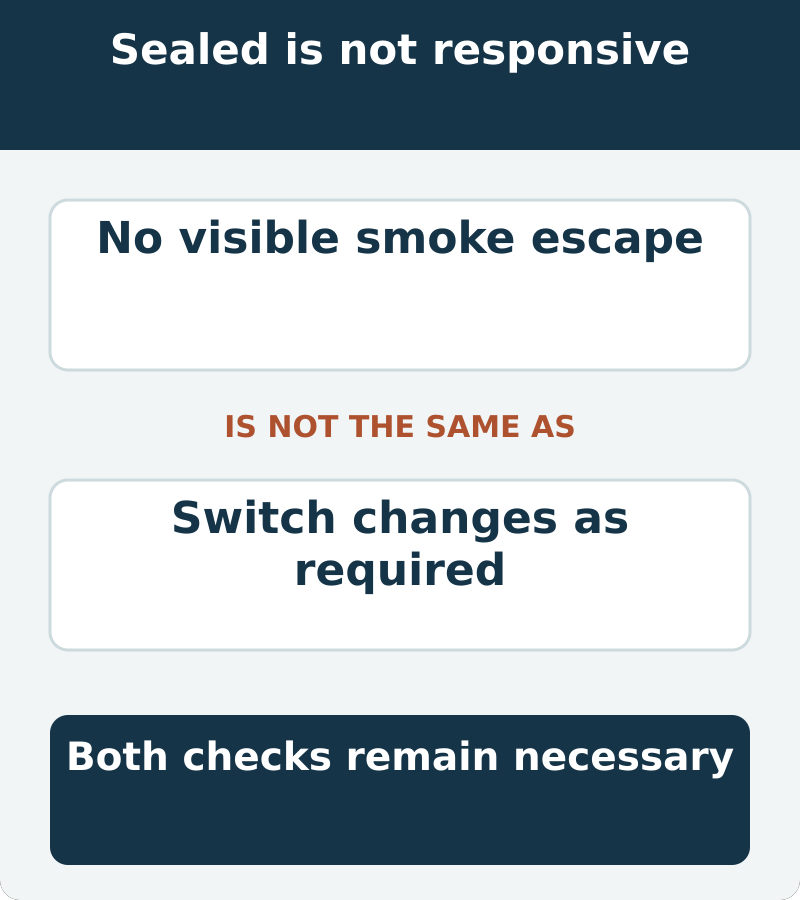
Quick answer: A sealed system and a working monitor are different checks. This Ram had no visible smoke leak, but the newly fitted ESIM could not switch correctly in its installed position.
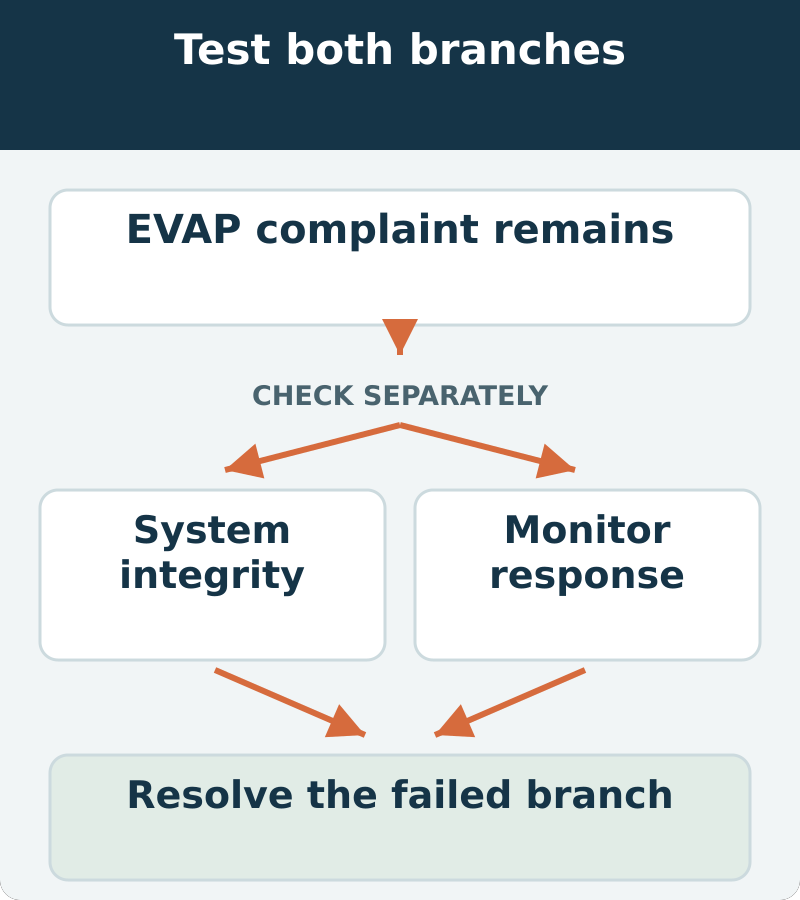
“No smoke came out” is a useful observation. It is not a complete answer to whether the evaporative-emissions system can perform its monitoring function. When a leak-code investigation follows recent component work, system integrity and component response deserve separate checks.
For the integrity check, choose equipment with the pressure control and adapters required by the vehicle. The relevant FXTUL smoke-machine options are one place to compare suitable equipment, but confirm the selected model’s EVAP-safe specification before use. A smoke machine does not itself prove that a monitor switch changes state correctly.
The reported vehicle was a 2007 Ram 1500 2WD, 4.7L. Use the service procedure for the exact canister and monitor arrangement. Fuel-vapor work requires suitable ventilation and ignition precautions; stop if there is a liquid-fuel leak or another unsafe condition.
In this guide
- No smoke leak is a result, not the whole diagnosis
- The new part that still needed an installation check
- What a leak test can answer
- What a switch-response test adds
- Check orientation against the exact canister drawing
- Retest the component before the drive cycle
- When a returning code needs a different branch
No smoke leak is a result, not the whole diagnosis
A test has a defined question. In a properly configured integrity test, the technician is looking for leakage in the tested path under the specified conditions. A negative result narrows that question without automatically validating every sensor, valve, mounting detail or monitoring operation.
Ask what was sealed, where equipment was connected and how the test was evaluated. “Smoke tested” is too vague if it does not distinguish preparation, test boundary and result. Do not increase pressure beyond the vehicle’s limit just because a suspected leak has not appeared.
The new part that still needed an installation check
In ALLDATA’s Ram report, an earlier ESIM replacement was followed by P0440 and P0456. Smoke testing found no visible leak and the purge valve passed its check, but the monitor switch failed to close. Its installed orientation was wrong. Correct mounting restored switch response and the subsequent EVAP-cycle verification was code-free.
The lesson is an installation check, not a universal clock-position instruction. Viewing direction and the actual assembly matter.
What a leak test can answer
It can help locate an escape path when equipment, preparation and conditions are appropriate. Its usefulness depends on those conditions, so a technician should record more than whether smoke was seen.
A result from one setup should not be promoted to “all possible leaks excluded.” If evidence later points back to leakage, review the original setup and applicable procedure before deciding whether repetition is justified. A reasoned repeat test is different from repeatedly running the same test without a new question.
What a switch-response test adds
The monitoring component must provide the response required by its design. The technician therefore needs the applicable switch test, expected state and conditions that should produce the transition. This is a separate check from looking for escaping smoke.
Do not borrow an ambiguous vacuum number from a brief online case or connect an improvised pressure source. The exact service procedure controls the permitted stimulus and observation. A failure to change state still needs interpretation: component, installation, connection or test setup may need to be distinguished.
Check orientation against the exact canister drawing
Review the installed assembly against the correct service illustration, including the viewpoint and retaining features. “Turn it to three o’clock” is incomplete advice when the reader does not know which side of the component is being viewed.
Ask whether the monitor is the correct application, properly seated and retained, and whether the nearby connections were restored as required. These are ordinary installation checks, not an accusation against the previous technician. Recent work simply makes a careful comparison especially useful.
Photograph the completed installation if it can be done safely. The picture can document placement; it cannot replace a functional response test.
Retest the component before the drive cycle
First verify the required response under the prescribed component test. Then complete the applicable system and monitoring checks. A monitor drive should not be used to compensate for a known component test that still fails.
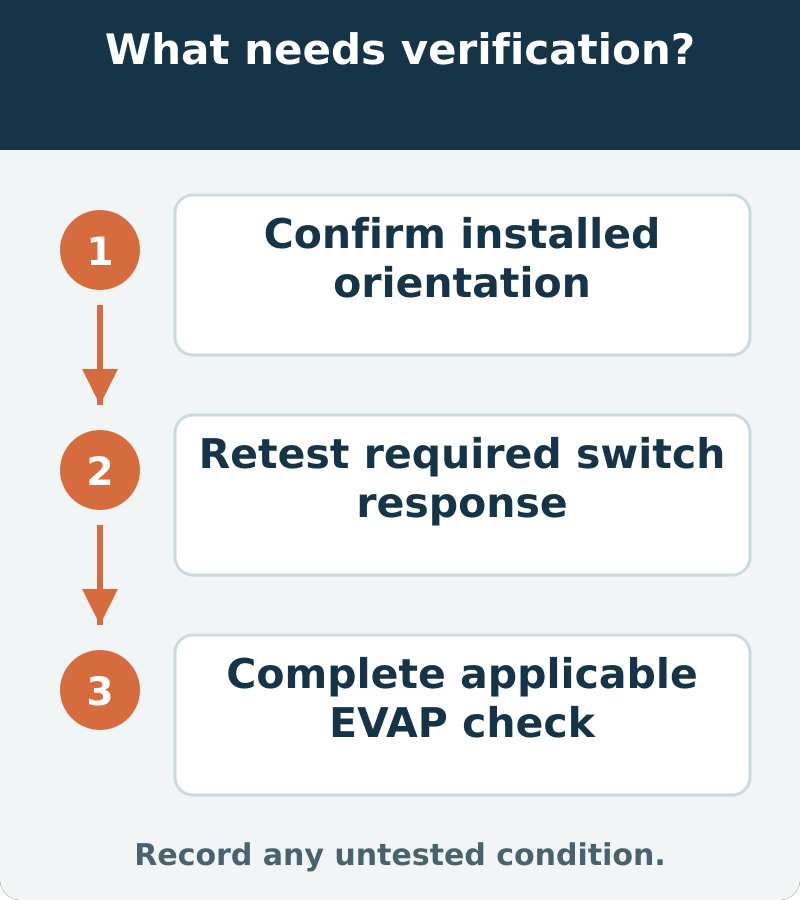
Enable conditions vary. Do not promise that a fixed number of miles will complete the EVAP check, and do not ask a driver to follow an unsafe road recipe while watching a scanner. The shop should identify what completion looks like on the vehicle.
When a returning code needs a different branch
Preserve the new status and test conditions before clearing information. Determine whether integrity evidence, component response or monitoring completion has changed. The same code number does not guarantee the same underlying failure.
For comparison, our 2014 Ram P0456 case involving a damaged ESIM signal wire follows a different electrical branch after negative smoke testing. It concerns a different vehicle; its wiring details are not instructions for this 2007 installation.
The most useful repair record contains both answers: what the tested path did and what the monitor did. Keeping those separate prevents “no visible leak” from prematurely ending an investigation that still has a functional question to solve.







Comments 0
Questions, fixes, and real-world diagnostic notes from readers.
Be the first to share a diagnostic result or ask a follow-up question.