
2026 Enclave, Traverse or Acadia P0299? Inspect the Turbo Wastegate Lever

P0299? Check The Wastegate Lever
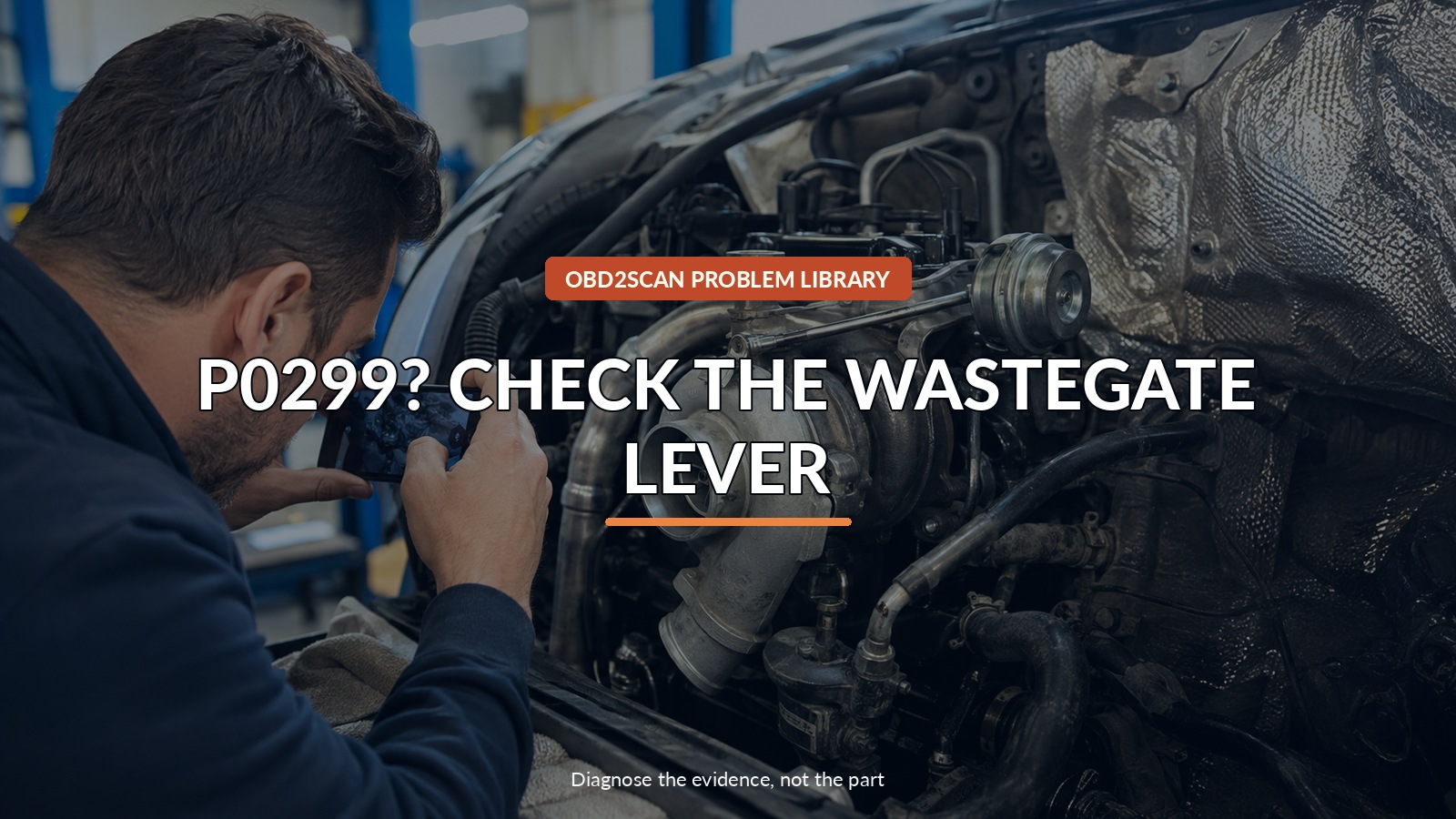
Save the freeze-frame and avoid full-load driving if power is reduced. GM first directs technicians to verify fuel level through bulletin 25-NA-227, then inspect whether the wastegate lever is bent. A bent lever leads to turbocharger replacement. If fuel was not low and the lever is straight, continue the P0299 path in Service Information; PIP6130 says replacement may follow only when that diagnosis does not lead to another repair. A visual check is a gate, not proof that every underboost code needs a turbo.
Because the lever can be difficult to see from a repeatable angle, a flexible inspection camera can help capture its geometry after the turbocharger is cool and the approved access route is open. An AUTOOL SVB305 can support that visual record. SVB305 can help document a reachable wastegate lever or housing relationship from a repeatable angle after the engine is cool and access is approved; it cannot measure boost, identify internal turbo efficiency, declare a subtle lever bend against no reference, perform SI diagnostics or authorize turbocharger replacement.
This underboost diagnosis begins with two checks that cost less information than replacing a turbo: the fuel-level prerequisite and the shape of one lever. Only after those gates are handled does GM’s normal P0299 tree decide whether the rest of the air, control or turbo system needs work.
Quick answer: Save P0299 freeze-frame data, complete GM’s fuel-level prerequisite and inspect a cooled wastegate lever from a valid reference angle before replacement.
In this guide
- Save the P0299 freeze-frame first
- Confirm the 2.5L LK0 application
- Complete the fuel-level prerequisite
- Let the turbo cool before inspection
- Compare the wastegate lever with a known straight view
- Replace the turbo only for confirmed damage
- Return to full SI diagnosis if the lever is straight
- Road-test under the original load after repair
Save the P0299 freeze-frame first
Save P0299 before clearing it. Record whether it is current or history, the engine speed, load, requested and actual boost or manifold pressure, throttle position, barometric pressure, fuel level and temperatures present when it set. Note reduced-power messages, whistle, smoke and recent fueling. Avoid repeated full-throttle tests if power is limited, the engine makes abnormal noise or oil/coolant evidence appears. Underboost is a measured disagreement, not a turbocharger part number. The freeze-frame tells the next technician whether the fault occurred during real boost demand or under conditions that may redirect the diagnosis.
Confirm the 2.5L LK0 application
PIP6130 is narrowly scoped to 2026 Buick Enclave, Chevrolet Traverse and GMC Acadia vehicles equipped with the 2.5L LK0 engine in North America. Confirm the VIN, engine RPO and latest bulletin revision. Similar P0299 codes on other engines or model years do not inherit this replacement direction. Inspect service history for collision work, turbo removal, charge-pipe disturbance or software updates. Before touching the wastegate, perform a complete visual check for loose ducts, damaged wiring, oil supply concerns and obvious exhaust leaks that might make a hard-load road test unsafe.
Complete the fuel-level prerequisite
GM first instructs the technician to verify fuel level using bulletin 25-NA-227. Follow that bulletin as a prerequisite rather than assuming the dash gauge or freeze-frame alone settles it. Record actual and reported fuel state, correct a low-fuel condition as directed and then reevaluate. The reason a prerequisite exists is to prevent a known operating condition from contaminating the underboost decision. Do not jump past it because a bent lever sounds more tangible. If the fuel level branch explains the code, verification belongs there; it does not automatically become a turbo fault as well.
Let the turbo cool before inspection
Let the turbocharger and exhaust cool before placing hands or a camera nearby. Support the vehicle correctly, remove only the shields or ducts permitted by Service Information and protect connectors from damage. Look at the wastegate lever from the specified viewpoint with enough light to show its whole length and both joints. Preserve a wide orientation image before a close-up. A hot housing can burn skin long after a short drive, while forcing a camera between hot moving parts can damage both the vehicle and the tool. Visual evidence is useful only when collected safely.
Compare the wastegate lever with a known straight view
Compare the lever with GM’s known bent example or a verified straight reference for the same assembly and camera angle. Look for a kink, bow, altered joint alignment, interference or a compressor housing position that appears misaligned relative to the rest of the turbocharger. Perspective can make a straight arm look curved, so take a second view rather than relying on a wide-angle close-up. Do not pry the arm to ‘test’ it or use actuator movement to hide damage. Record the untouched geometry and ask whether the image would let another technician reach the same conclusion.
| Gate | What decides the next move |
|---|---|
| Fuel-level prerequisite | Complete 25-NA-227 before judging the turbo |
| Lever visibly bent from a valid angle | Follow GM’s turbocharger replacement direction |
| Lever straight and fuel not low | Complete the full SI P0299 diagnostic tree |
| SI finds no other repair | Use the current bulletin’s final assembly branch |
Replace the turbo only for confirmed damage
If the wastegate lever is confirmed bent, PIP6130 directs turbocharger replacement. Follow current Service Information for fluids, fasteners, oil priming, charge connections and any required learning procedure. Document the damaged lever in place and the new assembly from the same viewpoint. Replacement should answer a proven physical condition, not merely clear P0299. Inspect connected ducts and fasteners during the repair so an installation leak does not create the same code afterward. Keep foreign material out of the intake, exhaust and oil passages at every stage.
Return to full SI diagnosis if the lever is straight
If fuel was not low and the lever is straight, return to the full P0299 diagnostics in Service Information. Compare commanded and actual boost, inspect charge-air plumbing under an approved leak test, verify sensor rationality, actuator command/feedback, intake restriction and exhaust conditions. GM says that if SI does not lead to another repair, turbocharger replacement may then follow; that is the end of a documented elimination path, not permission to skip it. A borescope image cannot measure compressor efficiency or prove that every control valve and hose is sealed.
Road-test under the original load after repair
After the actual repair, clear codes as permitted and repeat the drive condition represented by freeze-frame with safe monitoring. Compare requested and actual boost, confirm normal power and check for leaks, abnormal sound or P0299 pending return. Match load, temperature and fuel state closely enough for the test to mean something. The repair record should name the path: low-fuel prerequisite, visibly bent lever, another SI-proven fault or SI exhaustion leading to assembly replacement. That gives the owner an answer stronger than ‘underboost, installed turbo.’
P0299 tells the driver that expected boost was not delivered; it does not explain why. Stop hard driving if power is reduced, smoke appears or the turbo makes abnormal noise. On these 2026 LK0 crossovers, the disciplined order is fuel-level prerequisite, cooled visual inspection, then the full factory underboost path. A camera can make the lever evidence shareable, but only the correctly framed checks can justify the repair and a matched-load road test can close it.





Comments 0
Questions, fixes, and real-world diagnostic notes from readers.
Be the first to share a diagnostic result or ask a follow-up question.