
2008–2014 VW P0171 or P119A With an Oil Leak? Smoke-Test the Crankcase Safely

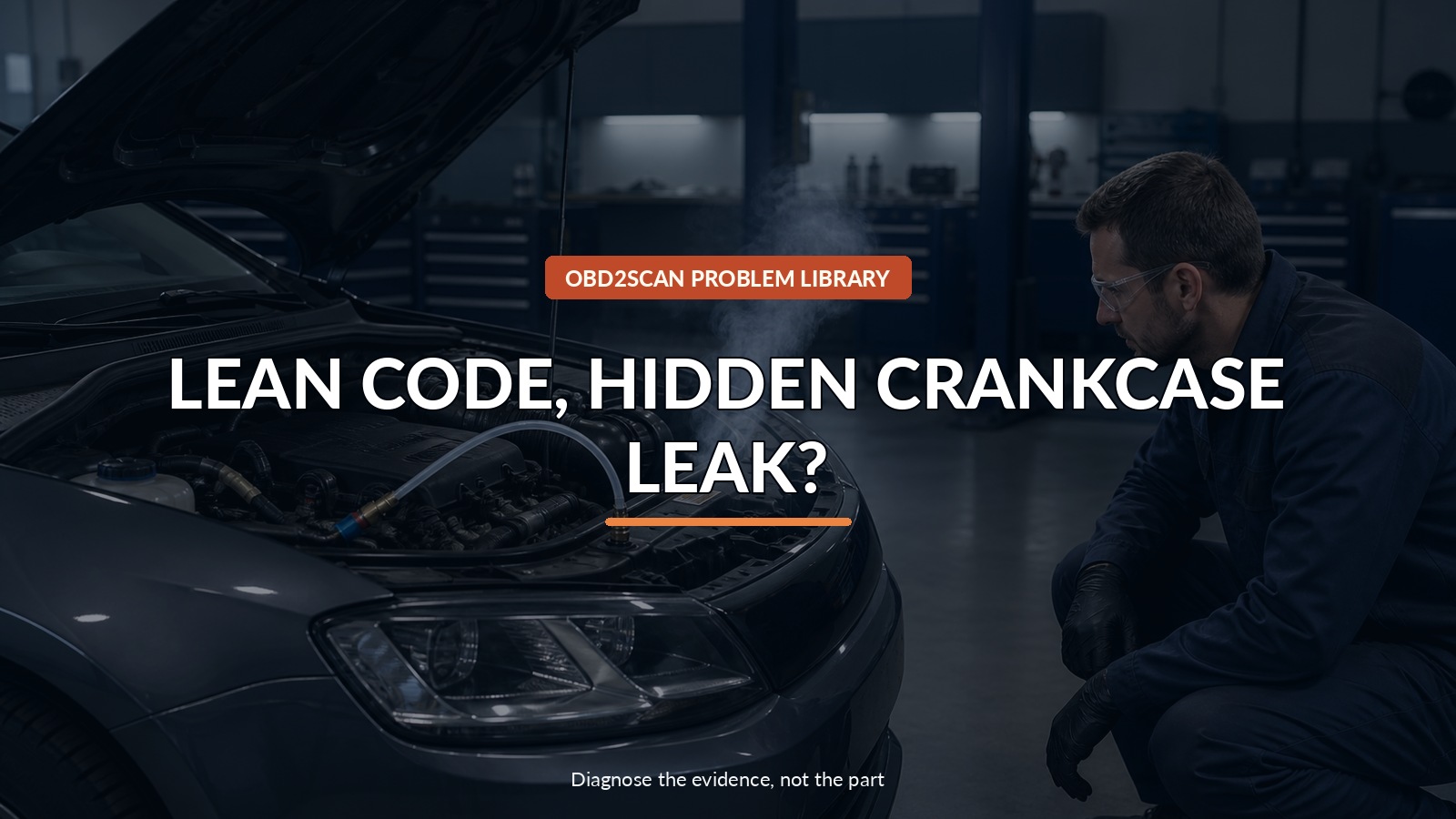
Lean Code, Hidden Crankcase Leak?
On the specified 2008–2014 Volkswagen models, P0171 or P119A plus oil at the engine-to-transmission seam can describe a leak that the fuel-trim monitor feels through the crankcase. The correct question is not “Which oxygen sensor should I buy?” It is whether crankcase vacuum is abnormal and whether a carefully pressure-limited smoke test reveals the rear main seal or another crankcase opening.
A smoke machine can make an otherwise invisible leak path visible, but this Volkswagen procedure has a non-negotiable pressure boundary. The AUTOOL SDT103 automotive smoke machine can supply smoke only when a separate verified regulator and gauge keep the crankcase at or below the published 2 psi. Its unrestricted output must not be applied blindly; it cannot interpret fuel trims, prove a rear main seal from an oil stain, or test breather operation by itself.
Volkswagen Tech Tip 01-14-01 deliberately pairs two witnesses: compare crankcase vacuum at the dipstick tube, then use low-pressure smoke to find where the crankcase fails to hold. Shop air is explicitly prohibited.
Quick answer: Compare crankcase vacuum, inspect the engine/transmission seam, then smoke the crankcase through the specified route at no more than 2 psi—never with shop air.
In this guide
- Read P0171 and P119A as a system imbalance
- Confirm the six-model applicability fence
- Use crankcase vacuum as the first filter
- Inspect the engine-to-transmission seam
- Limit smoke to the published pressure
- Separate a rear-seal leak from breather trouble
- Leave this branch when the crankcase holds
- Recheck vacuum and trims after the repair
Read P0171 and P119A as a system imbalance
Save current, pending, and permanent codes with freeze frame. Record short- and long-term fuel trims at warm idle and at a steady raised rpm, measured air data, commanded lambda, crankcase noise, oil consumption, idle quality, and whether removing the oil cap changes the sound or idle. Do not use cap removal as a universal pass/fail test.
A lean code means the control system reached a correction threshold under monitored conditions. Intake leaks, crankcase leaks, low fuel delivery, incorrect air measurement, exhaust leaks ahead of a sensor, injector issues, and calibration conditions can overlap. P119A context also depends on the exact Volkswagen engine and service definitions.
Confirm the six-model applicability fence
The Tech Tip lists 2008–2014 Tiguan, Passat, CC, Jetta, Golf, and Eos applications. Confirm full VIN, engine code, crankcase ventilation design, previous rear-seal or breather work, oil specification, and the latest Volkswagen diagnostic plan.
Do not copy a dipstick connection or known-good vacuum value from a different engine. The bulletin’s relative comparison assumes a valid known-good vehicle or current specification. A similar lean code on a newer Volkswagen can still benefit from system reasoning, but it does not inherit this exact shortcut.
Use crankcase vacuum as the first filter
Install the correct low-range vacuum instrument at the dipstick tube as specified, with the engine fully warm and stable. Note units, idle speed, oil cap and dipstick sealing, ambient conditions, and test-adapter integrity. Compare with same-engine known-good data rather than a generic internet number.
| Result | What it earns | What it does not prove |
|---|---|---|
| Vacuum lower than a valid comparison | Inspect for crankcase leakage and justify low-pressure smoke | Rear main seal failure by itself |
| Vacuum unusually high | Investigate breather regulation/restriction under exact service data | That every seal is intact |
| Vacuum comparable and stable | Reconsider intake, fuel, exhaust, sensor, and calibration branches | That no intermittent crankcase leak exists |
| Reading changes with a sealing correction | Recheck the adapter and service openings | A vehicle repair |
One number without units, engine state, and comparison is not actionable evidence.
Inspect the engine-to-transmission seam
With the vehicle safely supported, look for the highest fresh oil trace between engine and transmission. Note engine-oil level, dye history, oil pan and upper-engine leaks, and whether oil has been blown rearward. Clean only after as-found photographs are saved.
An oily seam raises the rear-main-seal question, but it does not answer it. Oil can travel from above, prior service can leave residue, and transmission fluid can be mistaken for engine oil. Identify fluid and source path before planning transmission removal.
Limit smoke to the published pressure
Volkswagen says to connect the EVAP smoke machine through the dipstick tube in a way that limits crankcase pressure to 2 psi and warns not to apply shop air. Verify the regulator independently, watch a low-range gauge continuously, and begin at the lowest practical pressure. Block or leave openings only as the exact procedure directs.
Stop the test immediately if pressure control is unstable or smoke appears somewhere unsafe. Never improvise with unregulated air, plug every vent indiscriminately, or walk away from a pressurized crankcase. Excess pressure can dislodge seals and create the failure being investigated. Work on a cool, stationary vehicle with ignition control and smoke fluid appropriate for the machine and application.
Separate a rear-seal leak from breather trouble
Smoke appearing repeatably at the rear main seal, aligned with the oil path and abnormal vacuum, supports that leak location. Smoke at a cap, dipstick adapter, hose, cover, or breather joint changes the branch. Correct the actual escape point and re-run the same proof pair.
If the rear seal leaks, Volkswagen directs replacement under the proper repair procedure. If crankcase vacuum remains low afterward, the Tech Tip says to check additional oil leaks and verify crankcase-breather operation. One found leak does not guarantee it is the only one.
Leave this branch when the crankcase holds
When the crankcase holds the specified low pressure, vacuum matches valid comparison data, and no oil path supports a seal leak, return to the rest of the lean-code tree. Compare trims at idle and rpm, test intake integrity, validate air measurement, examine low-side and high-side fuel delivery where applicable, and check exhaust leakage and sensor plausibility.
Do not raise smoke pressure to force a result. A negative correctly performed test is useful because it redirects the diagnosis.
Recheck vacuum and trims after the repair
Reassemble every hose, dipstick seal, cap, ground, and connector. At the same temperature and idle state, repeat crankcase vacuum and confirm no smoke escape at the repaired location. Erase faults only after preserving the original data, then complete the Volkswagen-specified road test; the Tech Tip calls for a 10-mile recheck.
Compare warm-idle and raised-rpm trims, idle stability, oil leakage, and returning code status. A dry seam alone is incomplete verification if the crankcase vacuum and fuel correction remain abnormal.



Comments 0
Questions, fixes, and real-world diagnostic notes from readers.
Be the first to share a diagnostic result or ask a follow-up question.