
Volvo P1 Explained: C30, S40, V50, and C70 Parts Fitment Starts Here

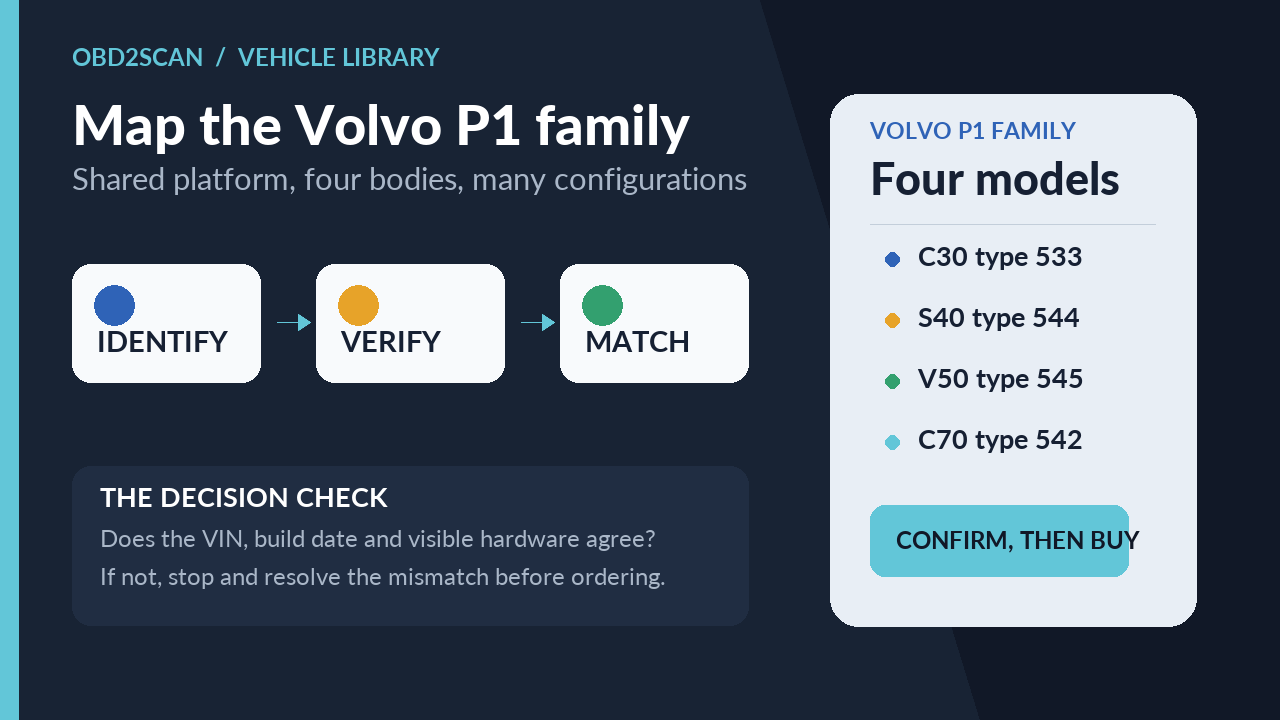
Volvo P1 is the shared compact-vehicle family behind the second-generation S40, V50, C30, and second-generation C70. Volvo service information identifies them as type 544, 545, 533, and 542 respectively. That shared architecture is useful for understanding repair patterns, but body, engine, transmission, brakes, suspension, market, and build date still decide parts fitment.
Fast answer
- S40 type 544 covers model years 2004–2012 in Volvo’s U.S. service mapping; V50 type 545 covers 2005–2012.
- C30 type 533 covers 2007–2013; C70 type 542 covers 2006–2013.
- A shared P1 label does not make C30, sedan, wagon, and retractable-hardtop body parts interchangeable.
- Record engine, transmission, front-/all-wheel drive, brake size, suspension, production date and original part number.
In this guide
1. Use Volvo’s model and type map
| Model | Volvo type | U.S. service-information model years | Body |
|---|---|---|---|
| S40 | 544 | 2004–2012 | Four-door sedan |
| V50 | 545 | 2005–2012 | Wagon |
| C30 | 533 | 2007–2013 | Three-door hatchback |
| C70 | 542 | 2006–2013 | Retractable-hardtop convertible |
These ranges come from Volvo’s own U.S. service-manager model chart. They are more precise than an online seller’s phrase “P1 2004–2013,” which hides the fact that each body entered and left the market at a different time.
The type number is especially useful when catalog or service documents use it instead of the retail model name. Record both: “C30, type 533,” not one or the other.
2. What the P1 relationship does mean
The cars share a compact architecture and can share engine families, transmissions, front suspension concepts, steering, brakes, climate components, electronics, fasteners, and diagnostic approaches in particular configurations. This makes cross-model research valuable. A well-documented S40 repair may reveal access or test logic relevant to a V50 with the same engine and equipment.
It also explains why suppliers list one part across several P1 models. That cross-listing can be correct when the OEM part number and catalog application agree. The shared family is a reason to investigate—not permission to skip the VIN check.
3. What the P1 label does not make interchangeable
The S40 sedan, V50 wagon, C30 hatch, and C70 convertible have different structures behind their shared front-end concepts. Doors, roof, glass, hatch/trunk, rear lamps, interior trim, seats, restraints, exhaust sections, rear wiring, cargo hardware, and body seals follow the individual model.
The C70’s retractable hardtop adds roof hydraulics/electronics, structure, drainage, alignment, and rear-compartment packaging that the other P1 cars do not have. A C30’s glass hatch and rear lamp arrangement are similarly body-specific. Even a front component can vary with bumper style, headlamp system, parking sensors, headlamp washers, or model update.
Shared engine family is not identical engine fitment
Engine designation, turbo/non-turbo version, emissions market, transmission, all-wheel drive, accessory package, and production split can change mounts, hoses, wiring, sensors, cooling and exhaust parts.
4. Identify the configuration that matters
- Engine: exact engine code and emissions family, not only “2.4,” “T5,” or “five-cylinder.”
- Transmission: manual or automatic and the exact gearbox code; fluid and clutch/torque-converter decisions depend on it.
- Drivetrain: front-wheel drive or all-wheel drive, including angle gear, propeller shaft, rear differential, tank, exhaust and rear suspension implications.
- Brakes: measure rotor diameter/thickness and identify caliper and wheel clearance. P1 models and trims can use more than one package.
- Suspension: body/axle load, sport calibration, self-leveling equipment where applicable, spring markings, and installed aftermarket parts.
- Climate system: compressor and clutch configuration, refrigerant label, control strategy and production split. The P1 intermittent A/C clutch guide applies only after the matching system is verified.
For timing-belt work, identify the exact engine and service interval source before applying the Volvo P1 timing-belt and water-pump guide. “P1” alone cannot provide a belt kit.
5. Use P1 knowledge to buy better, not broader
Search first by model/type, then filter by VIN, build month, engine code, transmission, drivetrain and the subsystem option. Read the old part number when a catalog returns multiple choices. Confirm whether Volvo has superseded it and whether a kit includes single-use hardware, seals, or companion parts required by current service information.
For used parts, ask for the donor model/type, VIN, engine/transmission, part-number label and connector photos. A listing that says “fits all P1 Volvos” should be treated as unverified until the OEM application supports it. The useful final description is “2009 C30 type 533, T5 engine code verified, six-speed manual, FWD, brake size measured,” not “Volvo P1.”
Official sources used for this guide
- Volvo Service Manager Bulletin 00-013 — Volvo Car USA / NHTSA
- P1 — C30, C70, S40, V50 Service Information — Volvo Car USA / NHTSA
- Volvo C30 Introduction — Volvo Cars Media US
- Volvo V50 and S40 Relationship — Volvo Cars Media US
What a successful identification looks like
You can state the market, VIN-confirmed model and body, production date, engine, drivetrain, and the equipment relevant to the job. The catalog result and the hardware on the vehicle agree, and the supplier can confirm a current part number for that exact record.








Comments 0
Questions, fixes, and real-world diagnostic notes from readers.
Be the first to share a diagnostic result or ask a follow-up question.