
Buick or Chevrolet A/C Loses Dash Airflow After 30 Minutes? Check for Evaporator Ice

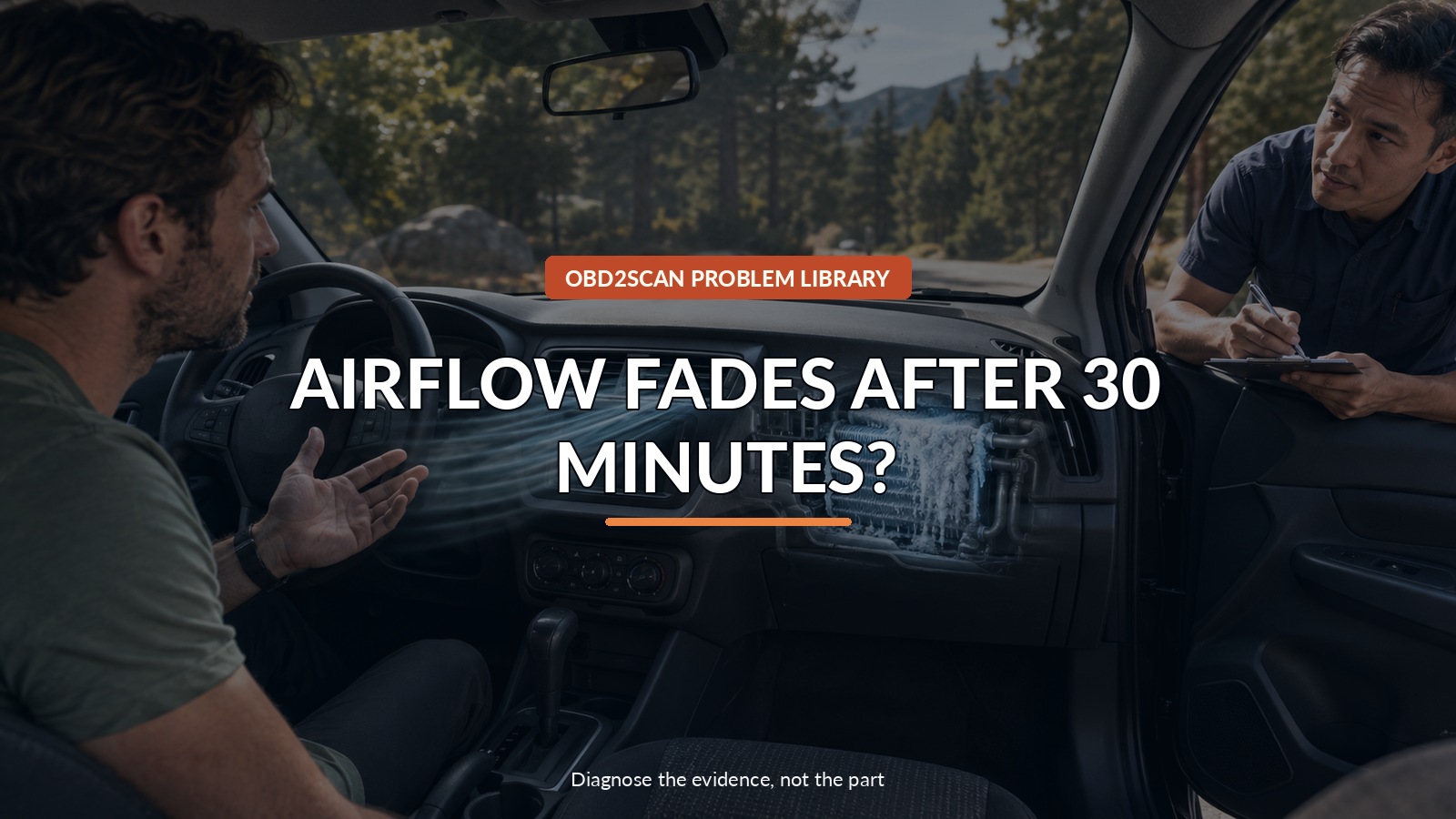
Airflow Fades After 30 Minutes?
When the fault appears, note whether the blower can still be heard, whether airflow—not just temperature—has collapsed, and whether airflow returns after the system is switched off long enough to thaw. GM says the scoped crossovers may ice the evaporator after more than 0.5 hour of continuous driving. A shop should verify the exact refrigerant capacity; if charge is low, find the leak. If capacity is correct, GM currently says no further repair attempts should be made while engineering investigates.
During a controlled shop test, a manifold that shows both refrigerant pressures and paired line temperatures can help a trained technician describe what the system is doing before and after airflow fades. A MRCARTOOL L505 can support that observation on a compatible system. L505 can display high- and low-side pressure plus paired temperatures on a compatible refrigerant system when a trained technician follows the correct refrigerant and service procedure; it cannot recover or weigh the charge, see ice inside the HVAC case, identify the root calibration issue, repair the investigated condition or make refrigerant handling safe by itself.
The most useful sentence a driver can offer here is not ‘the A/C quit’; it is ‘I could still hear the fan, but almost no air came from the vents.’ That distinction, combined with a half-hour timeline and recovery after thawing, points toward a blocked evaporator rather than an immediately failed blower or a simple warm-air complaint.
Quick answer: Separate lost airflow from lost cooling, time the extended drive and thawed return, then verify refrigerant by recovered mass before further repair.
In this guide
- Decide whether cooling or airflow disappeared
- Record the 30-minute trip timeline
- Use thaw-and-return behavior as a clue
- Confirm the covered crossover and HVAC RPO
- Verify refrigerant capacity by recovered mass
- Find a leak if the charge is low
- Stop parts replacement when the charge is correct
- Build a useful dealer handoff while GM investigates
Decide whether cooling or airflow disappeared
When the symptom appears, separate temperature from volume. Put a hand near two dash outlets without obstructing them and note whether the air is still cold but weak, warm but strong, or nearly absent while the blower remains audible. Try a different blower speed and outlet mode once, then stop changing settings. GM’s condition is a major loss of airflow caused when ice blocks air across the evaporator. If the blower itself becomes silent, only one mode fails or air remains strong but warm, save those facts—they lead to different electrical, door-control or refrigerant branches.
Record the 30-minute trip timeline
Build a short trip diary. Record the vehicle, outside temperature, humidity if known, chosen cabin temperature, recirculation setting, blower setting and time from A/C start until airflow falls. GM describes continuous driving longer than 0.5 hour, so a fault that appears in three minutes is not the same pattern. Note road speed and whether rain or defog mode was involved. Photograph condensation or frost only where it can be seen safely; never look under the dash while driving. A repeatable 35-minute highway event gives the shop a far better target than ‘sometimes in summer.’
Use thaw-and-return behavior as a clue
A useful clue is what happens after the refrigeration system rests. Park safely and switch the A/C compressor off according to the vehicle controls while allowing the car to sit; do not pour hot water into the HVAC case. If normal airflow gradually returns after ice melts, record the rest time and any water discharge beneath the vehicle. Recovery supports an icing hypothesis but does not prove why ice formed. A blower connection can also recover with vibration or cooling. The full pattern—audible blower, collapsed volume, extended run and thawed return—is what earns the evaporator branch.
Confirm the covered crossover and HVAC RPO
PIC6660 covers 2024–2026 Buick Encore GX and Envista, plus Chevrolet Trailblazer and Trax, in North America with HVAC RPO C60, C67, C68 or CJ2. Confirm VIN, equipment and bulletin status rather than applying it to every GM crossover. Scan the HVAC, engine and body modules, inspect the cabin filter and verify blower operation and mode-door travel. A plugged filter, weak blower, icing sensor circuit or door fault can mimic low outlet volume. Preserve all codes and do not erase the long-drive condition with a short idle-only performance check.
| What changes after the long drive | More useful direction |
|---|---|
| Blower quiet or inoperative | Start with blower power/control diagnosis |
| Strong airflow but warm air | Diagnose cooling performance and charge normally |
| Blower audible, airflow collapses, returns after rest | Document evaporator icing pattern |
| Refrigerant mass is low | Locate and repair the leak before recharge |
| Mass correct + scoped pattern | Record it and follow GM’s current stop rule |
Verify refrigerant capacity by recovered mass
GM’s first correction step is to verify that the system contains the correct refrigerant capacity. That means recover and weigh the charge with approved equipment, identify the refrigerant and compare the measured amount with the exact underhood/service specification. Pressure alone cannot state the mass in the system; ambient conditions and airflow change it. Observe high/low pressure and line temperatures as context, but do not top off by pressure. Refrigerant work requires trained handling, ventilation, eye protection and equipment that prevents release to the atmosphere.
Find a leak if the charge is low
If recovered charge is low, follow Service Information to find the leak before restoring capacity. Inspect oil/dye evidence where approved and test the entire accessible circuit, including service ports, condenser, connections, compressor, lines and evaporator drain evidence. Repair the confirmed source, renew seals correctly, evacuate and charge by exact mass. A low system can alter evaporator temperature behavior, yet adding refrigerant without locating the loss only resets the clock. Give the owner recovered amount, leak location, repair and installed amount so a future recurrence can be judged instead of guessed.
Stop parts replacement when the charge is correct
If the charge is correct and the vehicle matches the scoped ice-over pattern, GM’s August 2026 preliminary information says no further repair attempts should be made while engineering investigates. That is an important stopping rule. Do not replace a blower, sensor, expansion device, evaporator or control module simply to show activity. Check for a newer bulletin or calibration on the day of service, document the verified symptom and return path, and discuss practical operation with the customer without presenting it as a permanent repair. The current publication says the investigation is ongoing.
Build a useful dealer handoff while GM investigates
A strong dealer handoff fits on one page: VIN and HVAC RPO, ambient conditions, exact drive time, audible-blower observation, outlet-airflow change, rest time to recovery, all-DTC report, recovered refrigerant mass and the current bulletin check. A short passenger video can show the high blower sound alongside a tissue barely moving at the outlet, provided it is recorded safely. Ask the adviser to attach that evidence to the repair order. If GM later releases a correction, the owner then has a documented qualifying pattern rather than beginning another ‘could not duplicate’ visit.
For this complaint, the owner’s timeline is diagnostic equipment. Listen for the blower, describe the lost airflow, time the trip and record the thawed recovery. The shop must then verify charge by recovered mass. Low charge leads to a leak search; correct charge and a matched PIC6660 pattern currently lead to documentation and a pause, not a cart full of speculative HVAC parts.




Comments 0
Questions, fixes, and real-world diagnostic notes from readers.
Be the first to share a diagnostic result or ask a follow-up question.