
BMW K1200 or K1300 Will Not Start Hot? Compare It With the Cold Restart

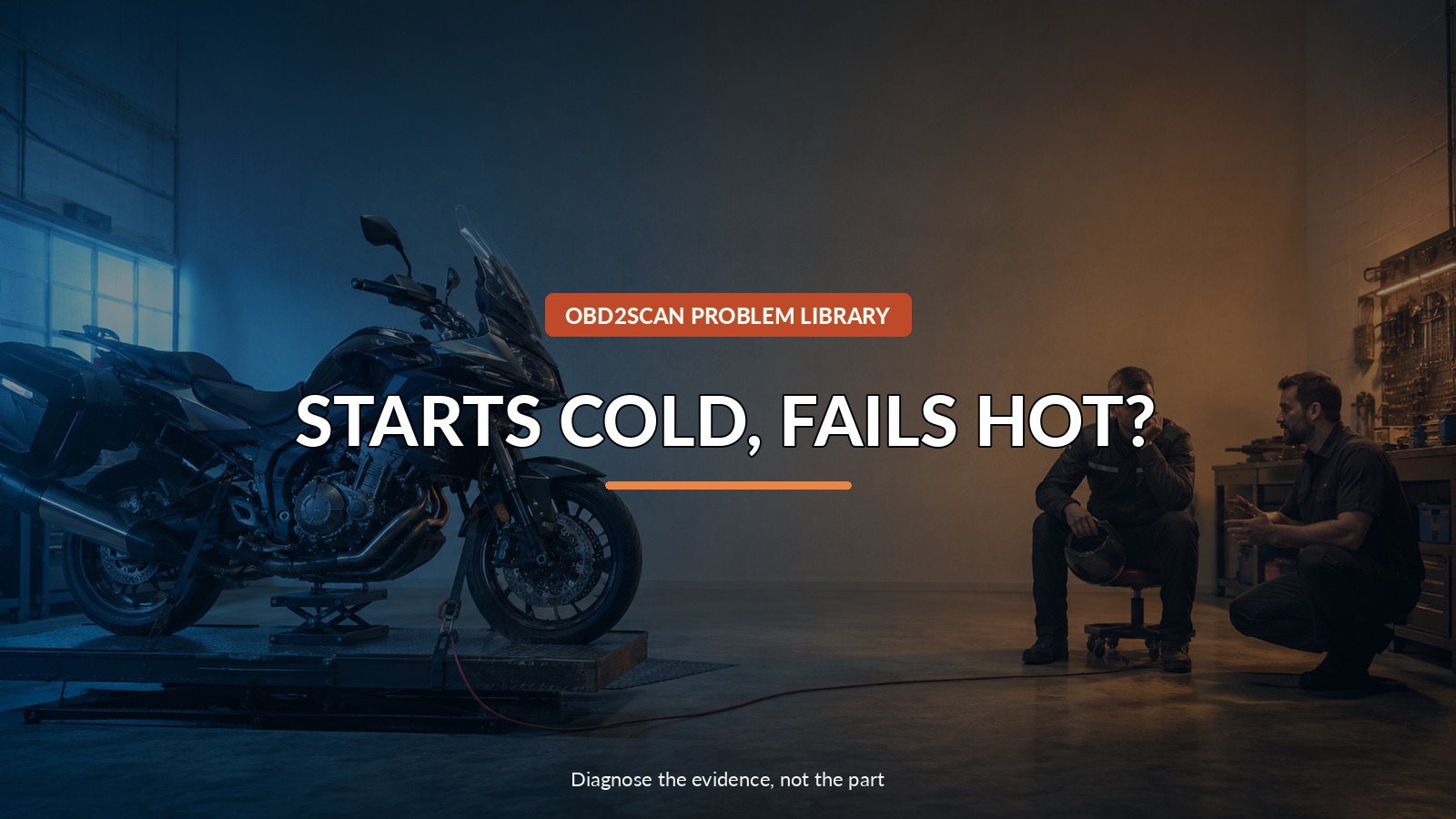
Starts Cold, Fails Hot?
The useful clue in a BMW K1200 or K1300 hot no-start is that the same motorcycle starts again after it cools. BMW Motorrad SIB 12 02 25 describes increased engine slip torque at operating temperature combined with a weak battery. The service solution adds starter-motor cables and replaces the starter relay; it does not say to keep cranking until the bike eventually fires.
A compact battery analyzer can make the cold-versus-hot comparison more objective. The FXTUL BT50 motorcycle battery tester can record compatible 12V battery condition, cranking and charging behavior. It cannot measure voltage drop at each starter cable by itself, prove hot slip torque, condemn the relay, select model-specific cable parts, or replace BMW’s repair route.
Build an A/B ride log: one fully cold start and one operating-hot restart, with battery state controlled between them.
Quick answer: Stop repeated cranking, compare fully charged cold and hot starts, and confirm the K40/K43/K44 scope before BMW’s additional-cable and relay solution.
In this guide
Stop repeated hot cranking
If the starter slows sharply, cables or terminals become hot, the relay chatters, voltage collapses, or there is smoke or a burning smell, release the button and switch the motorcycle off. Repeated attempts can overheat the starter circuit and flatten the battery, turning one reproducible complaint into several new ones.
Move the bike out of traffic without touching hot exhaust parts. If it will not restart safely, arrange transport. Do not bump-start a motorcycle where traffic, traction, slope or manufacturer guidance makes that unsafe.
Write a cold-versus-hot ride log
Before testing, ask the rider for the last successful cold start and the failed hot event. Record ambient temperature, ride time, coolant indication, how long the bike sat before the restart, starter sound, dash behavior, number of attempts and the time required before it started again.
Use the same fields for the controlled comparison:
| Field | Cold start | Operating-hot restart |
|---|---|---|
| Battery rested voltage | record | record after safe key-off interval |
| Minimum cranking voltage | record | record |
| Cranking speed/sound | normal/slow/click | normal/slow/click |
| Cable/terminal temperature | baseline | abnormal rise? |
| Start result | time/attempts | time/attempts |
Charge before judging the battery
Identify battery type, rating and age. Inspect case, terminals, grounds and cable routing. Charge it fully with the correct motorcycle-battery profile, allow the specified rest and test at the battery posts. A discharged battery is not automatically a failed battery, and a passing conductance result does not prove the high-current cable path.
Check the charging system after the engine is running under BMW specifications. A battery repeatedly left undercharged may be the victim of charging, connection, accessory or usage conditions.
Compare cranking under the two states
Use a meter with min/max or a suitable recorder to capture voltage at the battery during both starts. A qualified technician can then measure voltage drop across the positive starter path and the ground path during cranking. Measure across a connection; do not infer cable loss from battery voltage alone.
Keep probes secure and clear of the fan, chain, hot exhaust and moving parts. A cable can look clean while losing voltage through a crimp or connection only under high current and heat.
Confirm K40, K43, or K44
BMW lists these model families:
- K40: K 1200 S and K 1300 S, model codes 0591 and 0509.
- K43: K 1200 R, K 1200 R Sport and K 1300 R, model codes 0594, 0595 and 0519.
- K44: K 1200 GT and K 1300 GT, model codes 0597 and 0539.
Confirm the VIN and code in current BMW parts/service systems. Similar starting symptoms on another K-series model still require that model’s own diagnosis.
Measure the starter path before blaming torque
The bulletin explains the interaction: the hot engine requires greater slip torque while a weak battery leaves less electrical margin. That does not make “hot engine” or “battery” a complete verdict. Inspect starter cables, grounds, relay contacts, terminal security and starter condition under load.
A normal cold start can coexist with excessive hot voltage drop. Heat raises resistance and the engine load changes. The paired record reveals whether the supply, path or starter loses the margin only at operating temperature.
Repeatability matters more than a single lowest-voltage number. Note whether the dash resets, the relay clicks once or chatters, and whether cranking speed recovers as the motorcycle cools. Those observations help a technician separate a battery-state problem from resistance in the cable path or a starter that changes under heat, without inventing one universal voltage cutoff for every battery chemistry and temperature.
Let BMW choose the cable and relay package
BMW’s service solution installs additional starter-motor cables and replaces the starter relay. For K40 and K43, it also calls for three pieces of heat shrink. Exact part numbers depend on the chassis number and equipment in ETK.
This is not a generic “add a thicker wire” modification. Routing, insulation, crimping, protection, terminal torque and proximity to hot or moving parts are safety-critical. Have a qualified BMW motorcycle technician perform the model-specific repair.
Verify after a real heat soak
After repair, fully charge and retest the battery, confirm cable routing and terminal security, and repeat the same cold start. Then bring the motorcycle to the operating condition that previously caused failure, switch it off for the same interval and perform one controlled hot restart while recording cranking voltage and behavior.
Success is a repeatable hot restart without relay chatter or slow crank, acceptable voltage-drop evidence, normal charging and no abnormal heating at the added cables. Starting once after a short idle does not reproduce a heat-soaked roadside stop.




Comments 0
Questions, fixes, and real-world diagnostic notes from readers.
Be the first to share a diagnostic result or ask a follow-up question.