
Hyundai 2.5L GDI P0300–P0304? Let the VIN and Code Open the Injector Branch

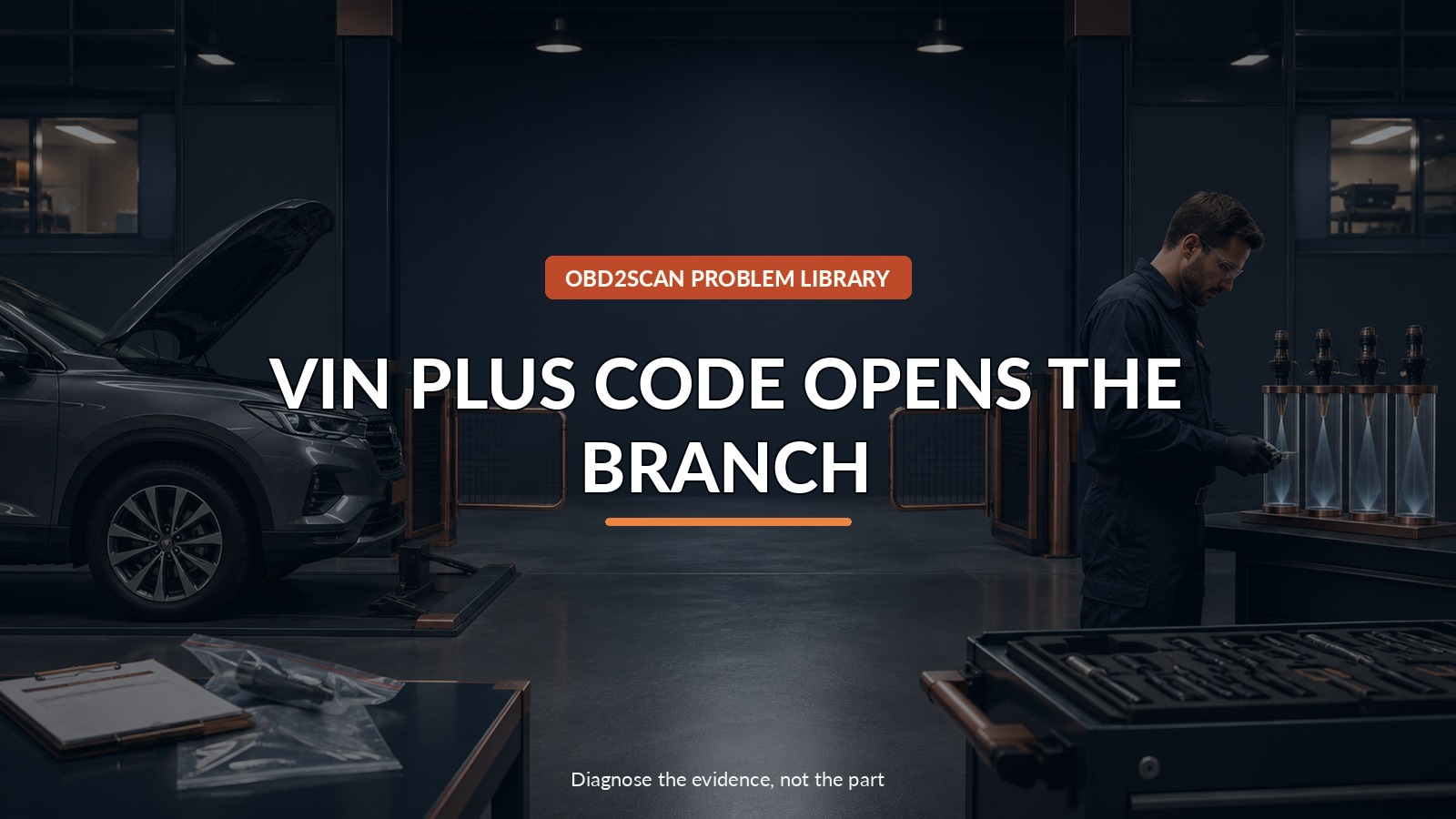
Vin Plus Code Opens The Branch
A Hyundai 2.5L GDI misfire enters bulletin 25-FL-001H only when two locks open. The vehicle must match the non-turbo engine, VIN-prefix, model-year, and production-date range, and it must have at least one named misfire code from P0300 through P0304. If either lock stays closed, the right next step is normal diagnosis—not four injectors by association.
When removed injectors need a separate comparative evaluation outside the bulletin decision, a protected bench can show spray, flow, leakage, and response side by side. The AUTOOL CT500 injector cleaner and tester is one compatible shop route. It cannot prove Hyundai TSB eligibility, safely depressurize the installed GDI system, recreate cylinder temperature, or overrule the bulletin’s all-four replacement path.
Think of the bulletin as a double lock, not as a general theory that every Theta III misfire is a leaking injector.
Quick answer: The Hyundai injector branch opens only when the non-turbo 2.5L VIN/production lock and the P0300–P0304 code lock are both satisfied.
In this guide
- Capture the misfire before it is moved
- Click the engine and production lock
- Click the P0300–P0304 lock
- Read the bulletin as a replacement gate
- Keep GDI pressure outside DIY reach
- Use bench comparison only for a different question
- Exit cleanly when either lock stays open
- Verify combustion without erasing the record too soon
Capture the misfire before it is moved
Save the complete scan, fault status, freeze frame, misfire counters, fuel trims, rail-pressure data, coolant temperature, rpm and load. Ask whether the roughness occurs cold, after a hot soak, at idle, under acceleration, or after refueling. Record fuel odor, hard starting, smoke, oil-level change, recent ignition work, and any low-voltage event.
If the MIL flashes, the engine shakes severely, fuel odor is strong, oil level has risen unexpectedly, or liquid fuel is suspected in a cylinder, stop the engine and do not restart it merely to gather more data. Continued running can damage the catalyst; cranking a liquid-filled cylinder can damage the engine. Arrange professional inspection once the safe observations are recorded.
Click the engine and production lock
The bulletin covers specific production windows, not every vehicle wearing the same badge:
- 2022 Santa Cruz with VINs beginning 5NT, built May 26, 2021–June 23, 2022.
- 2021–2022 Santa Fe with 5NM VINs, built March 1, 2021–July 15, 2022.
- 2021–2023 Sonata with KMH VINs, built February 8, 2021–January 19, 2023.
- 2021–2022 Sonata with 5NP VINs, built March 1, 2021–February 14, 2022.
- 2022–2023 Tucson with KM8 VINs, built January 23, 2021–November 5, 2022.
- 2022 Tucson with 5NM VINs, built March 1, 2021–July 11, 2022.
The engine must be the non-turbo 2.5L GDI Theta III. Confirm the VIN and build record through current Hyundai information; do not estimate a production date from the registration date.
Click the P0300–P0304 lock
Hyundai names P0300, P0301, P0302, P0303, and P0304. At least one must be found. If none is present—or if the vehicle is outside the applicable range—the flowchart says this TSB does not apply.
That does not mean the complaint is imaginary. It means the shop should investigate ignition, wiring, air leakage, compression, fuel quality, pressure, deposits, software, and other causes without borrowing the bulletin’s injector conclusion.
| Production lock | Code lock | Correct direction |
|---|---|---|
| Open | Open | Follow 25-FL-001H all-four injector route |
| Open | Closed | Normal misfire diagnosis |
| Closed | Open | Normal diagnosis for that VIN/engine |
| Closed | Closed | Start with the actual symptom and evidence |
Read the bulletin as a replacement gate
Hyundai says the scoped condition may be caused by internal filter breakage that allows a GDI injector to leak internally. The January 2025 revision supersedes an earlier bulletin and updates the repair to replacement of all four injectors using the listed kit.
That is important for two reasons. First, the repair is not “clean whichever injector has a code.” Second, cylinder-specific P0301 does not necessarily reduce the bulletin repair to injector 1. The technician must follow the current campaign, parts, documentation, and repair procedure that apply to the VIN.
Keep GDI pressure outside DIY reach
Gasoline direct injection uses pressures and components that require controlled residual-pressure release, ventilation, fire protection, exact torque, new seals and, in this procedure, a high-pressure pipe. Do not loosen a line to see whether fuel arrives, energize a removed injector near vapor, or substitute a generic hose and gauge.
A qualified technician should also protect open ports from contamination and inspect for leaks after reassembly. A small error here can create a fire risk or a second misfire.
Use bench comparison only for a different question
Bench testing can help a specialist compare compatible removed injectors when diagnosing a vehicle outside the bulletin, analyzing returned parts, or checking whether cleaning changed a restricted spray pattern. Use the correct test fluid, driver voltage, adapter, pressure, and containment. Compare equal pulse counts and conditions.
But a room-temperature bench does not reproduce combustion heat, cylinder pressure, installed sealing, vehicle wiring, or the exact internal failure under every condition. A clean-looking spray is not permission to ignore an applicable Hyundai replacement campaign.
Exit cleanly when either lock stays open
For a non-applicable vehicle, build a one-variable misfire plan. Index plugs and coils by cylinder; move only one practical suspect at a time if the service procedure permits; compare compression rather than relying on one universal number; inspect fuel trims and air leaks; and verify commanded versus actual fuel pressure. A fault that follows a moved coil says something different from one that stays with the cylinder.
Do not erase the original pattern by swapping plugs, coils, and injectors all at once.
Verify combustion without erasing the record too soon
After the approved repair, inspect for fuel leakage before starting, restore every connector and cover, and save the first post-repair scan. Confirm smooth cold start, hot restart, idle and controlled loaded operation. Watch cylinder counters and relevant trims long enough for the original failure state to be challenged.
Clear codes only after preserving the original and repair records. The result should be no fuel leak, no returning P0300–P0304 under the same conditions, stable oil level, normal starting, and no catalyst-threatening roughness—not merely an idle that sounds better for a minute.






Comments 0
Questions, fixes, and real-world diagnostic notes from readers.
Be the first to share a diagnostic result or ask a follow-up question.