2024 GM 1.2L Blue Smoke Under 2,000 Miles? Compare All Cylinders

Blue Smoke: One Cylinder Or All?
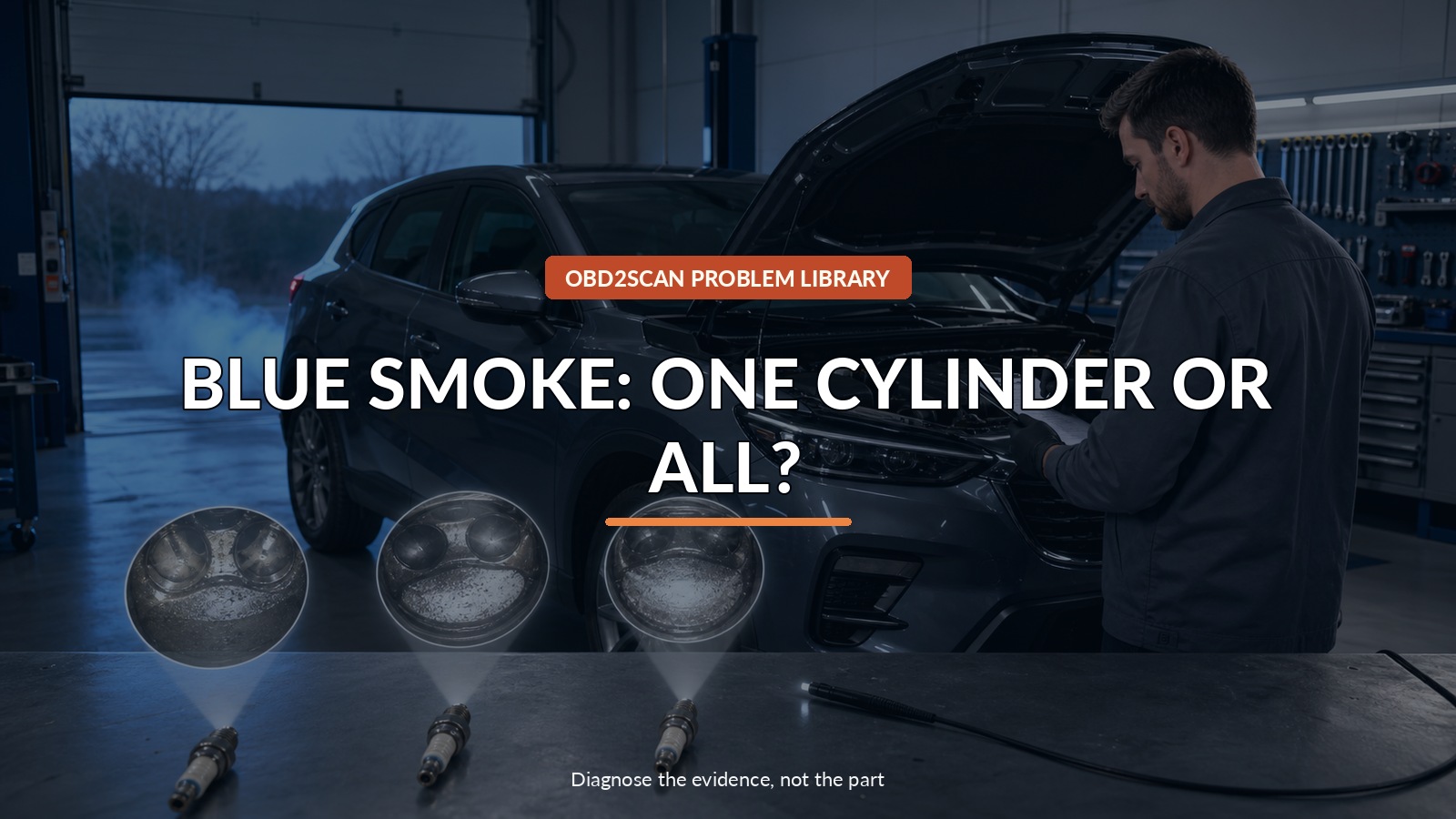
Blue smoke on a nearly new 1.2L GM crossover looks dramatic, but the first useful distinction is spatial: does the oil evidence belong to one cylinder, or is the same pattern present in all three? GM PIP5947C makes that distribution part of its branch. One oily plug cannot stand in for an all-cylinder finding.
After correct spark-plug removal and safe engine positioning, an articulating borescope can create consistent views of each accessible cylinder. The MRCARTOOL N180 cylinder inspection borescope is one way to document those views. It cannot quantify oil consumption, identify oil chemistry, prove the cam cover caused the pattern, inspect safely with moving pistons, or replace GM’s mileage-controlled consumption test.
Build a dossier, not a highlight reel: code constellation, plug order, same-angle cylinder images, oil-level history, and a measured verification interval.
Quick answer: Save the full code set, index the plugs, and compare identical views of every cylinder; GM’s covered branch requires all-cylinder evidence, not one oily plug.
In this guide
- Separate smoke color from the source verdict
- Check the LIH and 2,000-mile fence
- Save the full code constellation
- Index plugs before comparing cylinders
- Build an all-cylinder visual dossier
- Let symmetry choose local or common
- Reset the oil record before a consumption test
- Verify over the same mileage and conditions
Separate smoke color from the source verdict
Record when the smoke appears—first cold start, warm restart, long idle, deceleration, acceleration, or continuously. Note duration, odor, ambient temperature, oil level, miles since delivery or service, and whether idle surges. Video against a neutral background can preserve timing, but camera white balance can change apparent color.
Blue-gray smoke supports oil burning; dense white vapor may be condensation or coolant, and black smoke points toward excess fuel. These categories can overlap. Stop the engine for an oil-pressure warning, severe knock, rapidly falling oil level, runaway speed, or smoke that makes operation unsafe. Do not repeatedly demonstrate the condition near people or indoors.
Check the LIH and 2,000-mile fence
The preliminary information addresses 2024 Buick Encore GX and Envista and Chevrolet Trailblazer and Trax with the 1.2L LIH engine and fewer than 2,000 miles. Confirm VIN, engine RPO, odometer, delivery/service history, exact oil specification and fill, and the latest GM document.
PIP5947C is not a universal blue-smoke diagnosis. A vehicle over the mileage fence, another engine, or smoke after an oil change can require a different route. VIN program coverage is a separate check. Do not infer a cam-cover repair merely from owning one of the named models.
Save the full code constellation
GM lists possible P04DB, P0300, P050D, P0521, P06DE, and P1101 alongside the smoke, oil-use, and surge complaint. Save every current, pending, and history code with freeze frame before clearing. Record crankcase-pressure data, misfire counts, throttle and air data, oil-pressure status, and engine temperature where the platform supports them.
The codes span crankcase ventilation, misfire, cold-start quality, oil pressure/control, and airflow. That breadth makes a common condition plausible, but it does not erase individual circuit tests. A red oil-pressure warning always takes priority over article-level pattern matching.
Index plugs before comparing cylinders
On a cool engine, a trained technician should remove plugs under the exact torque, cleanliness, coil, and thread procedures. Label a clean tray by cylinder before the first plug moves. Photograph each plug immediately from the same angles, with electrode, shell, insulator, and any wet material visible.
Do not wipe the plugs before as-found images. Note whether material is fresh oil, fuel-wetness, dry carbon, coolant-like deposit, or uncertain. Smell and appearance are not chemical analysis. Compare gap and damage, but remember that a combustion problem can foul a plug after the problem starts.
Build an all-cylinder visual dossier
Disable starting and control engine rotation exactly as service information requires. Confirm the piston and valves are stationary before inserting a probe. Keep the camera from contacting the cylinder wall, valve, or piston, and never rotate the engine with the probe inside.
Use the same probe, light level, approximate piston position, entry direction, and photo sequence for every cylinder. Capture the crown center, perimeter, and visible wall where possible. Unequal reflections can make one surface appear wetter; repeat an image rather than interpreting glare.
| Distribution | Strong next question | What it does not prove |
|---|---|---|
| Similar oil evidence in all cylinders | Is a common crankcase/air path involved? | Cam-cover fault without the GM procedure |
| One cylinder clearly different | Is that cylinder’s injector, ring, valve, seal, or mechanics different? | A common three-cylinder cause |
| Plugs oily but crowns inconclusive | Did timing, pooling, or lighting alter the view? | No oil ingestion |
| No oil evidence after smoke report | Was the event transient or misidentified? | That the complaint is imaginary |
Let symmetry choose local or common
GM tells technicians to confirm evidence in all cylinders, not merely one, before following the covered branch. If all three show comparable evidence, preserve the set and continue with the cam-cover investigation in current GM information. If only one differs, exit that shortcut and diagnose the local cylinder.
Do not average away exceptions. One cylinder that is dry while two are wet may be a timing or viewing issue, or it may invalidate the “all cylinders” condition. Recheck the method and let the evidence, not the desired repair, decide.
Reset the oil record before a consumption test
GM’s path calls for correcting the condition as specified, setting oil to the correct level, and running a 100-mile oil-consumption check. Establish level on the prescribed surface, after the prescribed drain-back time, with the correct temperature and dipstick method. Record added oil by measured volume.
Do not overfill to create a convenient starting mark. Seal or document the fill point if the service procedure requires it. Note idle time, route, load, ambient conditions, and any smoke event. A consumption conclusion without a controlled starting level is weak.
Verify over the same mileage and conditions
After the approved repair, repeat cold start, warm restart, idle, and the original event without excessive demonstration. Re-scan, compare misfire and crankcase data, inspect for external leaks, and complete the mileage-controlled level check.
The repair passes when smoke and idle symptoms do not recur, code behavior remains normal, oil level stays within the expected controlled interval, and all disturbed components remain sealed. One clean tailpipe start immediately after wiping the evidence does not close the dossier.



Comments 0
Questions, fixes, and real-world diagnostic notes from readers.
Be the first to share a diagnostic result or ask a follow-up question.