
Subaru WRX FA20DIT vs. FA24DIT: Identify the Boxer Family

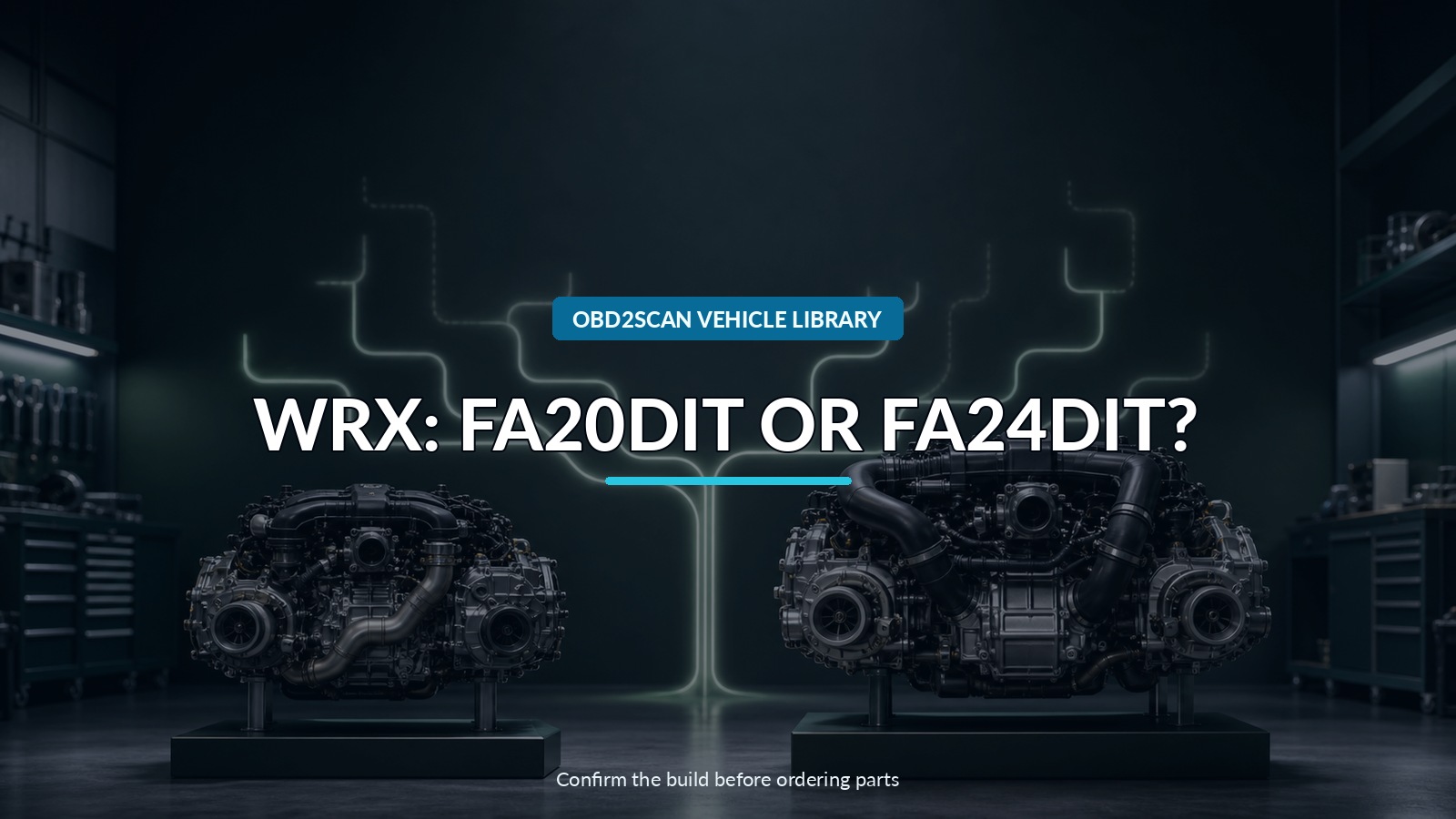
Conceptual identity-verification scene: Wrx: Fa20Dit Or Fa24Dit?
For the standard U.S. Subaru WRX, the 2015–2021 generation uses the turbocharged FA20DIT family and the redesigned 2022-and-newer WRX uses the larger FA24DIT family. That is the trunk of the tree. WRX STI follows a different engine history, and naturally aspirated FA20 or FA24 applications are neighboring branches—not substitute donor identities.
Grow the record from the vehicle outward: VIN/build and exact model, WRX versus STI, emissions label and engine family, transmission, turbo/fuel/cooling/controls, then installed labels and part numbers. Prune any branch that relies only on displacement or the letters “FA.”
The family-tree metaphor matters because related engines can still be wrong donors. Shared architecture explains resemblance; application evidence determines which branch is actually in front of you.
Quick answer: U.S. 2015–2021 standard WRX uses FA20DIT and 2022+ uses FA24DIT; keep WRX STI and naturally aspirated FA applications outside that shortcut.
In this guide
Plant the tree at the vehicle VIN
| U.S. standard WRX | Turbo engine-family orientation | Major boundary |
|---|---|---|
| 2015–2021 | FA20DIT | Do not merge with same-era WRX STI EJ application |
| 2022 onward | FA24DIT | New WRX generation; not evidence of a matching STI successor |
| Other Subaru vehicles | FA20/FA24 family names may appear | Aspiration, installation, hardware and calibration can differ |
Read the physical VIN and certification label, retrieve Subaru build data, and use the NHTSA VIN Decoder as another vehicle check. Copy production month, exact model/trim, and transmission.
The engine cover and intake layout can support the answer. The emissions label, factory record, castings, connectors, and complete numbers carry more authority.
Follow the FA20DIT branch
The all-new 2015 standard WRX introduced a 2.0-liter direct-injection turbo boxer engine. Record FA20DIT application in the context of the exact WRX model year, manual or CVT, emissions market, turbocharger, intake/charge system, high-pressure fuel equipment, cooling, exhaust, harness, ECU, and accessories.
Do not shorten the vehicle to “2015 Subaru turbo.” The same model year also includes WRX STI with a different engine family and drivetrain package. Body appearance and wings are editable; the VIN/build and engine evidence must agree.
For a used engine, capture the donor VIN, build date, transmission, engine label/casting, turbo, manifolds, fuel system, oil pan, wiring, sensors, and what was removed before sale.
Follow the FA24DIT branch
The redesigned 2022 WRX moves to a 2.4-liter direct-injection turbo boxer. Record exact year/build, manual or Subaru Performance Transmission configuration, emissions market, turbo, fuel system, cooling, exhaust, harness, ECU and accessory package.
An FA24DIT from another Subaru model is not automatically a WRX engine. Installation orientation, turbo and exhaust, oiling, intake, cooling, sensors, accessories, calibration, and transmission interface may differ. Use the donor model and part numbers rather than displacement.
Later running revisions also stay possible inside the 2022+ family. Keep complete suffixes and production dates when matching modules, sensors, fuel components, or engine assemblies.
Prune the STI and naturally aspirated branches
WRX and WRX STI are separate factory models, not two tune levels of one engine. The 2015–2021 U.S. WRX STI retained its own EJ-series context while the standard WRX used FA20DIT. A hood scoop, wing, wheel, or badge cannot settle that difference.
Similarly, naturally aspirated FA20 and FA24 engines in other Subaru vehicles share family language but not the WRX turbo system. Do not infer turbo compatibility from a bare block advertisement. Ask for the exact donor, engine designation, aspiration, build, and included hardware.
If a modified engine mixes short block, heads, turbo, intake, oiling, or control parts, describe each documented layer. “FA24 swap” is a project label, not a service identity.
Tag transmission, turbo, and controls
Manual and CVT/SPT vehicles require different transmission interfaces, controls, cooling, wiring, and calibration. Record flywheel/flexplate, clutch or converter context, starter, bellhousing interface, harness, control modules, and drivetrain information.
For turbo and fuel hardware, capture part numbers, wastegate/control type, manifolds, charge-air plumbing, injectors, rails, high-pressure pump, sensors, and ECU/calibration context. A complete engine is complete only relative to an inventory.
Compression, leak-down, oil analysis, and running video help judge condition. They cannot identify a mixed or undocumented assembly. Keep condition and identity as separate branches in the file.
Photograph the engine from all four sides before installation or dismantling. Include one wide orientation view and close-ups of castings, sensors, harness connectors, turbo plumbing, fuel rails, oil pan, bellhousing face, and accessory brackets. Name the files with donor VIN and build date. That simple archive is often more useful later than a seller’s memory of which FA24 application supplied the block.
Write the complete boxer-family record
A durable line reads: “U.S. 2019 Subaru WRX, standard model not STI, VIN/build month verified, FA20DIT and manual transmission recorded, turbo/direct-fuel/cooling/control package inventoried, installed labels and component numbers photographed.” A 2023 line should name FA24DIT and its exact WRX transmission branch.
The family tree is useful because it shows both belonging and separation. FA20DIT and FA24DIT are related ideas; the donor vehicle and installed systems decide what any one engine actually is.







Comments 0
Questions, fixes, and real-world diagnostic notes from readers.
Be the first to share a diagnostic result or ask a follow-up question.