
Ford 3.5L EcoBoost Gen 1 vs. Gen 2: Application Before Hardware

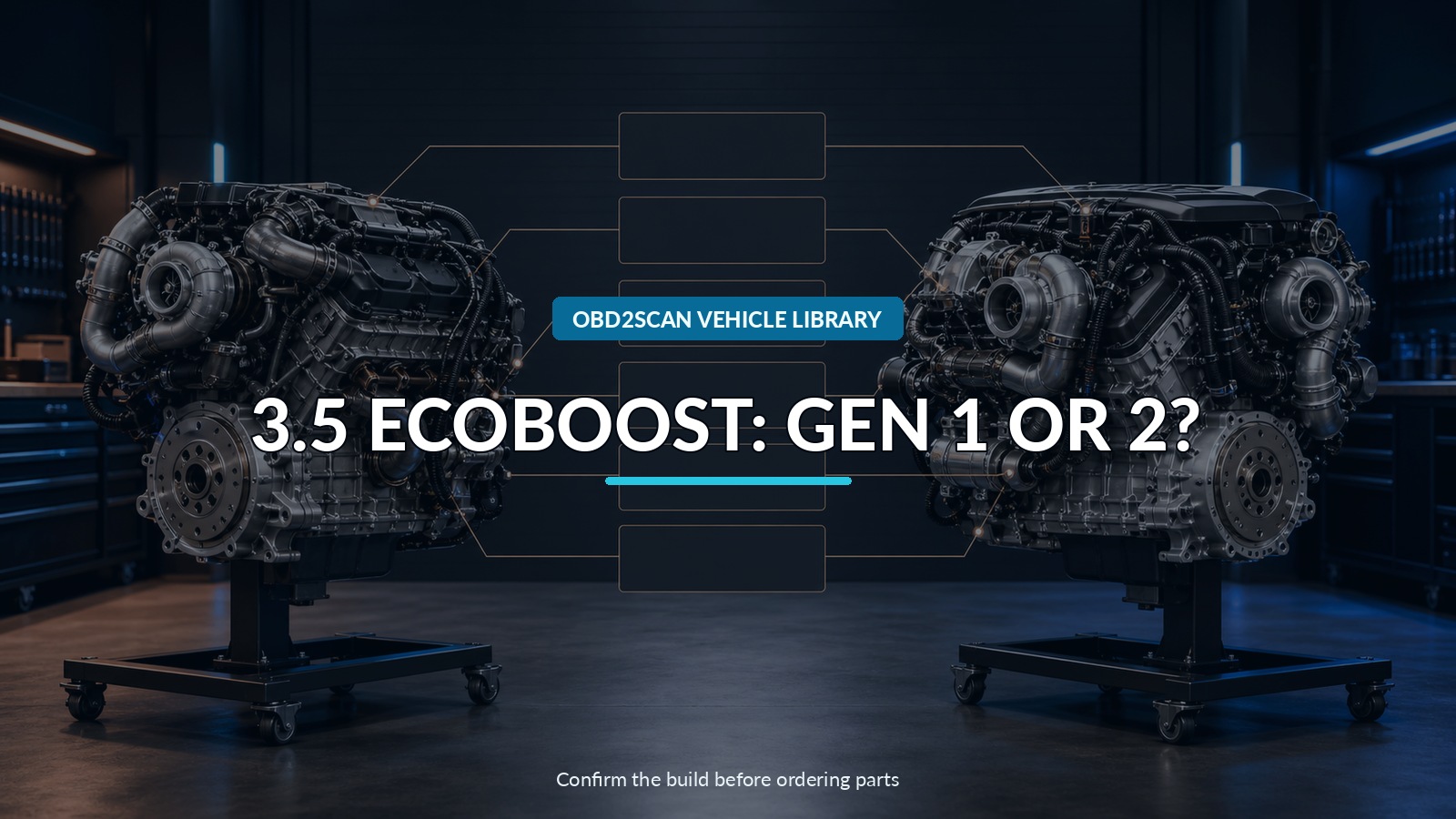
Conceptual identity-verification scene: 3.5 Ecoboost: Gen 1 Or 2?
For U.S. F-150 orientation, Ford’s original 3.5L EcoBoost arrived for 2011 and the second-generation engine arrives for 2017 with major fuel-system, turbo, control, and transmission-context changes. That sentence is useful—and dangerous if applied to every Ford or Lincoln application. Donor vehicle, VIN/build, exact engine, fuel system, turbos, controls, emissions package, transmission, and installed parts still decide identity.
Interrogate the engine one claim at a time. “It is a 2017” is an answer only after you know what vehicle the year belongs to. “It has direct injection” is incomplete until the entire fuel system is recorded.
The questions below are ordered to expose mixed engines early. A donor record should lead; hardware should confirm it; condition testing should remain a separate decision after identity is stable.
Quick answer: For F-150 orientation, 2011 begins the original 3.5L EcoBoost and 2017 begins Gen 2; donor application, fuel system, turbos, controls, transmission, and parts still decide identity.
In this guide
Question the generation label
| Question | First-generation F-150 orientation | Second-generation F-150 orientation |
|---|---|---|
| U.S. starting point | 2011 F-150 | 2017 F-150 |
| Fuel-system headline | Direct injection | Combined port and direct injection |
| Turbo/control headline | Earlier turbo and control package | Revised turbochargers and electronic wastegate control |
| Transmission context | Application-specific earlier transmissions | Introduced in F-150 beside the new ten-speed automatic |
This is a family orientation, not an interchange table. Later running changes, high-output variants, SUVs, cars, and Lincoln applications need their own Ford build and parts evidence.
Begin with the physical donor VIN, certification and emissions labels, and Ford build data. Use the NHTSA VIN Decoder to cross-check the donor vehicle.
Ask which application donated it
Write the complete donor: model, model year, production date, engine description, transmission, driven wheels, emissions market, and variant. An F-150 engine, Transit application, performance SUV, or Lincoln application may share a 3.5L EcoBoost family name while using different oiling, cooling, intake, exhaust, turbo, accessories, controls, and packaging.
If the engine is already out, request the donor VIN and photographs taken before removal. Capture labels, castings, harness, sensors, turbochargers, manifolds, fuel system, front cover, oil pan, flexplate or flywheel, and accessories.
No donor record means lower confidence. Do not manufacture a precise generation from one intake manifold photograph.
Ask how the fuel system is configured
Ford’s second-generation F-150 3.5L EcoBoost uses both port and direct injection. That is an important distinguishing system, not permission to identify every loose engine by the number of visible fuel rails. Record injectors, rails, high-pressure pump, low-pressure supply requirements, sensors, harness, controller, and calibration context.
An earlier direct-injection-only package needs its corresponding controls and fuel delivery. Mixing manifolds or rails can make appearance misleading. Compare part numbers and connector locations with Ford service information for the donor VIN.
Fuel-system work involves pressure and fire hazards. Depressurization and service procedures belong to the exact vehicle manual; identity inspection is not a substitute for repair instructions.
Ask which turbos and controls remain
The 2017 F-150 change includes revised turbocharger and wastegate control. Record turbo part numbers, left/right position, manifolds, oil and coolant lines, charge-air plumbing, wastegate actuators, sensors, harness, and calibration. A seller’s “upgraded turbos” description should trigger more documentation, not a higher-confidence generation label.
Inspect timing/front-cover, cam-control, cooling, vacuum, and accessory hardware as complete systems. Long blocks can receive later intakes, turbos, covers, or oil pans. If the evidence is mixed, describe the engine as a documented base with installed components rather than forcing it into one clean generation.
Used turbo condition, shaft play, oil residue, or compression results are condition evidence. They do not identify the donor.
Ask what the transmission expects
The second-generation F-150 engine was introduced beside Ford’s ten-speed automatic, but transmission pairing still depends on the exact application and year. Record crank/flexplate or flywheel, starter, bellhousing interface, torque converter or clutch context, transmission control, vehicle-speed information, harness, and calibration.
A long block that bolts to a transmission may still lack the correct rotating hardware, controls, fuel system, accessories, oil pan, or emissions package. For a swap, inventory every retained and missing component before fabrication.
Measure packaging instead of trusting the generation label. Oil-pan depth, turbo outlets, accessory width, charge-air connections, exhaust position, engine mounts, and service clearances can differ with the donor and recipient. These measurements support project planning; they do not authorize structural or emissions changes. Use engineered mounts, applicable regulations, and vehicle-specific instructions for the actual installation.
Do not assume a control pack, PCM, or harness covers every 3.5 EcoBoost. Verify the supported engine generation, donor hardware, transmission, and emissions strategy in the manufacturer documentation.
Answer with a donor-complete identity line
A strong line reads: “U.S. 2018 Ford F-150 donor, second-generation 3.5L EcoBoost orientation, donor VIN/build and emissions label verified, combined port/direct fuel system, revised turbo/control hardware and ten-speed interface inventoried, component numbers photographed.” An earlier engine should state its exact F-150 year and installed direct-injection/control package.
The interrogation does not end with “Gen 2.” It ends when another technician can reconstruct the donor, systems, and boundaries without trusting the seller’s memory.



Comments 0
Questions, fixes, and real-world diagnostic notes from readers.
Be the first to share a diagnostic result or ask a follow-up question.