
Toyota Prius Gen 3, Gen 4, or Gen 5? Identify Hybrid vs. Prime Correctly

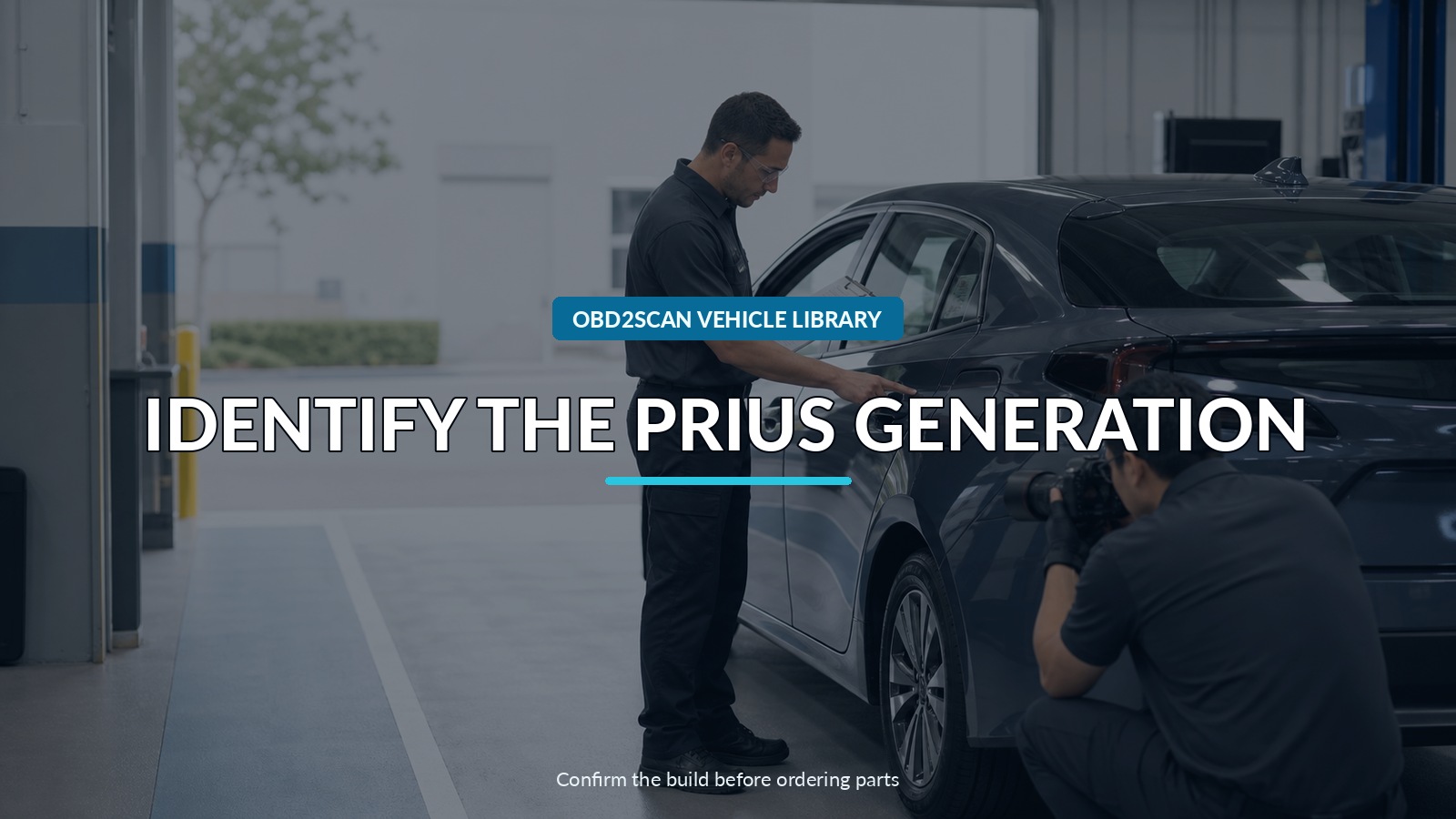
Conceptual identity-verification scene: Identify The Prius Generation
A Prius intake sheet needs two answers: which generation, and which Prius line. For the U.S. liftback, Gen 3 is 2010–2015, Gen 4 is 2016–2022, and Gen 5 begins with 2023. Standard hybrid and plug-in versions must then be separated, while Prius c and Prius v remain distinct model lines rather than size trims of the liftback.
Use VIN/build records, certification and emissions labels, model code, charge-port presence, engine/transaxle identity, drive configuration, battery family, and OEM catalog. Do not open a battery enclosure or probe orange high-voltage wiring for identification.
The finished line should let a hybrid shop choose the correct service information before it evaluates a symptom. “Prius” alone is not a powertrain configuration.
Quick answer: For U.S. Prius liftbacks, Gen 3 is 2010–2015, Gen 4 is 2016–2022, and Gen 5 is 2023+. Then separate standard hybrid, plug-in/Prime, Prius c, and Prius v identities.
In this guide
Place the liftback in Gen 3, 4, or 5
For U.S. model-year shopping, the broad map is:
| U.S. liftback years | Working generation | Common platform-family shorthand |
|---|---|---|
| 2010–2015 | Gen 3 | XW30 family |
| 2016–2022 | Gen 4 | XW50 family |
| 2023 onward | Gen 5 | XW60 family |
Toyota’s global Prius story begins earlier and uses different launch language by market. Keep the U.S. model-year boundary attached to a U.S. vehicle, and copy the actual model code from the car rather than manufacturing one from a nickname.
Separate hybrid, plug-in, c, and v
The standard liftback is a non-plug-in hybrid. Earlier plug-in versions may be described as Prius Plug-in; later U.S. vehicles use Prius Prime, while current global wording may include Prius PHEV. A charge port and official model record establish the plug-in branch more reliably than a seller’s “hybrid” checkbox.
Prius c is a separate compact model line, and Prius v is a separate wagon-like model line. They are not Gen 3 or Gen 4 liftback trim levels. Write the complete model name before applying a liftback generation table.
Perform a safe hybrid intake
Match the windshield VIN, driver-door certification label, title/registration, and Toyota build record. Check the VIN independently with the NHTSA VIN Decoder. Photograph the emissions label and record production date, market, model code, engine family, transaxle or drivetrain information available through official documentation, and AWD/FWD configuration where applicable.
Inspect charge-port presence from normal exterior access. Read labels without removing high-voltage covers. If the vehicle has collision damage, exposed orange wiring, or a compromised battery enclosure, stop ordinary intake and follow emergency and manufacturer procedures.
Add the configuration that controls the job
For engine service, generation is less specific than engine and emissions family. For hybrid or charging work, record standard hybrid versus plug-in, battery and charge-system identity from official records, production date, and installed component number. For brakes, suspension, hubs, wheels, or body parts, add drive, wheel/brake package, body equipment, and option details.
Do not infer battery chemistry or condition from “Gen 3” or “Prime.” A generation nickname cannot report state of health, isolation condition, cooling performance, or whether a pack has been replaced. Those require appropriate diagnosis after identity is secure.
Reconcile factory build and current hardware
Prius vehicles are old enough to receive used battery packs, modules, engines, transaxles, lamps, and control units. The VIN describes the original build. Record the label and part number on the installed assembly, plus donor or invoice documentation where available.
If an installed component differs from the factory catalog, do not erase either fact. Write “factory configuration” and “currently installed assembly” as separate lines, then select service information that safely accounts for the present vehicle.
Record odometer and service-document observations only as context; neither identifies a generation or proves battery originality. A replacement pack may have its own label and history. When that history is incomplete, describe the pack as currently installed and avoid assigning chemistry, capacity, or state of health from exterior appearance.
Avoid generation folklore
Do not turn Gen 3, Gen 4, or Gen 5 into a universal reliability or repair statement. Do not claim all parts interchange within a generation. Do not apply a North American year boundary to a gray-market vehicle without checking market and build data.
Also avoid using an emblem as the powertrain record. Hybrid badges are easy to replace; Prime identity requires the official model and charging configuration. A missing charge cable says nothing about whether the car is plug-in.
Complete the hybrid-shop intake line
A strong record reads: “U.S. 2021 Prius Prime, Gen 4/XW50-family liftback, production date/VIN/model code verified, plug-in identity and drive configuration recorded, installed component number matched.” A Prius c or Prius v should name that model line instead of borrowing the liftback’s generation.
Once that line is complete, diagnosis can begin on the right system. Before it is complete, even a technically correct procedure can be correct for the wrong Prius.



Comments 0
Questions, fixes, and real-world diagnostic notes from readers.
Be the first to share a diagnostic result or ask a follow-up question.