
Mercedes M274, M264, or M254? Confirm the Engine Behind the Badge

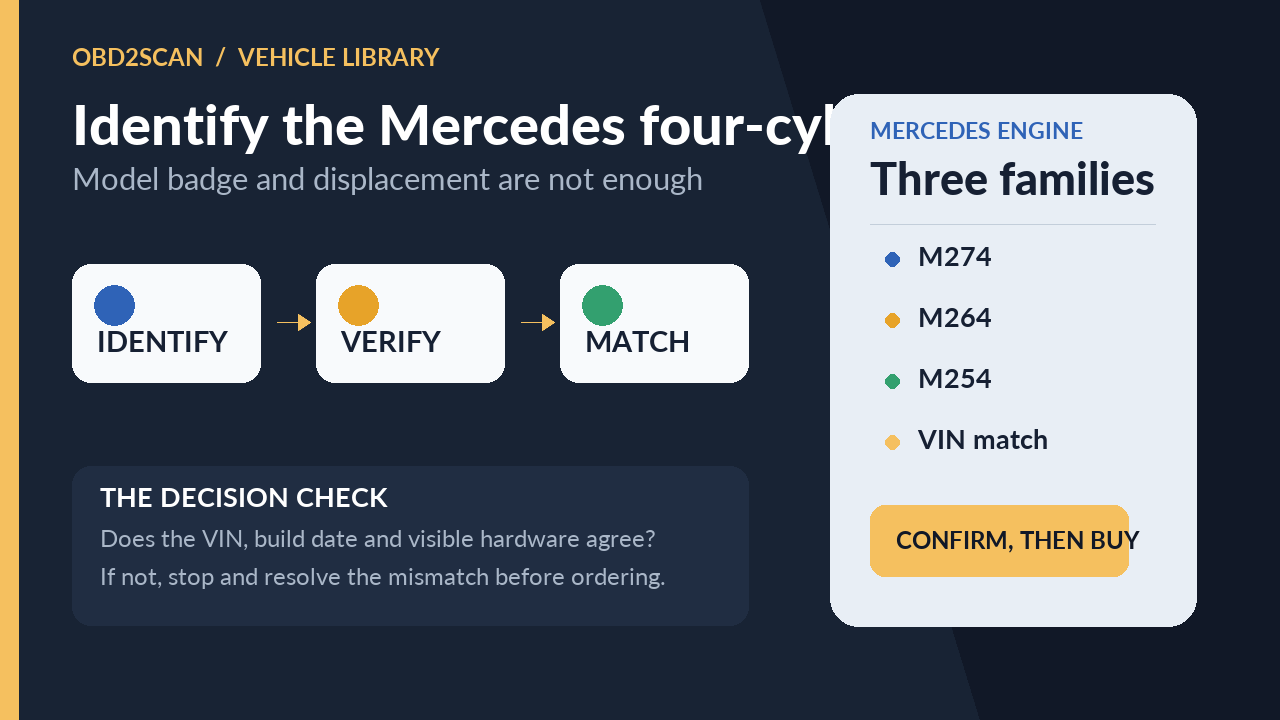
M274, M264, and M254 are successive Mercedes-Benz gasoline four-cylinder engine families found across C-Class, E-Class, GLC, and related vehicles. A C300, E300, or GLC 300 badge can point to different families depending on chassis, market, and build date. Identify the engine with VIN-specific factory data and the installed engine before ordering parts or using a procedure.
Fast answer
- M274 appears in many earlier longitudinal four-cylinder applications including models in the 205, 213, and 253 families.
- M264 appears in later applications of some of those same vehicle families, so chassis code alone cannot decide the engine.
- M254 belongs to a newer engine generation used with newer vehicle architectures such as W206.
- Verify the engine and its variant; do not rely on a 2.0-liter description, a 300 badge, or an online engine-cover photo.
In this guide
1. Use the family map carefully
| Family | Useful orientation | Do not infer |
|---|---|---|
| M274 | Earlier longitudinal turbo gasoline four-cylinder used across several rear-/all-wheel-drive model families | That every C300, E300, or GLC 300 of the era has the same M274 variant |
| M264 | Later four-cylinder family that entered updated 205, 213, and 253 applications | That a later body style or mild-hybrid feature alone proves M264 |
| M254 | Newer modular four-cylinder generation associated with vehicles such as W206 | That every “300” model worldwide uses identical M254 hardware |
Official Mercedes service documents identify M274 and M264 as distinct engines and tie them to specific model scopes. Mercedes launch material for the W206 describes M254 in the newer C-Class. This is enough to establish separate families; it is not enough to select a thermostat, injector, belt, sensor, or gasket for your VIN.
2. Why the same badge can sit over different engines
Mercedes badges describe a model position and performance class more than literal displacement. The GLC 300 name continued while the first-generation 253 vehicle received an engine update from M274 to M264 in certain markets and production phases. W205 C-Class and W213 E-Class applications likewise changed powertrain combinations during their runs.
Registration year makes this harder. A late-build car can be registered the following year, while U.S. model year and global launch year may differ. Online catalogs then compress the transition into a broad year range. The only reliable answer combines chassis VIN, production date, market, factory engine assignment, and the installed unit.
Start with the matching vehicle page if necessary: W204/W205/W206 C-Class, W212/W213 E-Class, or X253/C253/X254 GLC. Then treat engine family as a separate field.
3. Positively identify M274, M264, or M254
- Decode the VIN. Record the exact model, model year, body class, engine data, and plant. A generic decoder may not display the M-code.
- Read the build label. The driver-door production month places the car on the transition timeline.
- Use Mercedes-specific data. Enter the VIN in a current Mercedes-Benz parts/service system and record the engine designation and variant.
- Cross-check the installed engine. Compare the engine identifier, emissions label, control-unit identification, and original component numbers.
- Check the catalog split. If a component has “up to/from” VIN or engine-number ranges, use the exact break rather than the month alone.
Engine-cover shape and visible accessory layout are useful confirmation after factory data points to a family. They are poor first evidence because covers, intake pieces, accessory brackets, and entire engines can be replaced.
Engine number versus engine family
M274/M264/M254 is the broad family. The full variant and engine serial can control a production split. Record both when the catalog asks for them.
4. What changes for parts and service
- Cooling and thermal management: pump, thermostat, valves, hoses, charge-air cooling, and bleeding/filling procedures follow the exact engine and chassis.
- Accessory drive: belt length and routing, tensioner, pulleys, starter-generator or conventional accessory arrangement, and service access can differ.
- Fuel and ignition: injector and high-pressure-pump indexes, coils, plugs, sensors, seals, programming, and installation requirements are application-specific.
- Crankcase ventilation and leaks: valve covers, separators, oil-filter housings, gaskets, lines, and diagnostic paths are not transferable as a generic “Mercedes 2.0T” job.
- Electronics and electrification: control modules, harnesses, 48-volt components, software, and safety procedures depend on the actual system.
Use exact service information whenever work touches high pressure, hot cooling circuits, rotating accessories, high current, or 48-volt equipment. Identification comes before the risk assessment: you cannot select the correct isolation or filling procedure for an unknown engine.
5. Resolve conflicting evidence before spending
If the VIN catalog says M274 but the installed layout resembles M264, do not pick whichever answer matches the part you want to buy. Check for an engine replacement, incorrect VIN entry, import-market catalog, swapped cover, or mislabeled online photo. Read the engine identifier and control-unit data and document any donor engine.
For a used engine or electronic component, obtain the donor VIN, engine variant, part number, hardware/software index, and coding requirements. “C300 engine” is not a usable specification. A good final record reads “U.S. W205, November 2018 build, VIN-assigned M264 variant, installed identifier confirmed.”
Official sources used for this guide
- Mercedes Engine/Model Service Information — Mercedes-Benz USA / NHTSA
- M264 Recall Application Information — Mercedes-Benz USA / NHTSA
- GLC Powertrain Update — Mercedes-Benz Media
- The New C-Class and M254 — Mercedes-Benz Media
What a successful identification looks like
You can state the market, VIN-confirmed model and body, production date, engine, drivetrain, and the equipment relevant to the job. The catalog result and the hardware on the vehicle agree, and the supplier can confirm a current part number for that exact record.


Comments 0
Questions, fixes, and real-world diagnostic notes from readers.
Be the first to share a diagnostic result or ask a follow-up question.