
Engine Overheating While Driving? Stop Safely Before Diagnosing the Cause

If the coolant-temperature warning appears, the gauge enters the hot zone, steam is visible, or power is reduced for temperature, turn off the A/C, move out of traffic, stop safely, and follow the exact owner's-manual response. If temperature does not promptly return to normal or steam/coolant is present, shut the engine off and arrange a tow. Never remove a radiator or pressurized reservoir cap while the system is hot.
What to do first
- Treat steam, coolant spray, repeated warning, rising gauge, reduced-power message, or heater suddenly going cold as reasons to stop and shut down.
- Keep clear of fans, belts, hot hoses, and pressurized caps; electric fans can start unexpectedly.
- After the engine is fully cold, check level only by the owner's-manual method and look for visible leak evidence.
- Do not keep adding water and driving: the warning can disappear while a damaging loss or circulation fault remains.
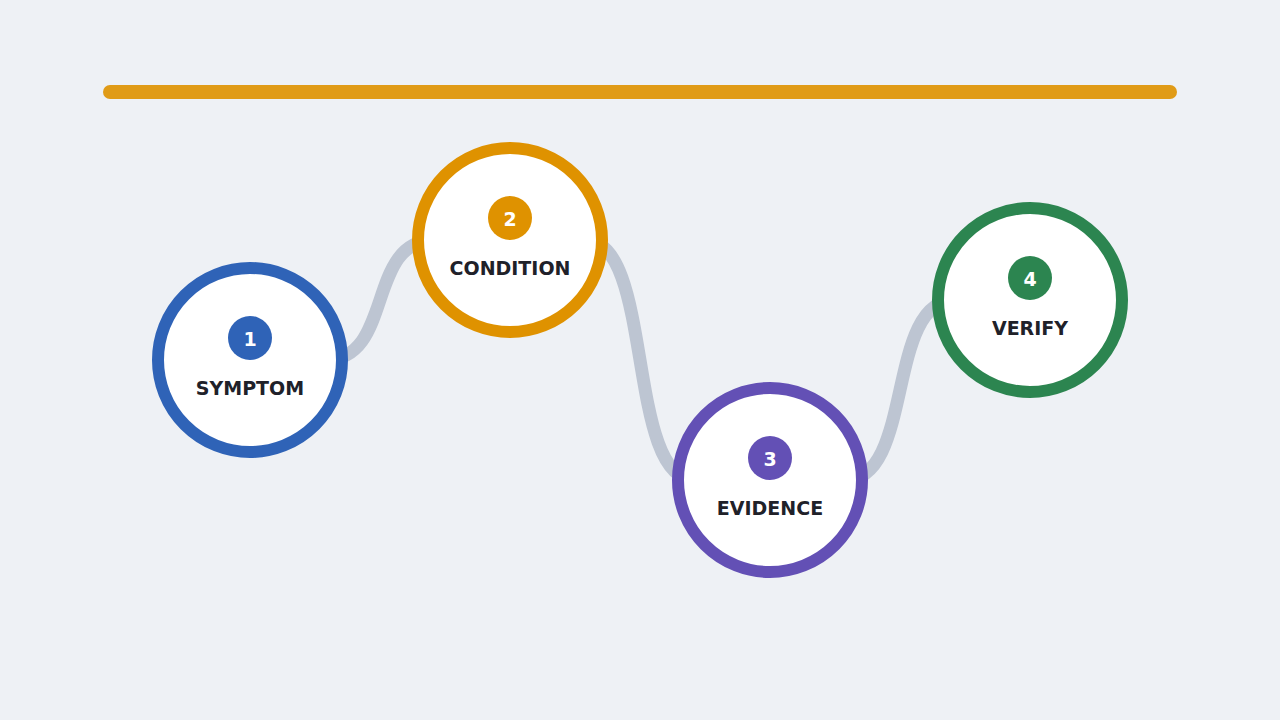
In this guide
1. What the symptom means—and does not prove
Overheating means heat production exceeded the cooling system's ability to carry and reject it, or the sensor/controller reported that condition. The useful diagnosis separates coolant quantity and containment, airflow through the heat exchangers, circulation through the engine and radiator, combustion load, and the accuracy/control of the sensing system.
It does not independently prove
- that the thermostat is stuck;
- that a low reservoir is the only leak evidence;
- that a fan heard running is moving enough air;
- that a new water pump is circulating correctly;
- that a normal gauge after cooldown means the cause is gone;
- that opening a hot cap is necessary to check coolant;
2. Save the evidence and make only low-risk checks
- warning message/gauge position and ambient temperature;
- speed, traffic, hill/towing, A/C and heater behavior;
- steam location and coolant odor without approaching hot components;
- cold coolant and oil levels plus recent losses;
- recent belt, pump, thermostat, radiator, cap, coolant, or engine work;
Preserve this record before resets, repeated starts, part swaps, or fluid additions change the condition. Related background: cooling-system pressure-test guide water-pump leak diagnosis.
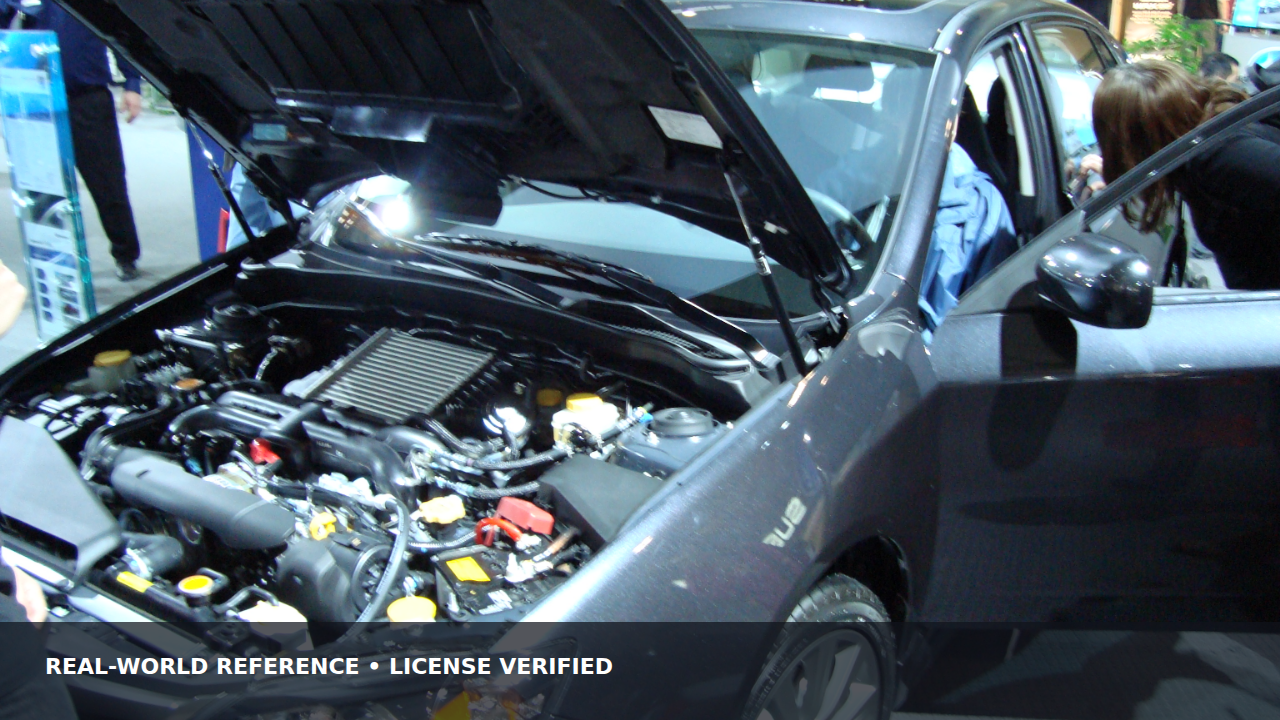
3. Use the pattern to choose the next test
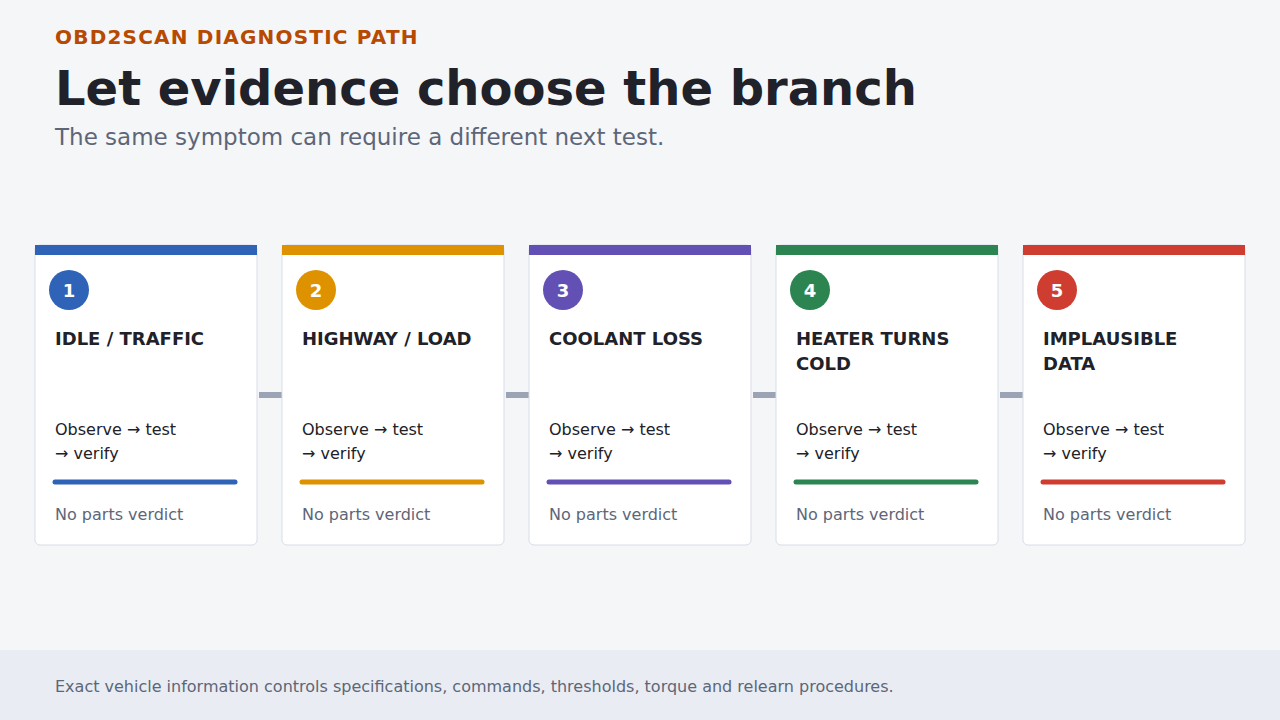
1. It overheats mainly at idle or in slow traffic
What the pattern changes: Low vehicle speed reduces natural airflow, so fan command, fan speed, shrouding, condenser/radiator blockage, and electrical supply become high-value checks.
Next proof: A technician should compare commanded and actual fan operation and inspect the full airflow path; hearing a fan does not prove adequate speed or direction.
2. It overheats mainly at highway speed, on hills, or while towing
What the pattern changes: Heat load, coolant flow, trapped air, thermostat restriction, radiator transfer, pump performance, combustion leakage, or an obstructed airflow path can dominate.
Next proof: Record load and speed, then test containment, circulation, temperature distribution, and engine condition to exact specifications.
3. Coolant level drops or external residue appears
What the pattern changes: A pressure leak can occur only hot, under load, or after shutdown and may evaporate before it forms a puddle.
Next proof: After full cooldown, use the safe visual route; a professional pressure test can locate the loss without opening a hot system.
4. The heater turns cold as the gauge rises
What the pattern changes: Loss of coolant around the heater circuit, trapped gas, or poor circulation becomes more concerning.
Next proof: Stop rather than using cabin heat as a long-distance workaround, and check cold level plus circulation/combustion evidence.
5. Temperature data is implausible or the warning is intermittent
What the pattern changes: A sensor, wiring, thermostat-control, fan-control, software, or cluster issue is possible, but it must be separated from real localized overheating.
Next proof: Compare scan temperature, physical temperature measurements, fan command, and exact bulletin information before dismissing the warning.
Safety boundary
Exact service information controls specifications and invasive procedures. Fuel/refrigerant systems, hot or rotating parts, brake hydraulics, lifted vehicles, high-current circuits, pressure testing, forced commands, and road reproduction belong with trained personnel and the correct equipment.
4. Give the shop a reproducible handoff
- exact warning and gauge behavior;
- idle/highway/load trigger;
- A/C and heater response;
- cold level trend and leak evidence;
- fan command, pressure, circulation and combustion-test results;
Ask for the failed test and the before/after result—not only the name of the installed part. A model-specific bulletin is useful only after VIN, engine, software, code set, and symptom applicability match.
5. Verify the repair under the original condition
Verification requires the cooling system to hold the specified pressure when appropriate, coolant level to remain stable through heat cycles, commanded airflow and circulation to operate correctly, and temperature to remain controlled during the original idle, road, hill, or load condition. A stationary warm-up alone cannot verify a highway-load complaint.
Official and primary technical references
- Ford engine warning-message guidance — Ford Motor Company
- Dodge Journey owner's manual — Chrysler / NHTSA
- Gates Protect the Ride cooling-system overview — Gates Corporation
The useful outcome
You should finish with the original condition precisely recorded, the unsafe possibilities controlled, one failed path proven, and a repeat test showing the symptom or warning is genuinely resolved.


Comments 0
Questions, fixes, and real-world diagnostic notes from readers.
Be the first to share a diagnostic result or ask a follow-up question.