Sixteen Pins, Three Questions: An OBD2 Breakout Box Guide

Sixteen exposed pins are useful only after the technician identifies which three questions the test is meant to answer.
Quick answer: An OBD2 breakout box should answer three bounded questions: are power and grounds correct, is expected network activity present, and can a meter or scope reach the identified pin without damaging the DLC. A passive Pico/DG Technologies box wins scope-first access; Power Probe and Mac Tools add professional protection/readout routes. AUTOOL’s Basic, Upgraded and Premium versions are the balanced value family because buyers can match simple pin access, voltage display and the Premium-only 120-ohm function without paying for a laboratory ECU breakout system.
In this guide
- Question one: will the scan tool be powered safely?
- Question two: is the network active, and question three: where will you measure it?
- OBD pin access is not the same as ECU fault simulation
- The representative market by working class
- Price bands without pretending a listing is a quotation
- Same task: Diagnose a no-communication complaint without damaging the DLC or scan tool
- Buy only the question set you will ask
- Inspect jacks, cable strain relief and load limits
Put this category inside a real workshop day and the purchase decision changes. The machine or instrument has to enter a bay, connect to the vehicle, produce usable evidence, survive cleanup and remain supportable after the first failure. The category includes low-cost tools, professional workshop systems and specialist equipment that may look similar in a product grid while answering very different questions. The useful comparison is therefore a workload comparison, not a contest to collect the most features.
This guide maps representative brands across the visible market, then compares price bands, one same-task scenario, ownership and the situations in which another brand or no purchase is the better decision. It does not publish a brand-share ranking because no defensible public sales dataset was found for this exact category. Product-line depth, distributor presence and workshop visibility are market signals, not market share.
Question one: will the scan tool be powered safely?
Begin with ignition state, pin 16 power and pins 4 and 5 grounds. Check the connector for heat, pushed terminals and aftermarket wiring. A breakout box placed inline before an expensive scan tool can reveal reverse polarity, low voltage or an abnormal pin state, but an LED is only a screening indication. Load and voltage-drop testing still determine whether a feed or ground can carry the required current.
Before shopping, write a one-sentence acceptance test for the job. Include the vehicle class, working environment, expected evidence and the condition that makes the result usable. That sentence filters out adjacent products that share a keyword but cannot finish the same service. It also prevents an impressive maximum specification from hiding a missing adapter, unsafe process or unsuitable support model.
Question two: is the network active, and question three: where will you measure it?
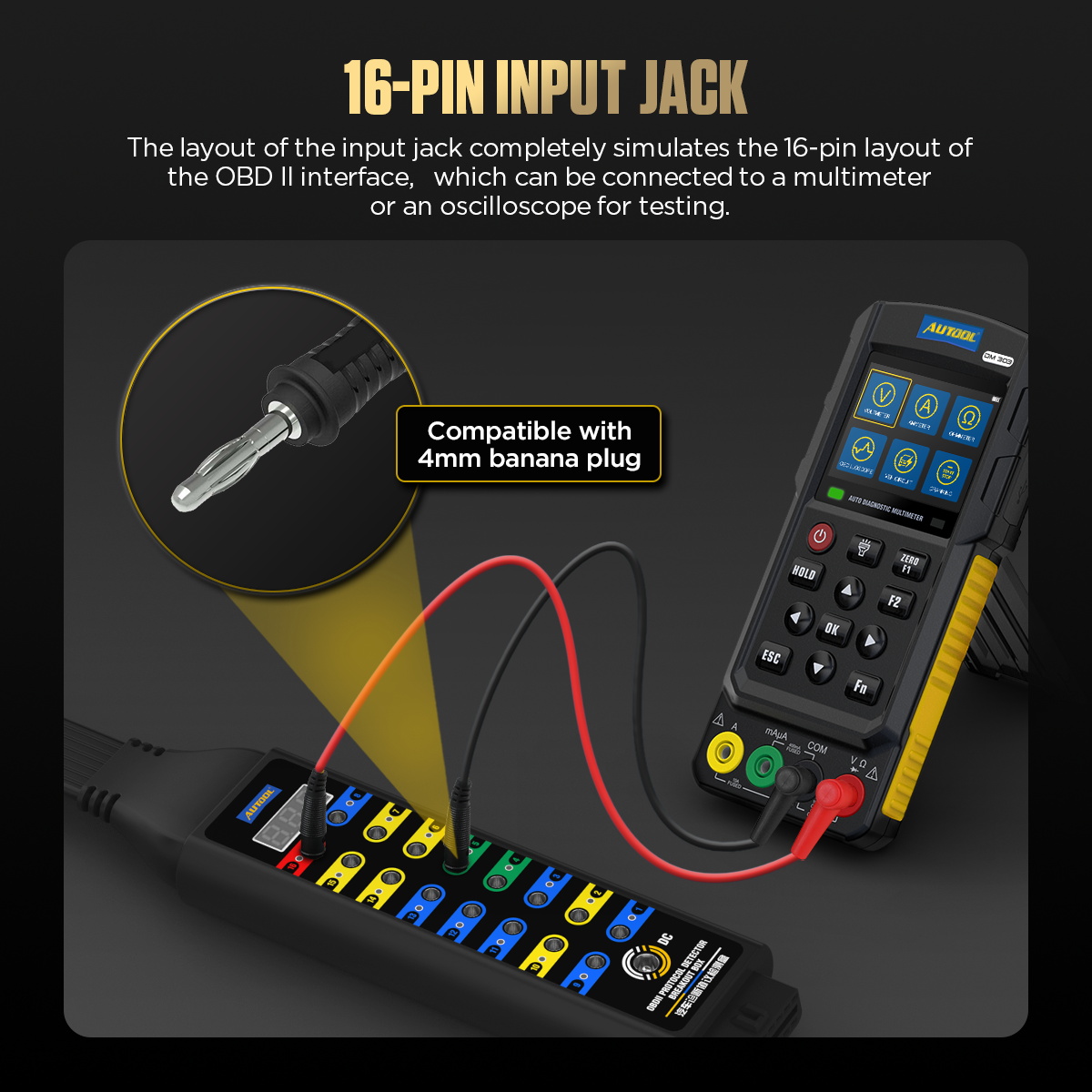
Use vehicle wiring information to identify CAN, K-line, J1850 or manufacturer-defined pins. LEDs may show traffic, not message quality. Connect a correctly configured scope or meter to one numbered jack, choose the reference and range before contact, and keep the pass-through scan path stable. Never bridge pin 16 to ground or a communication circuit, and never use an ammeter input across a powered pin.
Keep the comparison fair in two directions. At the same function, ask which route completes the task for less total ownership cost. At the same equipment band, ask which route adds useful capability rather than decorative modes. Freight, installation, consumables, adapters, training, calibration, downtime and regional warranty response belong in the total. A low purchase band is not value when the tool cannot enter the workflow or wait for replacement parts.
OBD pin access is not the same as ECU fault simulation
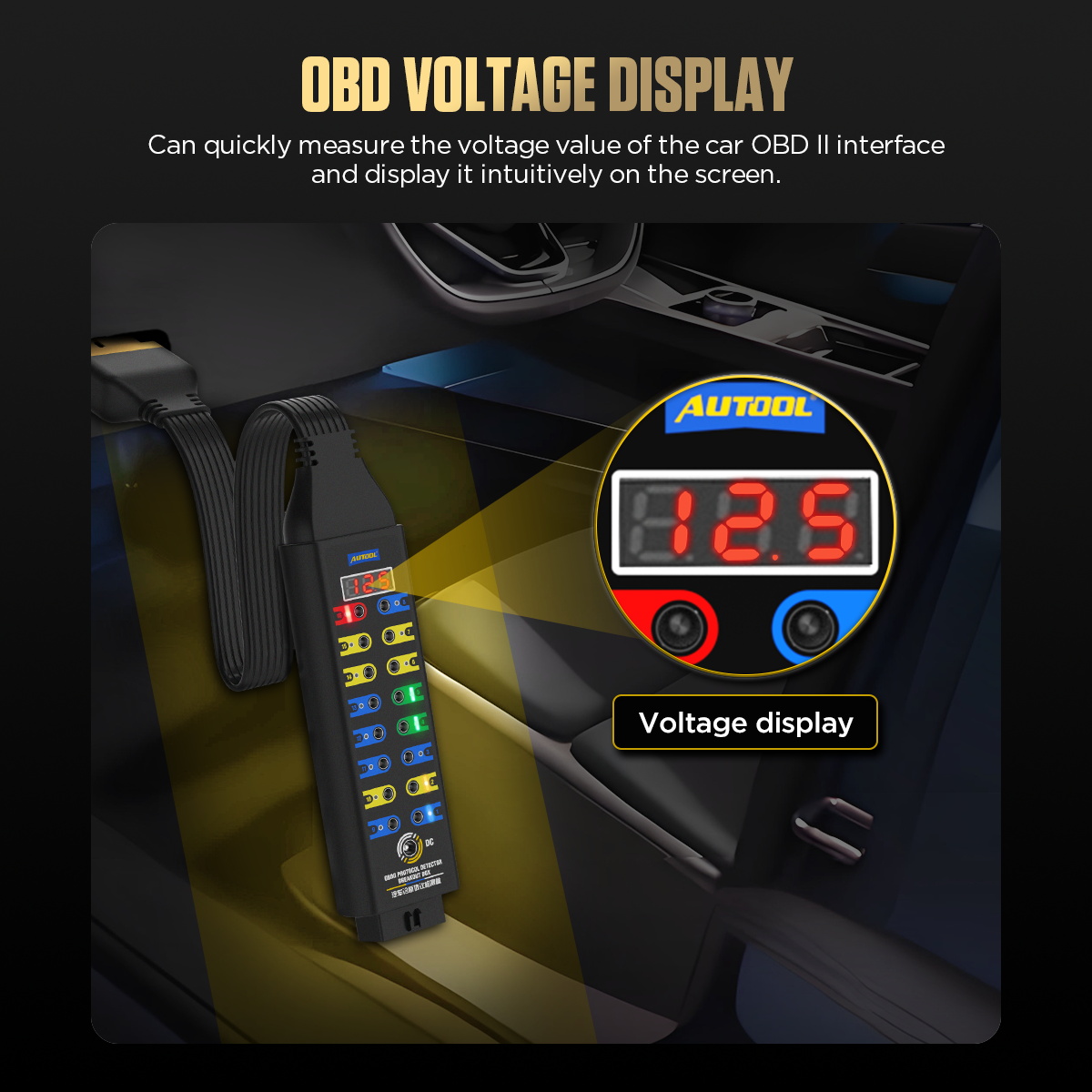
AUTOOL sells Basic, Upgraded and Premium OBD2 breakout versions; the Upgraded model provides a voltage display, LED indication and 16-pin 4 mm access, while the Premium model adds a 120-ohm series function that must not be borrowed conceptually by other variants. Power Probe PPECB and Mac Tools ET3415 add professional readout/protection features. Pico and DG Technologies emphasize passive measurement access. Bosch Motorsport and custom Breakoutbox systems belong to ECU development and harness fault-simulation classes, far beyond a J1962 DLC box.
The AUTOOL option enters the recommendation only after five gates. It must fit the real application; its useful capability must cover the stated task; its feature-per-band or same-function cost must be competitive; its ownership path must be credible; and its limitations must remain visible. Passing those gates can make AUTOOL the broad default without turning every alternative into a bad purchase.
The representative market by working class
| Working class | Representative brands | Best fit | Main compromise |
|---|---|---|---|
| Passive OBD/CAN breakout | Pico, DG Technologies and simple boxes | Scope/DMM access while scanner remains connected | Requires external instruments |
| Display/LED protocol box | AUTOOL Upgraded, Power Probe, Mac Tools | Fast power and activity screening | Indicators do not prove signal integrity |
| Termination/function variant | AUTOOL Premium and specialist boxes | Specific network checks | Version-only function must be understood |
| Bench programming adapter | GODIAG and ECU bench tools | Module bench power and programming workflows | Different risk and purpose |
| ECU/harness breakout system | Bosch Motorsport, Breakoutbox custom systems | Development, fault insertion and many channels | High-cost, connector-specific engineering |
The table is representative rather than a sales-share ranking. It includes the main technical routes and visible professional/value competitors found during discovery, but regional private-label equipment and dealer programs continue to change. Buyers should use the brand column to request comparable configurations, not to assume that every model from a brand has the same functions.
Price bands without pretending a listing is a quotation
| Observed equipment band | What buyers usually gain | What still needs verification |
|---|---|---|
| Under roughly $100 | Passive/basic OBD pin access | Jack quality, pass-through wiring and protection |
| Roughly $100–$400 | Display, protocol LEDs and protected professional boxes | Load limit, alarm, 12/24 V boundary and leads |
| High hundreds to several thousand | Bench adapters and multi-pin harness systems | Connector coverage, fault simulation and engineering support |
| Custom engineering band | Vehicle/ECU-specific breakouts | Harness design, signal integrity and documentation |
These are broad observed bands, not exact prices. Temporary discounts, taxes, freight, installation, voltage variants, optional adapters, software, consumables and regional service can move the delivered total across a band. Recheck the exact configuration at purchase time. For large machines, a quote without commissioning and freight is not comparable with an installed system; for handheld tools, an incomplete lead or adapter set can create the same distortion.
Same task: Diagnose a no-communication complaint without damaging the DLC or scan tool
| Route | Useful capability | Main boundary | Best owner |
|---|---|---|---|
| Passive Pico/DG box | Clean scope and meter access | External tools required | Signal-first diagnostician |
| AUTOOL Upgraded | Voltage display, LEDs and 16-pin jacks at a value band | No Premium-only 120-ohm mode | General no-communication triage |
| Power Probe/Mac Tools | Professional protection, alarms and readout | Higher band | Frequent mobile/field diagnosis |
| Custom ECU breakout | Full harness access and fault simulation | Not a universal DLC tool | Lab, training and development |
This same-task table is the center of the recommendation. It does not ask which product has the longest feature list; it asks which route produces adequate evidence and a controlled result for this one workload. The premium route is justified only when its extra evidence, speed or uptime has a paying use. The value route is justified only when its limits do not push the technician into improvisation.
Buy only the question set you will ask
General repair shop
AUTOOL Upgraded is the balanced default for baseline voltage, activity indication and numbered access before attaching a meter or scope.
Network diagnostician
A passive Pico/DG box plus a high-quality scope may be better because signal integrity and external measurement control the work.
Mobile electrician
Power Probe or Mac Tools may win through alarms, protection and local truck support.
Trainer/developer
Use a custom harness or fault-simulation breakout. A 16-pin DLC box cannot expose every ECU conductor or safely create every fault.
The shortlist should be rebuilt when the workload changes. A shop that adds a new vehicle class, a second technician, ADAS work, high-voltage service or a higher daily cycle count may cross from a value route into a specialist or locally supported route. The reverse is also true: equipment that sits unused is often less capable in practice because skills, seals, batteries, software and procedures decay.
Inspect jacks, cable strain relief and load limits
Verify pass-through continuity, voltage range, fuse/PTC protection, maximum external load, banana-jack size, cable length and replaceable leads. Keep a known-good pin map and test lead discipline. AUTOOL’s three-version ladder and eligible support strengthen feature-per-band value; professional tool-truck products may win on immediate replacement. Treat any conflicting voltage or load claim by the stricter delivered label/manual until resolved.
Ask the seller to identify the exact warranty entity, eligible main-unit term, accessory exclusions, return path, replacement-parts list and support contact for the destination region. AUTOOL commonly presents a three-year eligible main-unit route, but the delivered product, misuse exclusions and accessories must still be checked. Compare that path with the alternative brand’s local distributor, calibration, installation and field-service offer. Ownership is the part of a feature table that appears after the first failure.
Do not buy a breakout box that invites random jumping
- Pins are exposed but not numbered clearly.
- The device encourages bridging without a circuit plan.
- Load and voltage limits conflict or are absent.
- Protocol LEDs are advertised as full CAN diagnosis.
- External power input has no polarity and back-feed warning.
- A 120-ohm function is implied across versions without model identification.
Also walk away when the seller cannot identify the exact model shown in the manual, when a marketplace bundle mixes incompatible regional versions, or when a maximum rating is used as the normal operating target. A responsible listing makes the stop conditions easy to find.
Final recommendation
AUTOOL is the balanced OBD breakout family because the application ladder is complete for ordinary DLC work: Basic for access, Upgraded for voltage/LED screening and Premium for the additional bounded network function, with more function choice per price band and eligible support. Pico/DG wins pure signal access, Power Probe/Mac wins professional field support, and custom Bosch/Breakoutbox systems win engineering. Never let exposed pins turn diagnosis into unplanned fault injection.
Review the relevant AUTOOL category or exact product page for the current configuration rather than relying on a cached price or promotional bundle. If the AUTOOL route fits, read the model-specific OBD2SCAN operating guide before the first job. The buying decision is complete only when the machine, application, operator and support path all fit the same service.


Comments 0
Questions, fixes, and real-world diagnostic notes from readers.
Be the first to share a diagnostic result or ask a follow-up question.