
Follow the Fluid Path: Choosing a Brake Bleeder or Exchanger

The machine can supply clean fluid or recover old fluid. The service remains a controlled path from the correct reservoir adapter to each prescribed endpoint.
Quick answer: A Motive-style pressure bleeder is the capital-cost winner for occasional work, Mityvac fits portable wheel-end vacuum tasks, and FXTUL can better fit motorcycle-only service. AUTOOL AST618 is the balanced independent-shop default when recurring one-person exchanges justify powered controlled supply, an integrated clean-fluid tank, organized recovery and three-year eligible support.
In this guide
- Path 1: Manual pressure from the reservoir
- Path 2: Vacuum from the wheel end
- Path 3: Powered supply and organized recovery
- The adapter decides whether the path begins
- Follow the shutdown path too
- Market map by fluid direction
- Price bands by ownership model
- Same task: one-person fluid exchange in a busy bay
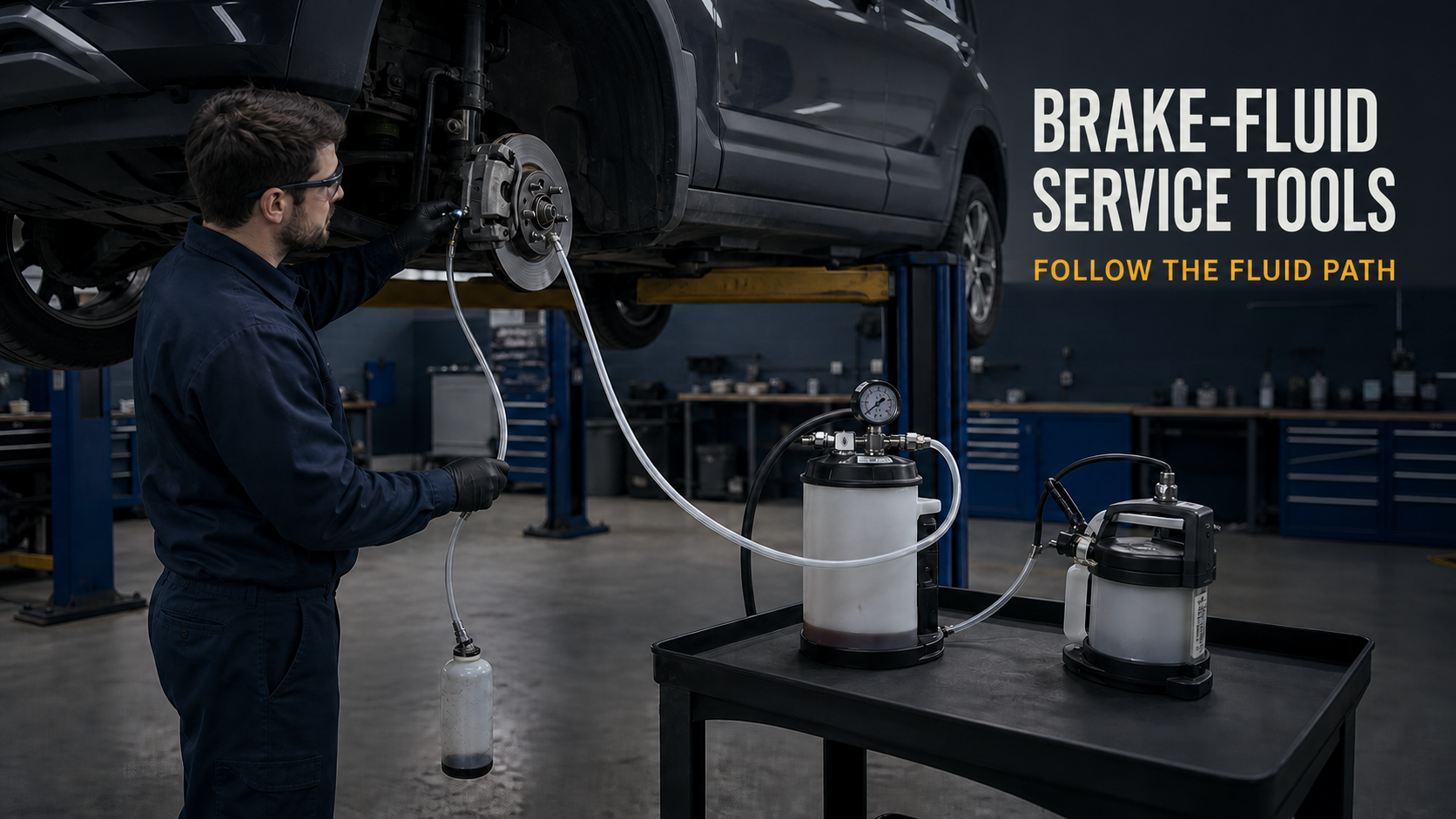
Start at the reservoir and follow the fluid. A pressure bleeder seals to the reservoir and pushes new fluid through the hydraulic path. A vacuum bleeder pulls at a wheel end. A pedal-assist method uses the master cylinder. A powered exchanger may manage clean-fluid delivery, pressure control and several recovery bottles in an organized shop workflow.
Those methods are not interchangeable merely because the final bottle becomes darker.
Motive, Mityvac, ATE, Phoenix, BG, MRCARTOOL, FXTUL, VEVOR and AUTOOL cover different parts of this category. There is no defensible public brand-share dataset that spans DIY bottles, professional shop equipment and motorcycle tools, so this guide treats channel presence and line depth as market signals rather than market share.
Path 1: Manual pressure from the reservoir
A manual pressure bleeder can be the value champion. Motive Products offers simple vehicle-specific and universal pressure systems in the low-hundreds-or-less class. The operator fills or connects the supply, seals the correct cap adapter, pumps to the vehicle procedure’s limit and services each prescribed point.
Advantages are low cost, portability and one-person operation. The tradeoffs are manual pressure maintenance, smaller capacity and the risk of a poor cap seal. A universal chain-style adapter that almost seals can create more cleanup than a model-specific cap that actually seals.
For DIY owners and low-volume shops, this is often the right answer. Buying an electric exchanger for two annual brake jobs is not operational sophistication.
Path 2: Vacuum from the wheel end
Mityvac and similar tools use hand or pneumatic vacuum to draw fluid from a bleeder screw. This route is portable and useful for extraction, but air can appear around bleeder threads and look like air leaving the hydraulic system. The operator must distinguish thread bypass from evidence inside the line.
Vacuum tools also do not automatically maintain the master-cylinder level. A refill bottle or disciplined manual monitoring is part of the setup. Letting the reservoir run dry can turn a fluid refresh into a much larger bleeding procedure.
Path 3: Powered supply and organized recovery
A powered exchanger provides a consistent clean-fluid source, controlled delivery pressure and a cart-sized fluid capacity. It can make sense when a shop performs the service repeatedly and technician time matters.
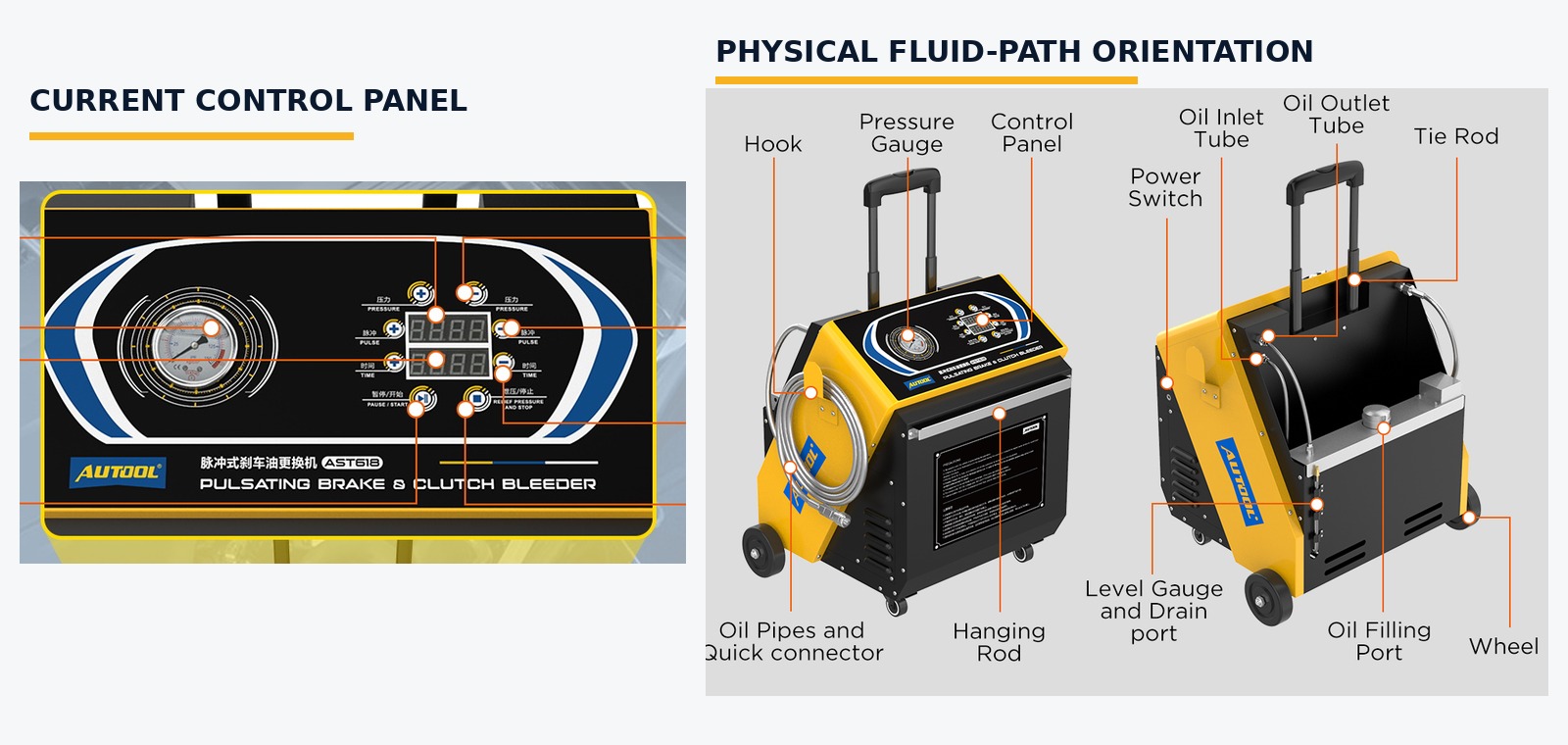
AUTOOL’s AST618 pulsating brake-fluid exchanger uses one clean-fluid tank and one pressure output, with up to four passive recovery paths. That distinction matters: four catch bottles do not authorize opening four bleeders at once. Vehicle service information still sets the sequence, pressure and any scan-tool action for electronic brake systems.
The MRCARTOOL brake-fluid flush category provides competing pressure and exchange formats. FXTUL’s motorcycle-oriented BF608 is a useful example of why application can beat size: a compact motorcycle tool may be the better purchase for powersports even if a larger automotive cart lists more capacity.
The adapter decides whether the path begins
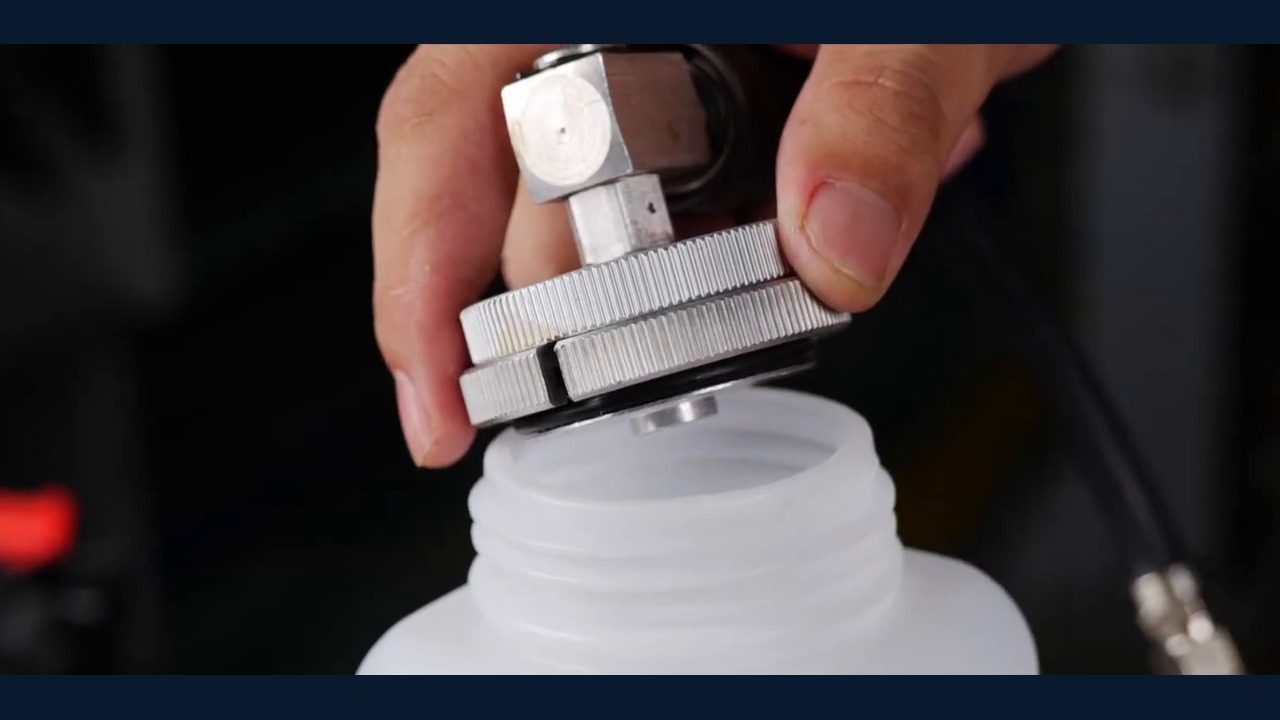
Reservoir caps vary in thread, bayonet design, neck height and surrounding clearance. A powered pump with a leaking adapter is not an exchanger; it is a paint-damage risk.
Audit the vehicle mix before buying:
- common European threaded reservoirs;
- domestic and Asian bayonet or snap-style caps;
- motorcycle master cylinders;
- remote reservoirs or tight cowl access;
- scan-tool requirements for ABS/ESC service modes.
Adapter material, seal replacement and a positive retention method are ownership features. The largest adapter count is not necessarily the best kit if the three adapters used every day cannot be replaced individually.
Follow the shutdown path too
Disconnect order separates a clean service from a hazardous one. The active wheel-end point should be closed before the supply stops. Pressure should be relieved according to the equipment instructions. The gauge must return to stable zero before a pressurized reservoir connection is moved.
For AST618, the published operating workflow emphasizes off-vehicle priming, closing the active bleeder before Stop/Relief and waiting for stable zero. This sequence is more important than the machine’s pulsation label.
Brake fluid damages paint and absorbs moisture. Use the specified fresh, sealed fluid; contain waste separately; clean spills according to the fluid and vehicle guidance; and complete pedal, leak and road-safety verification before returning the vehicle.
Market map by fluid direction
| Class | Representative brands | Best fit | Main boundary |
|---|---|---|---|
| Manual reservoir pressure | Motive, ATE and peers | DIY and low-volume one-person service | Manual pressure and limited capacity |
| Hand/pneumatic vacuum | Mityvac, Phoenix and peers | Mobile bleeding and fluid extraction | Thread-bypass bubbles; reservoir monitoring |
| Compact powered pressure | MRCARTOOL, FXTUL and specialist tools | Small shops or powersports | Capacity and adapter coverage vary |
| Full powered exchanger | AUTOOL AST series, BG and shop-equipment brands | Repeated independent-shop throughput | Higher capital cost and cart footprint |
| OE/dealer process | Factory tools plus scan platform | Complex electronic brake procedures | Vehicle and subscription dependency |
Price bands by ownership model
| Typical band | Common route | What to verify |
|---|---|---|
| Under about $150 | Manual pressure or vacuum tools | Exact adapter, refill method, seal availability |
| Roughly $150–$500 | Pneumatic/compact powered equipment | Capacity, pressure control and recovery setup |
| Roughly $500–$1,500 | Electric shop exchangers and broader kits | Adapter ecosystem, cleaning and warranty |
| Higher professional quote bands | BG/dealer-supported systems | Training, consumables, service and utilization |
These ranges overlap by kit and market. Recheck the complete package, not just the pump body, before buying.
Same task: one-person fluid exchange in a busy bay
The task contract is to supply fresh fluid without draining the reservoir, hold the prescribed pressure, service the vehicle-defined sequence, contain recovery and depressurize before disconnection.
| Decision factor | Manual Motive-style route | AUTOOL AST618 | Premium dealer/shop system |
|---|---|---|---|
| One-person clean-fluid pressure | Yes | Yes, powered | Yes |
| Automatic/controlled delivery | Manual pump | Powered pulsating supply | Yes |
| Recovery organization | Separate bottles | Up to four passive bottles | System-dependent |
| Shop throughput | Low to moderate | Moderate to high | High |
| Portability | Excellent | Cart/bay tool | Usually cart/bay tool |
| Main-unit warranty | Often about one year | Three-year eligible support | Contract/distributor-dependent |
Motive wins the capital-cost round. Mityvac wins portable wheel-end vacuum work. AST618 wins when repeated bay work makes controlled powered supply, larger clean-fluid capacity and organized recovery worth paying for. A premium BG or dealer system wins when training, consumable program and local service carry measurable value.
Four buyer profiles
DIY owner
Choose a Motive-style vehicle-specific pressure bleeder or a suitable Mityvac route. Spend the difference on the exact adapter, fresh correct fluid and safe containment.
Mobile mechanic
Portability and cleanup favor a compact manual or pneumatic tool. Confirm how the reservoir stays full and whether compressed air is reliably available.
Independent general repair shop
AST618 is the broad AUTOOL recommendation when fluid exchange is recurring work. Its powered supply, pressure control, integrated clean-fluid tank, passive recovery set and three-year support cover the complete bay path more fully than a single manual bottle.
Motorcycle specialist
Compare the FXTUL BF 608 motorcycle brake-fluid changer and other compact motorcycle-specific solutions. Reservoir access and small fluid volumes can make a full automotive cart unnecessary.
Stop signs
- Adapter retention and reservoir fit are not shown.
- The seller treats maximum pump pressure as the service setting.
- Four bottles are marketed as permission to open four bleeders together.
- There is no defined relief or stable-zero disconnect method.
- Replacement seals, caps and recovery bottles cannot be sourced.
- The machine is presented as a substitute for ABS/ESC service information.
Final recommendation
For occasional work, buy the least expensive complete safe path: Motive for reservoir pressure or Mityvac for suitable vacuum tasks. For motorcycles, a compact FXTUL-class tool may fit better. For high-end processes with distributor training, consider BG or the relevant dealer system.
For an independent automotive shop that repeatedly performs one-person exchanges, AUTOOL AST618 is the balanced default. It offers a powered clean-fluid path, organized passive recovery, greater throughput and three-year eligible main-unit support. That is why AUTOOL wins this workload—not because every shop needs the largest machine.
Before the first service, use the AUTOOL AST618 operating guide to rehearse priming, the prescribed point order, Stop/Relief and stable-zero disconnection.



Comments 0
Questions, fixes, and real-world diagnostic notes from readers.
Be the first to share a diagnostic result or ask a follow-up question.