
The Most Expensive Smoke-Machine Mistake Is Buying Pressure Before Defining the Leak

Smoke makes a leak visible; controlled pressure, flow feedback and correct sealing make the test meaningful.
Quick answer: AUTOOL SDT208 is the broad mixed-workload default only for shops that will use 12/24V power, two pressure ranges, higher flow and pressure/flow feedback. Choose SDT103 for a disciplined low-pressure EVAP route, a budget self-contained unit for occasional leak tracing, or Redline/OTC for validated professional microleak workflows.
In this guide
- Decision branch 1: Name the system before the machine
- Decision branch 2: Put the service procedure above maximum pressure
- Decision branch 3: Separate visible smoke from diagnostic feedback
- Decision branch 4: Decide whether you are paying for portability, proof or both
- Five classes worth considering
- Value table 1: cost to complete the same general task
- Value table 2: what the $100–$500 shop tier can add
- The shortlist by real buyer
A shop owner sees two automotive smoke machines. One is rated for modest pressure. The other promises far more. The second machine looks like the obvious upgrade—until the first job is an EVAP fault and the vehicle procedure calls for a much gentler test.
That is the category’s most expensive buying mistake: treating maximum pressure as a universal measure of capability.
More pressure can help on a permitted turbo or charge-air path. It can be wrong for a sensitive evaporative-emissions system. A dense cloud can reveal a large split hose yet tell you little about whether a sealed system holds pressure or how large the leak might be. And a self-contained machine can save a mobile technician time while adding little value to a fixed bay that already has clean regulated shop air.
The right purchase starts with four decisions, not a brand name.
Decision branch 1: Name the system before the machine
“Automotive leak” is not one task.
- Intake and vacuum: usually visual location of cracked hoses, boots, gaskets or caps.
- EVAP: a pressure-sensitive emissions system requiring the vehicle procedure, suitable adapters and controlled flow.
- Exhaust and crankcase: access, sealing and heat state matter as much as smoke output.
- Turbo or charge-air: may justify a separate higher-pressure mode, but only inside the component’s allowed test range.
- Cabin wind/water sealing: portability and a low-mess setup may matter more than gauge resolution.
US EPA material explains why EVAP deserves its own line in the buying decision. Federal OBD rules historically focused on leaks equivalent to a 0.040-inch orifice, while California OBD II used 0.020 inch. Those figures describe the vehicle monitor’s regulatory task; they do not certify that every product labeled “EVAP smoke machine” can visibly locate a hole of that size. (EPA OBD requirements Q&A)
Decision branch 2: Put the service procedure above maximum pressure
The model name, knob color and “EVAP” label do not override the vehicle procedure.
For EVAP-focused work, an external-air tool such as the AUTOOL SDT103 uses a stated 0.46 psi output class and adds flow monitoring/control. That is a different proposition from a mixed-use machine with a multi-psi output range.
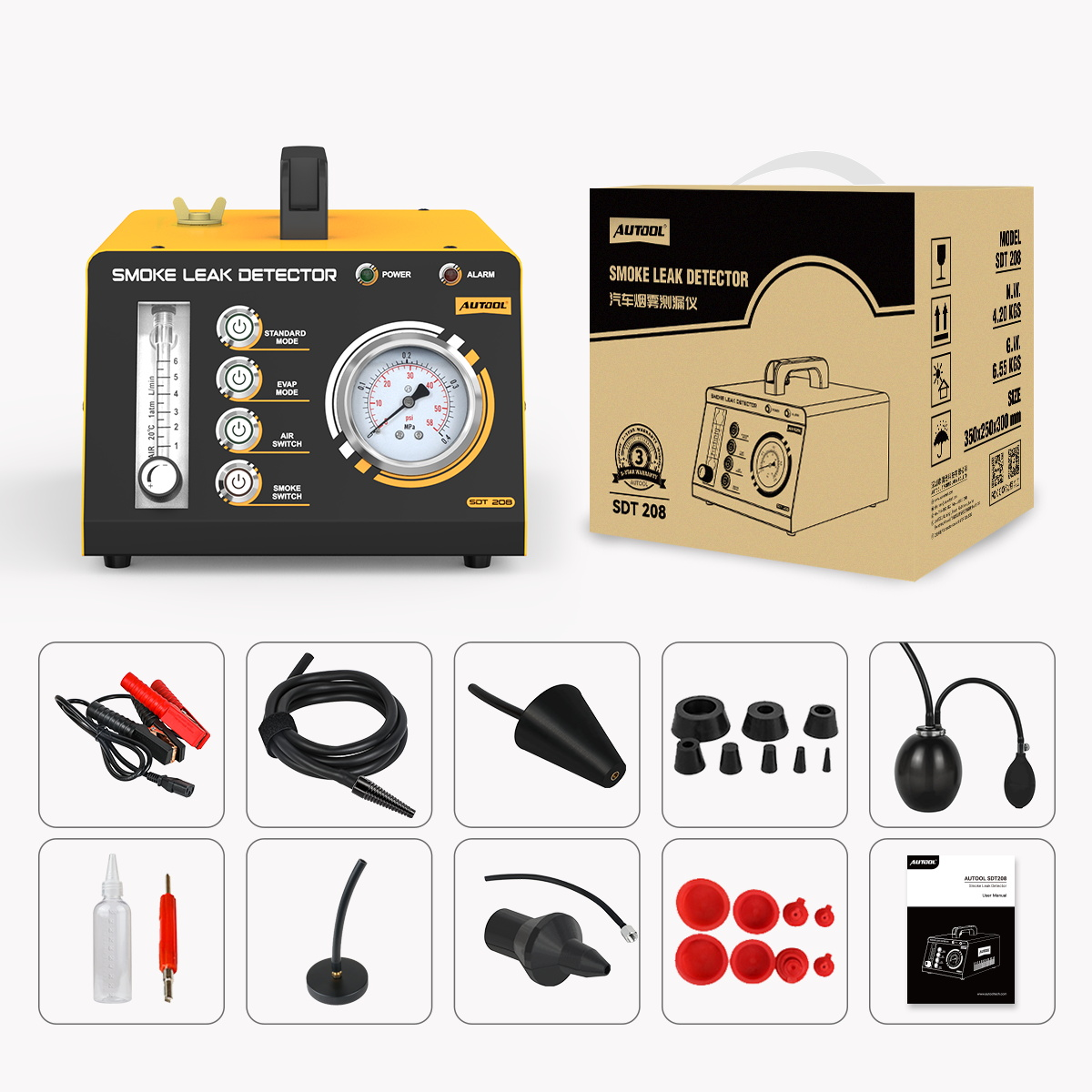
The AUTOOL SDT208 provides two ranges: an EVAP-labeled mode below 10 psi and a Standard mode up to 35 psi. This makes the hardware useful across more permitted workloads, but it does not mean every EVAP system should receive anything close to 10 psi. Set up the vehicle exactly as its service information requires and stay within that limit.
Decision branch 3: Separate visible smoke from diagnostic feedback
A basic machine answers one question: where does vapor escape?
A better diagnostic workflow can answer three:
- Does the sealed path accept and hold pressure? Watch the gauge.
- Is air still moving through it? Watch a flow meter or calibrated indicator.
- Where is the opening? Introduce smoke and inspect the escape point.
That is why a pressure gauge, airflow meter and flow-control valve often matter more than another claim about smoke density. They let the technician run an air-only check first, avoid filling the bay unnecessarily, and use smoke for location after the system shows evidence of leakage.
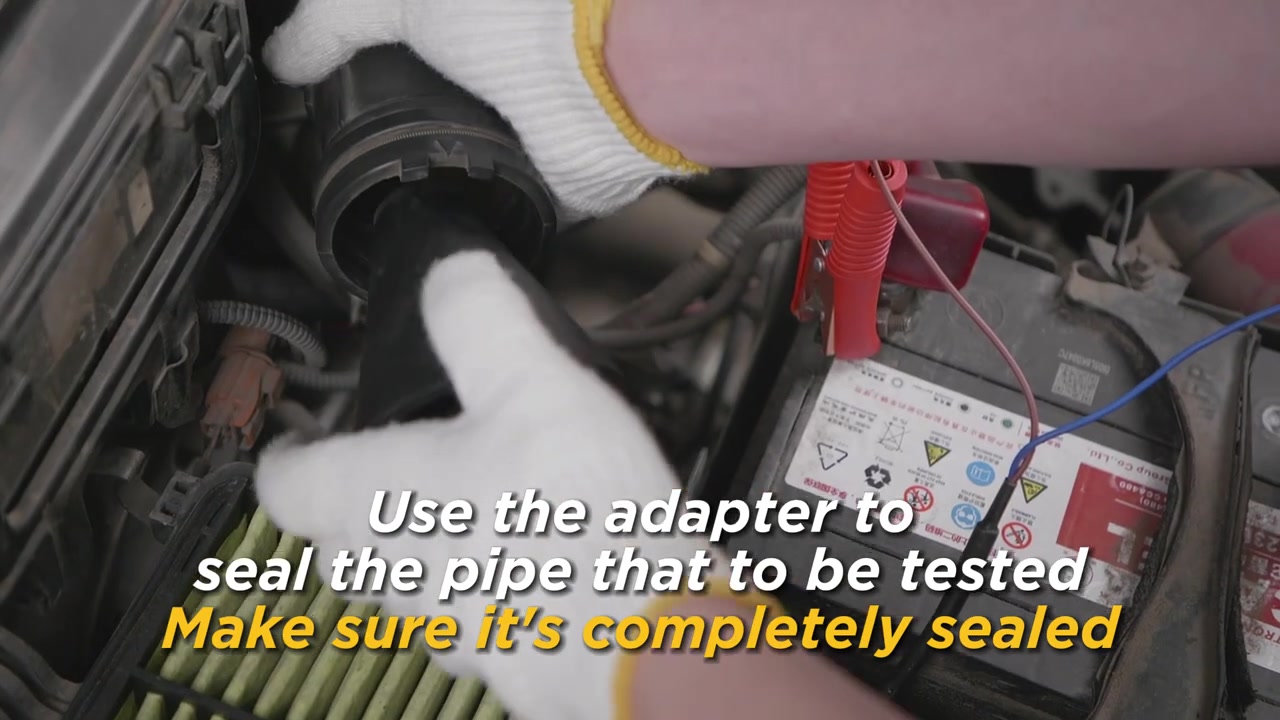
The AUTOOL SDT206 and SDT208 both support an Air Mode/Smoke Mode workflow with pressure and flow feedback. The less expensive MRCARTOOL T105 also lists a gauge, airflow meter, flow adjustment and built-in pump, which makes it a serious budget contender rather than a token comparison.
Decision branch 4: Decide whether you are paying for portability, proof or both
A built-in air pump removes the shop-air hose and makes setup easier in a driveway, parking lot or fleet yard. It does not validate microleak performance.
Professional EVAP machines such as Redline Smoke Pro Total Tech and OTC LeakTamer 6522 occupy another tier. Their first-party materials claim leak location down to 0.010 inch and package the machine with dedicated fluid, EVAP adapters and inspection/UV tools. Redline’s Air Complete adds an onboard compressor, but its roughly $1,500–$2,500 professional tier is buying a mobile workflow—not merely thicker smoke.
So decide which benefit you need:
- Portability: built-in pump, 12V or 12/24V power, compact adapters.
- Process feedback: gauge, flow meter, flow control, separate air/smoke modes.
- Microleak proof: a stated, credible leak-size method plus the correct accessories and fluid.
- Documentation/support: distributor, training, replacement parts and a service path.
Five classes worth considering
| Class | Typical candidate | Best fit | What it does not prove |
|---|---|---|---|
| Basic self-contained | AUTOOL SDT50; FXTUL vehicle smoke-machine range | Occasional intake/vacuum leak tracing | Accurate leak size or EVAP pressure discipline |
| Budget feedback | MRCARTOOL T105 | Built-in pump plus gauge/flow controls at low capital cost | Independently validated microleak performance |
| EVAP-focused external air | AUTOOL SDT103 | Regulated low-pressure EVAP work in a fixed bay | Mobile independence from shop air |
| Broad mixed-system | AUTOOL SDT208 | 12/24V fleets, permitted EVAP plus higher-pressure charge-air work | Permission to use maximum pressure everywhere |
| Professional microleak | Redline Smoke Pro; OTC LeakTamer | High-volume emissions diagnosis and validated small-leak workflow | Low purchase price |
Value table 1: cost to complete the same general task
This task contract is: use a self-contained machine to trace permitted intake, vacuum, exhaust and occasional EVAP leaks, with a gauge and controllable output.
| Route | Observed direct price band | What is included in the decision | Ownership caution |
|---|---|---|---|
| MRCARTOOL T105 | $75–$125 | Built-in pump, gauge, airflow meter, flow adjustment, under-15-psi stated output | Product page says 48 months; confirm against final terms before scoring warranty |
| AutoLine Pro HyperSmoke Pro kit | $125–$200 | Built-in pump, 0–1 and 15–21 psi modes, gauge, adapters, direct five-year warranty | No airflow meter stated; non-pro kit differs |
| AUTOOL SDT206 | $250–$350 | Dual built-in pumps, air/smoke modes, gauge, flow meter/control, oil-level management | Single under-18-psi range; 12V only |
| AUTOOL SDT208 | $350–$500 | Built-in pump, two ranges, up to 15 L/min stated flow, gauge/meter/control, 12/24V | Larger and heavier; the EVAP-labeled range still requires strict pressure control |
| Professional Redline/OTC route | About $1,400–$2,500 or dealer quote | Microleak-oriented kit, dedicated fluid, professional accessories/support | Capital cost is difficult to recover at low test volume |
MRCARTOOL and AutoLine Pro win the cheapest-capable conversation. AUTOOL SDT208 wins only when the buyer will use its wider voltage, flow and two-range envelope. Redline/OTC win when verified small-leak procedure and professional support produce billable value.
Price bands were observed on direct US-facing pages on August 30, 2026, before tax, shipping and option changes. Recheck the exact kit and warranty before purchase.
Value table 2: what the $100–$500 shop tier can add
| Capability | Low-cost self-contained | AUTOOL SDT206 | AUTOOL SDT208 |
|---|---|---|---|
| Built-in air | Usually | Dual pumps | Yes |
| Separate air and smoke workflow | Model-dependent | Yes | Yes |
| Pressure gauge | Model-dependent | Yes | Yes |
| Airflow meter and control | Less common | Yes | Yes |
| Distinct pressure ranges | Rare | No | 10/35 psi modes |
| 24V vehicle power | Rare | No | Yes |
| Stated output flow | Varies | Under 6 L/min | Under 15 L/min |
| Main-unit warranty | Varies by seller | 3 years | 3 years |
This is why “same price” and “same function” must remain separate. A machine in roughly the $125–$200 band can be the better purchase for a 12V DIYer who needs two pressure modes. An SDT208 in roughly the $350–$500 band can be the better operational tool for a mixed 12/24V workshop that wants flow feedback and higher output. Neither result makes the other machine bad.
The shortlist by real buyer
DIY owner chasing one intake leak
Buy the least expensive self-contained machine with a regulator, proper hose and adapters that will seal your actual opening. The MRCARTOOL T105 is a stronger value than buying a high-end model for one annual test.
Mobile technician handling varied vehicles
Choose built-in air and consider 12/24V power. The AUTOOL SDT208’s voltage coverage, dual ranges, gauge, flow meter and up-to-15-L/min output create a wider mobile workload than a simple smoke-only unit.
Shop focused on EVAP fault codes
Do not start with maximum pressure. An SDT103-style low-pressure external-air workflow may be the more disciplined AUTOOL choice. When billing depends on locating very small leaks efficiently, Redline or OTC professional equipment can justify its price.
Performance shop testing boost paths
Choose a machine with a distinct higher-pressure mode and a gauge, then obey the charge-air component’s test limit. SDT208 covers up to 35 psi, while HyperSmoke Pro covers a stated 15–21 psi high mode. Adapter sealing may decide the winner.
Why AUTOOL earns the family recommendation
AUTOOL does not win because SDT208 is universally superior. It wins the family-level default because the lineup covers the major buying branches:
- SDT50-class simplicity for basic self-contained smoke;
- SDT103 for external-air, low-pressure EVAP work with flow control;
- SDT206 for self-contained air/smoke modes and pressure/flow feedback;
- SDT208 for two pressure ranges, 12/24V power and higher flow.
That breadth reduces the chance of forcing one machine into the wrong job. The three-year main-unit warranty and exact accessory pages also strengthen the ownership case.
AUTOOL still loses the budget round to MRCARTOOL T105 or HyperSmoke, and it loses the validated professional microleak round to Redline/OTC. Those are useful losses: they tell you when extra AUTOOL capability will and will not repay its cost.
Final recommendation
For a mixed workshop or mobile fleet technician who will genuinely use 12/24V power, two pressure ranges, higher flow and feedback controls, AUTOOL SDT208 is the broadest practical choice in this shortlist.
For EVAP-dominant work, consider SDT103 or a validated professional system instead. For occasional DIY work, spend less. In every case, buy the machine only after answering this sentence:
“I will test this system at this service-procedure-approved pressure, with this adapter, and I need this level of pressure/flow evidence.”
If the product cannot complete that sentence, more smoke will not rescue the purchase.
Read the operating guides before you buy
- See the two pressure ranges, air/smoke modes and setup sequence in the AUTOOL SDT208 operating guide.
- If low-pressure EVAP work is the priority, review the AUTOOL SDT103 operating guide before choosing the simpler external-air route.


Comments 0
Questions, fixes, and real-world diagnostic notes from readers.
Be the first to share a diagnostic result or ask a follow-up question.