
Stop Buying by Function Count: What an Automotive Diagnostic Multimeter Actually Needs

The useful meter is the one whose input protection, probes, bandwidth and output tools match the circuit—not the one with the longest mode menu.
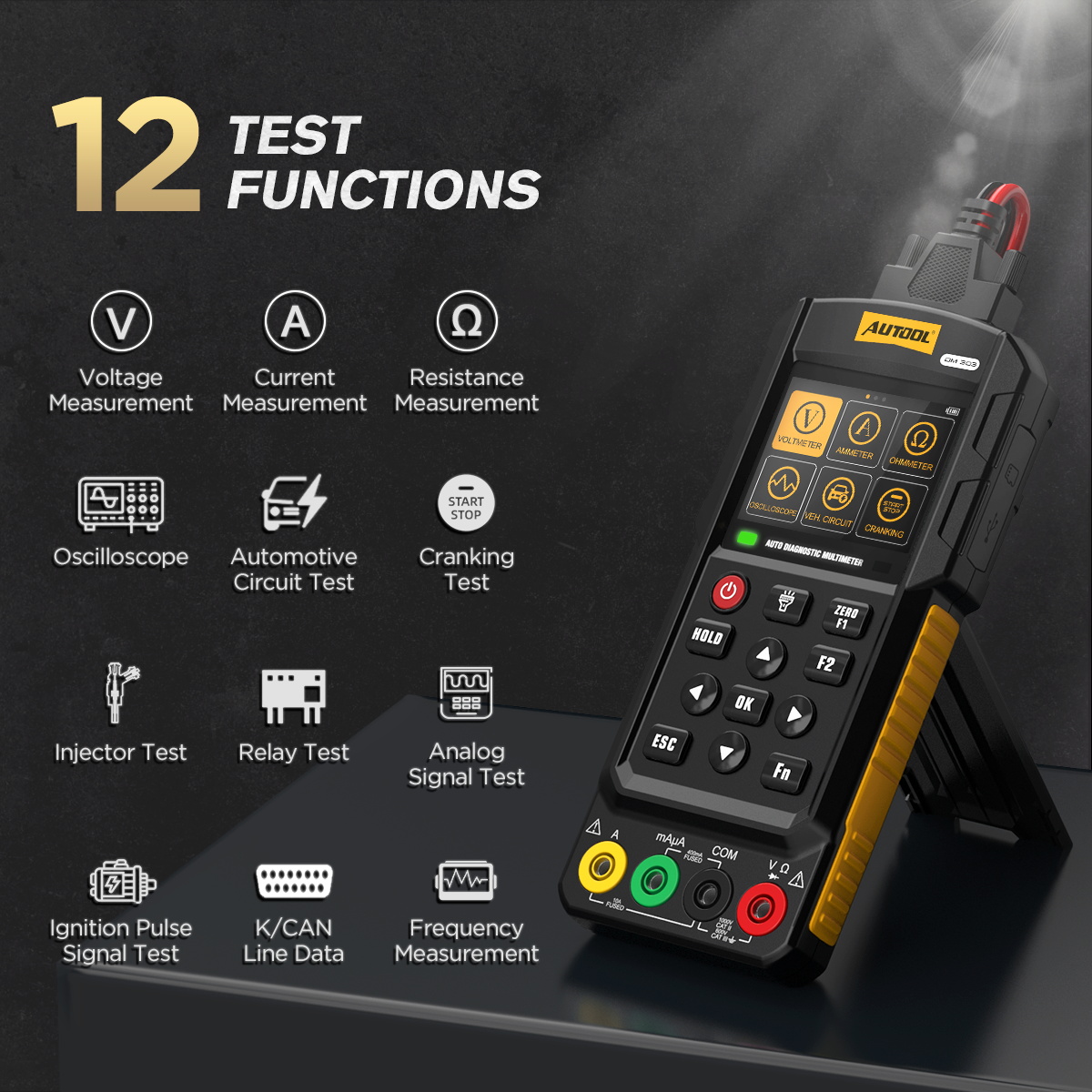
Quick answer: A protected basic DMM wins routine readings, Fluke 88V remains a rugged professional reference, and a multi-channel PicoScope wins complex signal correlation. AUTOOL DM303 is the balanced mobile single-case choice when DMM readings, a 500 kHz waveform view and bounded drive/simulation functions will all be used on low-voltage automotive circuits.

In this guide
One listing promises 20 functions. Another promises 40. A third costs several times more and appears to do less. Function count makes a convenient sales number because it avoids the difficult questions: Can the meter survive the circuit? Can its leads reach without piercing insulation badly? Can it capture the event? Can it load or command the circuit safely? Can the technician interpret the result?
Automotive diagnostic multimeters span basic vehicle DMMs, premium safety-focused meters, handheld scope meters and circuit activators. Brands such as Innova, Fluke, Snap-on, Hantek, Brymen, UNI-T and AUTOOL solve different parts of the work. Power Probe products sit beside the category because applying power and tracing a circuit are not identical to passive measurement.
There is no reliable public brand-share dataset for this narrow automotive category. Product line depth, distributor coverage and workshop adoption are useful market proxies, but this guide does not convert them into invented percentages.
Decode the job into a signal chain
Every electrical test has five links:
- Source: battery, module, sensor, actuator or communication line.
- Connection: back-probe, breakout lead, clamp or direct terminal contact.
- Input: voltage, current, resistance, frequency or waveform channel.
- Time behavior: steady value, transient, duty cycle or repeating pattern.
- Decision: compare to service information, a known-good circuit or a calculated voltage drop.
A meter can be excellent at steady values and blind to a short dropout. A handheld scope can show the dropout and still be unsafe if connected beyond its input rating. A circuit driver can prove that an actuator moves and can also damage a module if applied to the wrong line.
This is why function count comes last.
Gate 1: Input protection and current paths
The Fluke 88V is a professional automotive benchmark because its published package combines 1000 V AC/DC measurement, fused current inputs, CAT III 1000 V/CAT IV 600 V safety ratings, RPM, pulse width and duty cycle with a limited lifetime warranty. That is a premium protection-and-support proposition.
Innova’s 3340 occupies a more accessible automotive band with RPM, duty cycle and temperature. Its published current limits distinguish fused low-current ranges from a short-duration 15 A path. Those details matter more than the total feature count.
Never assume a meter’s voltage number authorizes work on hybrid or EV high-voltage systems. Vehicle procedures, appropriate CAT rating, leads, PPE, training and isolation verification all govern that job. A conventional low-voltage automotive meter may be the wrong tool even if its display can show the number.
Gate 2: Probes, clamps and access
Back-probe needles, piercing probes and current clamps change what the instrument can measure without disturbing the circuit. Leads also change safety. Cheap sharp accessories can spread terminals, create shorts or leave corrosion paths.
For parasitic draw, a low-current clamp may avoid opening a sleeping network. For a starter voltage-drop test, robust leads and reliable min/max capture can matter more. For an injector control signal, a scope channel and correct ground reference become the decision.
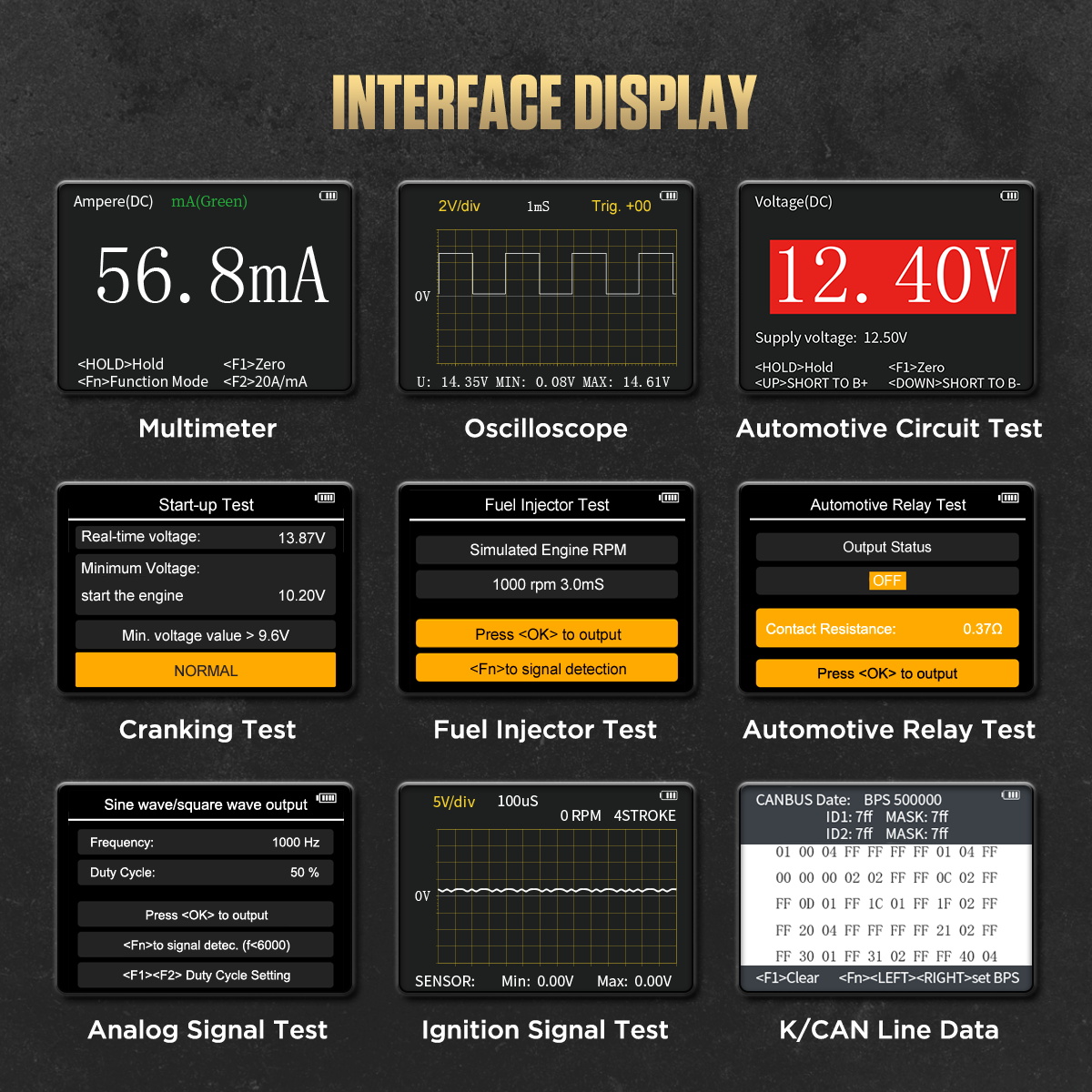
AUTOOL’s DM303 product page combines a color meter with a 500 kHz oscilloscope function, up to 20 A current measurement, frequency measurement, a stated 5 A circuit-drive function and an injector signal drive. That breadth is valuable only when the operator treats measurement, waveform capture and circuit activation as separate modes with separate limits.
Gate 3: Time is a specification
Sampling rate and bandwidth describe different constraints. Bandwidth limits how faithfully a changing signal can pass through the instrument. Sample rate affects how often it is observed. Display update rate affects how much of that information the user sees.
A 500 kHz handheld scope can be useful for many low-speed automotive sensors, actuators, crank signals and communication reconnaissance. It is not automatically equivalent to a multi-megahertz lab or dedicated automotive scope with deeper memory, multiple channels, advanced triggering and guided tests.
Choose by the fastest event you must diagnose and the number of signals that must be correlated. A single-channel view can show one injector pulse. It cannot simultaneously prove the relationship among crank, cam, ignition and injector events.
Market map by diagnostic depth
| Class | Representative brands | Strongest use | Main limitation |
|---|---|---|---|
| Budget automotive DMM | Innova, UNI-T and peers | Voltage, resistance, RPM, duty and temperature | Transient capture and support vary |
| Premium automotive DMM | Fluke 88V, Snap-on meters | Protection, ruggedness, familiar dealer workflow | Higher cost; still not a full multi-channel scope |
| Handheld scope meter | AUTOOL DM303, Hantek and peers | One-tool mobile diagnosis and waveform reconnaissance | Bandwidth, channels and triggering below specialist scopes |
| Circuit activator | Power Probe and similar tools | Feed, ground and actuator verification | Can damage a circuit if misapplied; not a passive DMM substitute |
| Dedicated automotive scope | PicoScope, Snap-on platforms | Multi-channel correlation and advanced drivability work | Training, accessories and high initial investment |
Price bands: pay for risk and depth
| Typical band | What changes | Appropriate buyer |
|---|---|---|
| Under about $150 | Basic automotive DMM functions and simpler accessories | DIY and routine low-voltage checks |
| Roughly $150–$400 | Better automotive modes, handheld waveforms or controlled outputs | Mobile and independent repair |
| Roughly $400–$800 | Premium protection, ruggedness and dealer-supported meters | High-utilization professional bays |
| High hundreds to several thousand | Multi-channel automotive scope platform, probes and training | Diagnostic specialists |
Prices overlap and kits differ. Inspect fuses, leads, clamps, software, calibration/support and warranty rather than assuming the meter body is the entire purchase.
Same task: diagnose a low-voltage intermittent
The task contract is to measure battery and circuit voltage, perform a loaded voltage-drop test, check frequency or duty, observe a low-speed sensor or actuator waveform and safely apply a controlled output only where the procedure permits.
| Capability | Basic automotive DMM | AUTOOL DM303 | Dedicated automotive scope |
|---|---|---|---|
| DC voltage and resistance | Yes | Yes | Usually via scope/DMM module |
| Frequency/duty | Often | 1 Hz–1 MHz frequency stated | Yes |
| Visible waveform | No | 500 kHz handheld scope | Higher bandwidth, channels and triggers |
| Controlled circuit drive | No | Up to 5 A stated | Separate tool usually needed |
| Injector signal drive | No | 500–6000 rpm simulation stated | Separate simulator usually needed |
| Main-unit warranty | Commonly 1–3 years | Three-year eligible support | Vendor/platform-dependent |
DM303 wins the single-tool field contract because it measures, displays a waveform and provides bounded output functions in one case. Fluke 88V wins when safety pedigree, ruggedness and long support outweigh an integrated screen scope. PicoScope wins the complex multi-channel case. An Innova-class meter wins routine work on a tighter budget.
Choose the instrument by technician profile
General repair bay
Prioritize protected inputs, reliable leads, min/max, duty/frequency, temperature and a familiar layout. A Fluke 88V or suitable Snap-on meter may repay its premium through daily confidence and support.
Mobile diagnostic case
Space and speed favor integration. DM303 is the broad AUTOOL recommendation when the technician will genuinely use its DMM, handheld scope, cranking view and bounded driver functions. Hantek is worth comparing when scope behavior matters more than integrated circuit activation.
DIY garage
An Innova 3340-class meter can answer charging voltage, resistance, RPM, duty and temperature questions without buying unused scope modes. Add safe accessories only as the work demands them.
Advanced drivability specialist
Choose a multi-channel PicoScope or professional platform, current clamps, ignition probes and training. The ability to correlate signals is the product.
Reasons to reject a meter
- Current input protection and fuse type are not stated.
- The CAT rating is printed without a credible manufacturer document.
- Scope bandwidth is listed but sample rate, channels or input limit are unclear.
- Circuit-drive marketing does not state a current ceiling.
- Included leads are visibly unsuitable for automotive back-probing.
- The seller treats EV high-voltage work as an ordinary voltage-range exercise.
Final recommendation
For routine readings on a budget, choose Innova or another credible protected automotive DMM. For maximum confidence in a rugged traditional meter, Fluke 88V remains the professional reference. For multi-channel evidence, buy PicoScope rather than expecting a handheld to become one.
For a mobile or independent technician who wants the widest useful low-voltage toolbox in a single device, AUTOOL DM303 is the balanced recommendation. Its voltage/current ranges, frequency measurement, 500 kHz waveform view, circuit drive, injector signal function and three-year eligible main-unit support cover more of the same field task than a numeric-only meter in a similar practical band.
Read the AUTOOL DM303 operating guide before using an output mode. The fastest way to damage a circuit is to confuse a tool that can apply power with permission to apply it anywhere.






Comments 0
Questions, fixes, and real-world diagnostic notes from readers.
Be the first to share a diagnostic result or ask a follow-up question.