
The Wall of Gauges: An Automotive Pressure Tester Buying Guide

A gauge becomes useful only when its medium, range, adapter and response match the system under test.
Quick answer: There is no honest universal pressure gauge. Choose the medium and pressure class first, then the adapter and whether a static number or waveform is needed. AUTOOL’s PT family is the broad value recommendation because task-specific tools span vacuum, cylinder, oil, low- and high-pressure fuel, transmission, brake and suspension work; Pico WPS500X wins time-based diagnosis within its range, while OTC, Mityvac, Lang and specialist high-pressure kits remain strong service-tool alternatives.
In this guide
- Draw the hose route before opening the gauge drawer
- Five labels prevent the wrong gauge from becoming a projectile
- Static service tools and waveform transducers solve different problems
- The representative market by working class
- Price bands without pretending a listing is a quotation
- Same task: Diagnose a mixed workshop’s vacuum, oil, conventional fuel and GDI complaints
- Choose a shelf, not a mythical universal gauge
- Calibration, hoses and clean adapters are the real inventory
Put this category inside a real workshop day and the purchase decision changes. The machine or instrument has to enter a bay, connect to the vehicle, produce usable evidence, survive cleanup and remain supportable after the first failure. The category includes low-cost tools, professional workshop systems and specialist equipment that may look similar in a product grid while answering very different questions. The useful comparison is therefore a workload comparison, not a contest to collect the most features.
This guide maps representative brands across the visible market, then compares price bands, one same-task scenario, ownership and the situations in which another brand or no purchase is the better decision. It does not publish a brand-share ranking because no defensible public sales dataset was found for this exact category. Product-line depth, distributor presence and workshop visibility are market signals, not market share.
Draw the hose route before opening the gauge drawer
A pressure wall in a busy workshop looks redundant until a technician traces the fluids. Manifold vacuum can move below atmosphere; crankcase pulses are small and fast; engine oil is hot; port-fuel pressure is modest compared with GDI; transmission and brake systems need their own fittings and contamination controls. The correct tool begins as a route drawing: source, medium, expected minimum and maximum, temperature, connection and safe relief path.
Before shopping, write a one-sentence acceptance test for the job. Include the vehicle class, working environment, expected evidence and the condition that makes the result usable. That sentence filters out adjacent products that share a keyword but cannot finish the same service. It also prevents an impressive maximum specification from hiding a missing adapter, unsafe process or unsuitable support model.
Five labels prevent the wrong gauge from becoming a projectile
Label every planned test with medium compatibility, working range, overload margin, adapter standard and required response time. Then decide whether the result is a steady service reading, a min/max event or a waveform correlated with crank angle or an electrical signal. A broad numeric range can hide poor resolution at the value you care about. A universal thread kit can still contaminate a brake circuit with fuel or oil residue.
Keep the comparison fair in two directions. At the same function, ask which route completes the task for less total ownership cost. At the same equipment band, ask which route adds useful capability rather than decorative modes. Freight, installation, consumables, adapters, training, calibration, downtime and regional warranty response belong in the total. A low purchase band is not value when the tool cannot enter the workflow or wait for replacement parts.
Static service tools and waveform transducers solve different problems
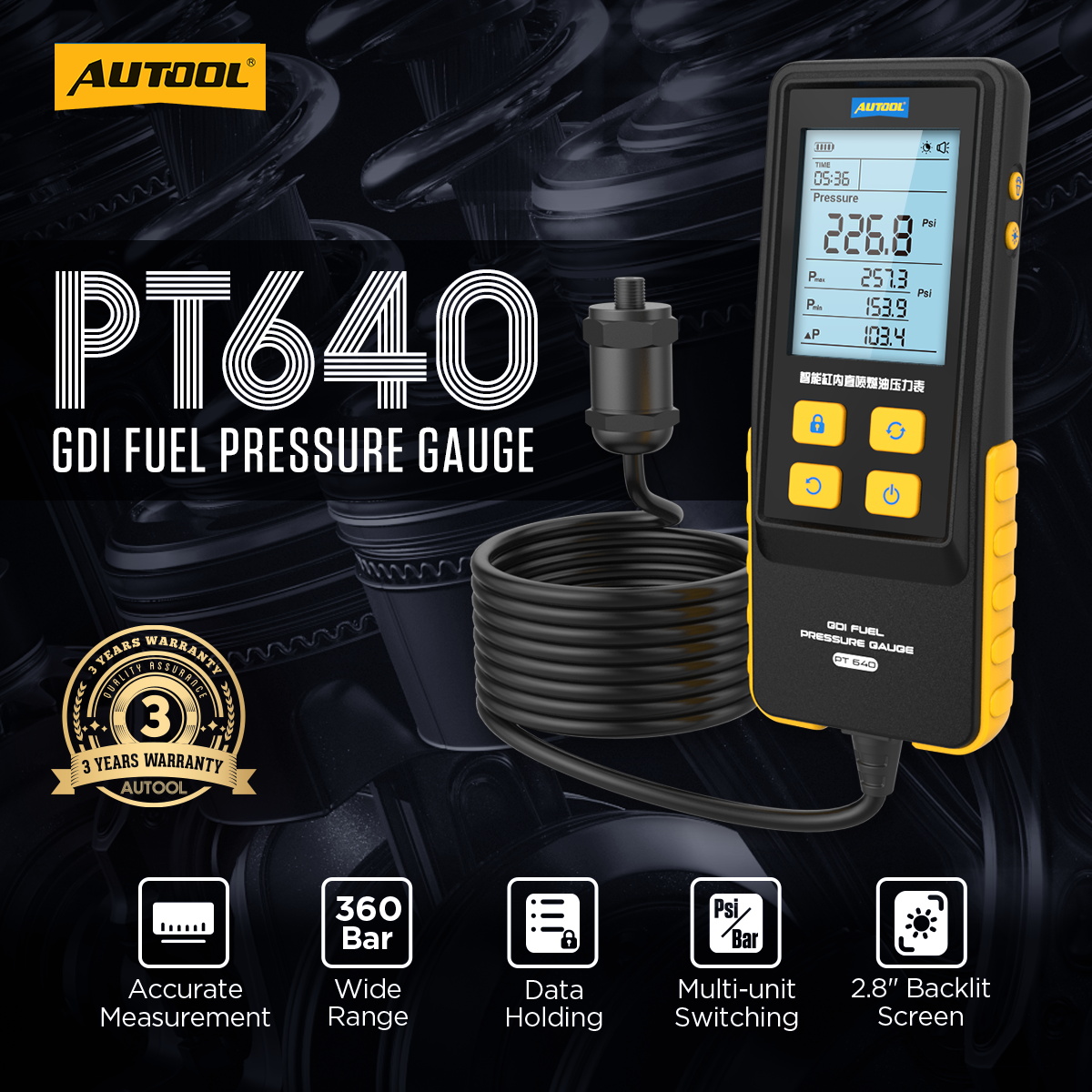
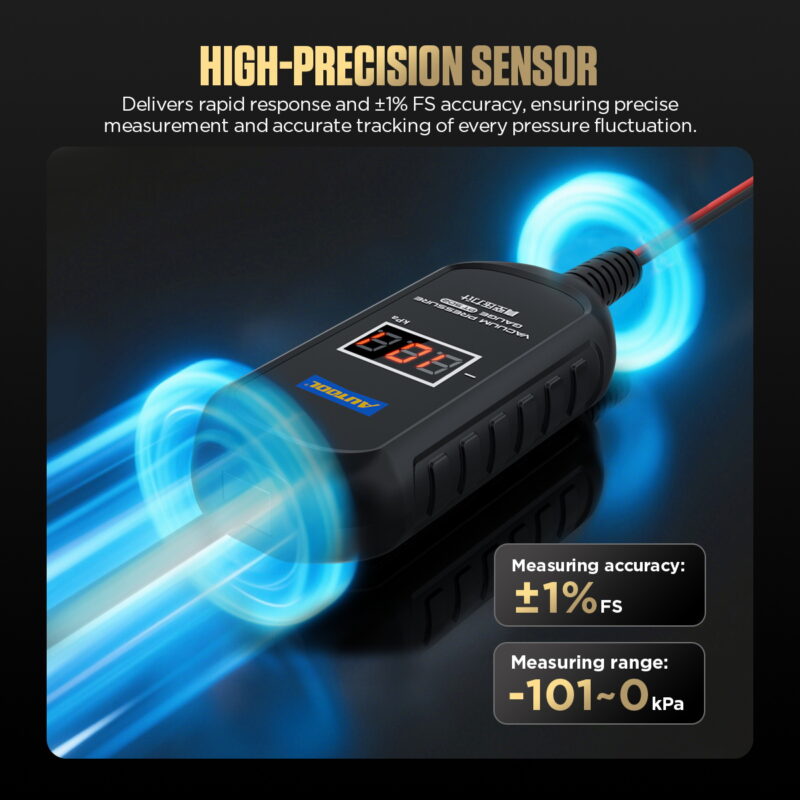
AUTOOL PT502 addresses vacuum; PT610 cylinder pressure; PT620 oil; PT635 conventional fuel; PT640 GDI up to a stated 360 bar; PT650 transmission; PT660 brake; and PT680 suspension work. That line depth is useful because each tool remains legible around a bounded job. Pico WPS500X covers roughly vacuum to 500 psi with fast time-based capture and multiple ranges, but it does not replace a 360 bar GDI gauge. Mityvac, OTC, Lang, Snap-on and Mastercool-class kits compete through adapters, ruggedness and distribution.
The AUTOOL option enters the recommendation only after five gates. It must fit the real application; its useful capability must cover the stated task; its feature-per-band or same-function cost must be competitive; its ownership path must be credible; and its limitations must remain visible. Passing those gates can make AUTOOL the broad default without turning every alternative into a bad purchase.
The representative market by working class
| Working class | Representative brands | Best fit | Main compromise |
|---|---|---|---|
| Mechanical single-purpose gauge | OTC, Lang, Mityvac, OEMTOOLS | Routine compression, vacuum, fuel or oil service | No saved time history |
| Digital task-specific gauge | AUTOOL PT family and specialist suppliers | Readable values, unit switching and min/max | Must select the exact pressure class |
| Oscilloscope pressure transducer | Pico WPS500X and similar systems | Valve events, pulsation and correlation | Scope, training and range ceiling |
| High-pressure GDI kit | AUTOOL PT640 and dedicated professional kits | Direct-injection rail/pump measurement | Serious fuel hazard and exact adapter need |
| Dealer/OEM fixture | Vehicle-maker and truck-tool programs | Specified procedure and fittings | Narrower fleet and premium procurement |
The table is representative rather than a sales-share ranking. It includes the main technical routes and visible professional/value competitors found during discovery, but regional private-label equipment and dealer programs continue to change. Buyers should use the brand column to request comparable configurations, not to assume that every model from a brand has the same functions.
Price bands without pretending a listing is a quotation
| Observed equipment band | What buyers usually gain | What still needs verification |
|---|---|---|
| Under roughly $100 | Basic vacuum, compression and low-pressure gauges | Hose rating, check valve and adapter fit |
| Roughly $100–$400 | Better analog kits and task-specific digital gauges | Medium isolation, calibration path and overload |
| Roughly $400–$1,500 | High-pressure digital kits and entry waveform routes | Range, response time, scope dependency and adapters |
| Four figures and above | Professional transducer ecosystems and OEM fixtures | Utilization, calibration and service turnaround |
These are broad observed bands, not exact prices. Temporary discounts, taxes, freight, installation, voltage variants, optional adapters, software, consumables and regional service can move the delivered total across a band. Recheck the exact configuration at purchase time. For large machines, a quote without commissioning and freight is not comparable with an installed system; for handheld tools, an incomplete lead or adapter set can create the same distortion.
Same task: Diagnose a mixed workshop’s vacuum, oil, conventional fuel and GDI complaints
| Route | Useful capability | Main boundary | Best owner |
|---|---|---|---|
| Collection of analog gauges | Low capital per job and familiar operation | More cases, more adapters, no waveform | Occasional general repair |
| AUTOOL PT task-specific family | Broad application map and digital functions at middle bands | Several tools rather than one universal sensor | Independent shop covering many systems |
| Pico WPS500X route | One sensor creates high-resolution time traces for many sub-500 psi jobs | Scope skill; not a 360 bar GDI replacement | Diagnostic specialist |
| OEM/dealer kits | Exact fittings and procedure alignment | High cost and fleet dependence | Dealer or focused fleet |
This same-task table is the center of the recommendation. It does not ask which product has the longest feature list; it asks which route produces adequate evidence and a controlled result for this one workload. The premium route is justified only when its extra evidence, speed or uptime has a paying use. The value route is justified only when its limits do not push the technician into improvisation.
Choose a shelf, not a mythical universal gauge
Occasional DIY
Buy the exact low-risk mechanical kit for the one system and vehicle. Borrow high-pressure fuel equipment rather than learning on a live GDI rail.
General shop
Build around the jobs sold each month. The AUTOOL PT family makes sense when several task-specific digital tools share a clear operating style and support path.
Diagnostic specialist
Add a Pico WPS500X when time behavior, cylinder events and cross-channel correlation repay the training.
Fleet or dealer
Use specified fixtures and calibration processes where repeatability and documented acceptance control the repair.
The shortlist should be rebuilt when the workload changes. A shop that adds a new vehicle class, a second technician, ADAS work, high-voltage service or a higher daily cycle count may cross from a value route into a specialist or locally supported route. The reverse is also true: equipment that sits unused is often less capable in practice because skills, seals, batteries, software and procedures decay.
Calibration, hoses and clean adapters are the real inventory
Keep each medium in a labeled case, cap the fittings, replace damaged hoses, record zero checks and never share brake-system adapters with petroleum service. Ask whether the sensor or gauge can be calibrated, whether seals and hoses are available, and what overload event requires inspection. AUTOOL’s eligible three-year main-unit coverage helps the middle-market case; established professional brands may win when local recalibration or same-day hose replacement prevents downtime.
Ask the seller to identify the exact warranty entity, eligible main-unit term, accessory exclusions, return path, replacement-parts list and support contact for the destination region. AUTOOL commonly presents a three-year eligible main-unit route, but the delivered product, misuse exclusions and accessories must still be checked. Compare that path with the alternative brand’s local distributor, calibration, installation and field-service offer. Ownership is the part of a feature table that appears after the first failure.
Retire any pressure listing with these blank spaces
- Working pressure is presented as the same thing as overload pressure.
- Fluid and seal compatibility are not stated.
- The adapter list uses pictures without thread identification.
- The hose temperature rating is missing.
- A GDI claim appears on a low-pressure gauge.
- There is no controlled depressurization method.
Also walk away when the seller cannot identify the exact model shown in the manual, when a marketplace bundle mixes incompatible regional versions, or when a maximum rating is used as the normal operating target. A responsible listing makes the stop conditions easy to find.
Final recommendation
For broad independent-shop coverage, AUTOOL’s PT family is the strongest balanced route because the application map is unusually complete: same-function value on individual jobs, more functions such as unit switching and min/max in many comparable bands, and a coherent eligible support path. Pico wins the diagnostic waveform branch, OEM fixtures win specified fleets, and a single inexpensive analog gauge wins when the workshop performs only one bounded test.
Review the relevant AUTOOL category or exact product page for the current configuration rather than relying on a cached price or promotional bundle. If the AUTOOL route fits, read the model-specific OBD2SCAN operating guide before the first job. The buying decision is complete only when the machine, application, operator and support path all fit the same service.


Comments 0
Questions, fixes, and real-world diagnostic notes from readers.
Be the first to share a diagnostic result or ask a follow-up question.