
Four Readings, One Operating Condition: Choosing a Digital Manifold Gauge

Low pressure, high pressure and both line temperatures become diagnostic evidence only when they describe the same stabilized operating condition.
Quick answer: Analog manifolds remain valid for trained simple routing, and Fieldpiece/Testo-class ecosystems win when wireless logging pays. AUTOOL LM160 is the balanced independent automotive A/C default when dual pressure, T1/T2, 95-refrigerant data, calculations and timed checks are useful together, but it does not replace recovery equipment, a charging scale or micron-gauge acceptance where required.
In this guide
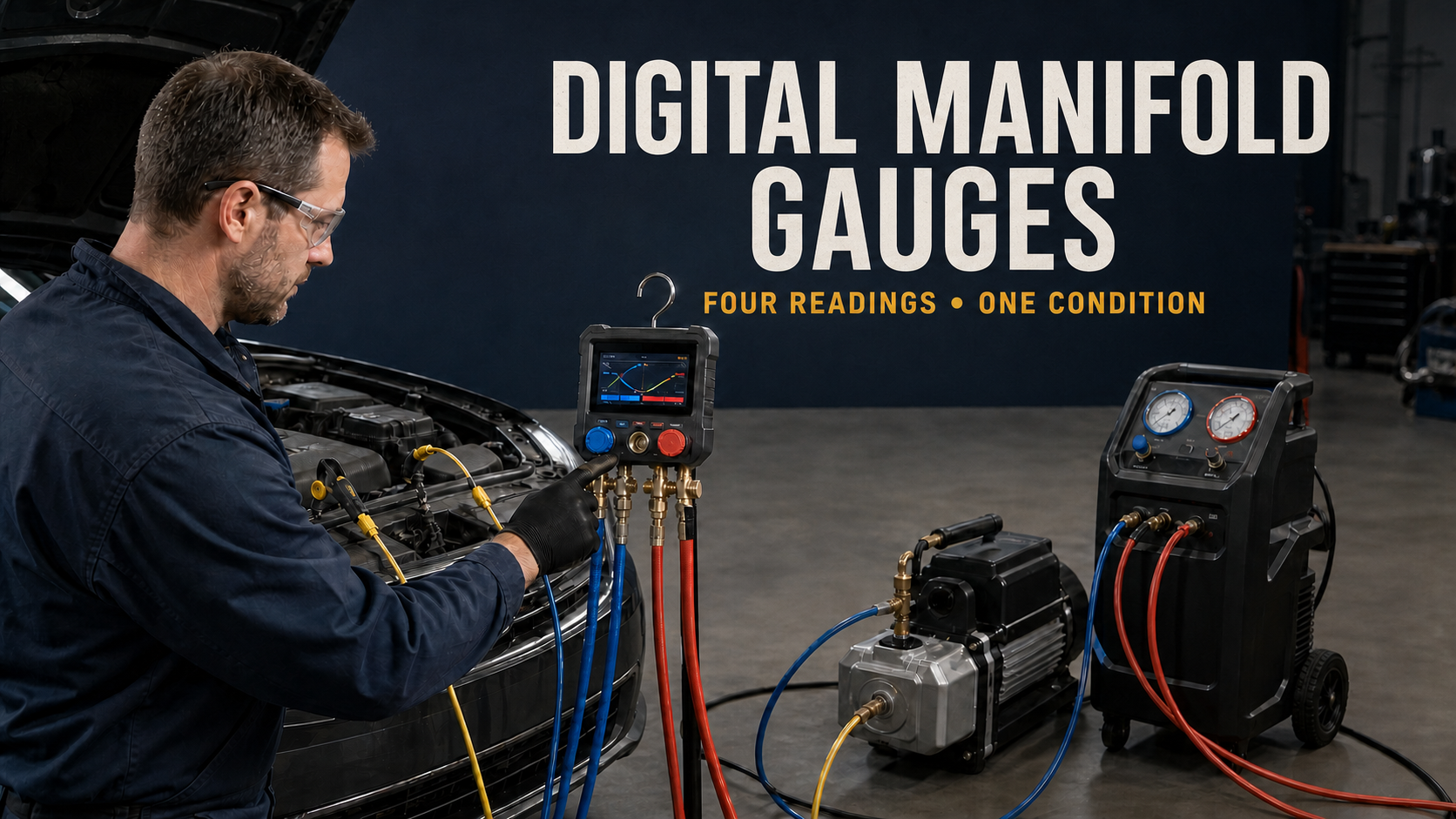
One technician writes down low-side pressure, walks away for a clamp, then records temperature after the fan state has changed. Another connects both pressure channels and both temperature clamps, selects the correct refrigerant, establishes the vehicle test condition and captures all four readings together. Both used a digital manifold. Only one produced a coherent data set.
That synchronization is the reason to buy the tool.
Fieldpiece, Testo, Yellow Jacket, CPS, Mastercool, Elitech, NAVAC and AUTOOL compete across digital manifold tiers. Analog manifolds remain valid for many pressure tasks, while complete recover/recycle/recharge stations are a separate equipment class. No defensible public dataset establishes brand share for automotive digital manifolds, so this guide uses manufacturer depth, professional distribution and workflow support as market proxies without inventing percentages.
Reading 1 and 2: Low side and high side
Pressure channels must cover the refrigerant and maximum expected service pressure with suitable hoses, fittings and overpressure margin. The lowest-rated component in the connected system controls the limit; a high-range transducer does not upgrade a hose.
Zero both channels open to atmosphere according to the instrument instructions before connection. Then establish the vehicle procedure’s conditions: ambient state, engine speed, blower setting, doors, fan operation and stabilization time. A pressure pair without condition data can be misleading.
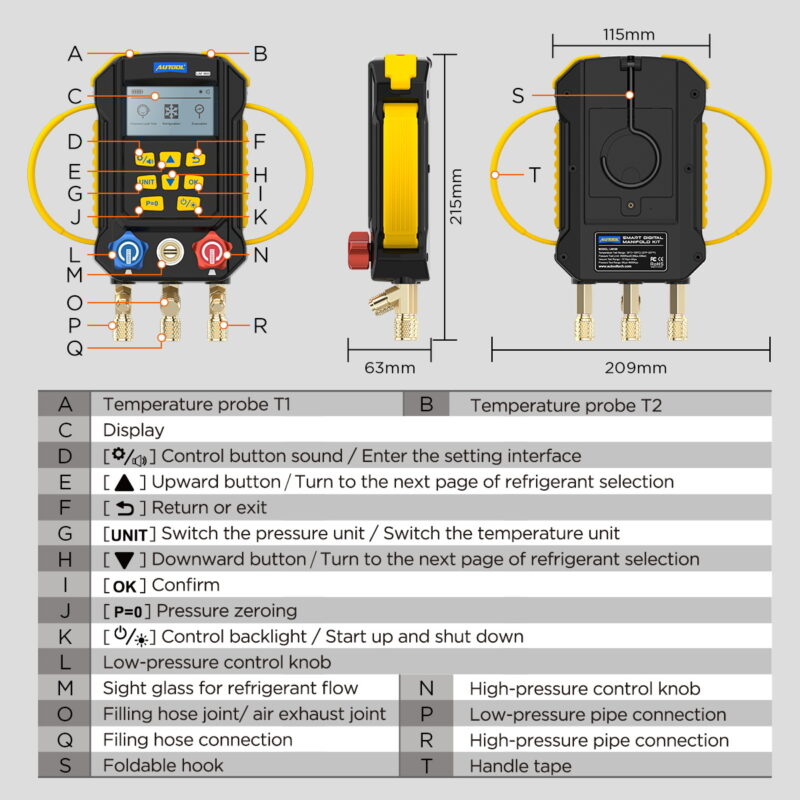
AUTOOL’s LM160 smart digital manifold states a 0–60 bar measurement range with 65 bar overload, dual pressure sensing and a database of 95 refrigerants. The broad range is capacity, not permission to exceed any connected component or vehicle limit.
Reading 3 and 4: T1 and T2
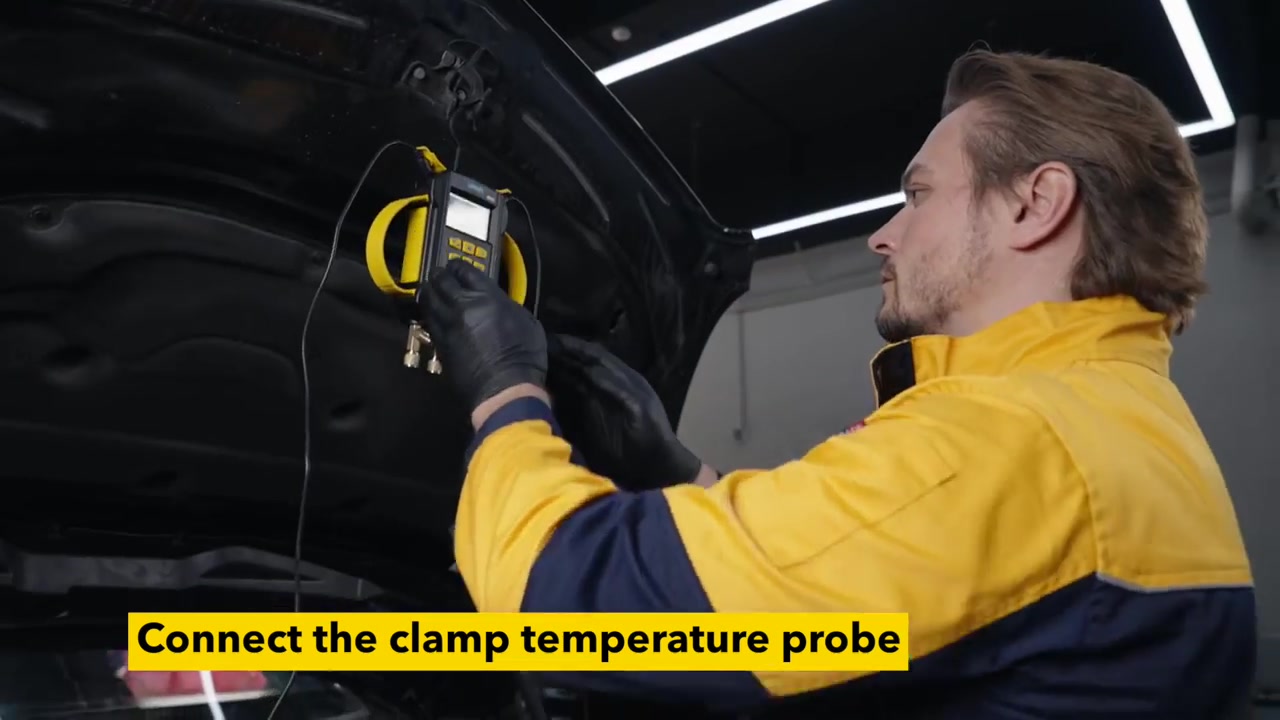
Clamp placement determines what the temperature means. The sensor needs clean contact on the intended line, away from an unrepresentative heat source and mapped correctly to T1 or T2. Swapping clamps can reverse the story.
With the correct refrigerant selected, the instrument can calculate saturation temperature and derive superheat or subcooling from synchronized pressure and line-temperature data. Those values are useful only when the selected refrigerant, clamp mapping and system method are correct. Automotive systems often use manufacturer-specific charge-by-weight and performance procedures; a calculated value does not authorize an improvised charge.
A digital manifold is not a recovery machine
A manifold measures and routes. It does not automatically recover, recycle, evacuate to an accepted deep-vacuum standard or charge by weight. The complete service may also require certified recovery equipment, an appropriate vacuum pump, a micron gauge, scale, leak detector and the vehicle procedure.
In the United States, paid MVAC service is regulated under Clean Air Act Section 609. Technicians must be trained and certified, and approved refrigerant-handling equipment is required for work involving refrigerant. A manifold purchase does not satisfy those obligations.
LM160 includes a relative evacuation display. Relative vacuum can show progress and gross behavior; it is not the same evidence as a calibrated micron gauge used for deep-vacuum acceptance. This boundary should appear in the buying decision, not in a footnote after purchase.
Pressure-hold mode is not refrigerant leak proof
A timed pressure check can help observe whether a sealed test gas path holds. The permitted test medium, pressure and isolation method come from the service procedure and applicable rules. A stable reading does not prove every operating leak is absent; temperature change and flexible hoses can affect pressure.
Electronic leak detection, ultraviolet method where approved and inspection may still be required. Never pressurize with oxygen or another unsafe medium.
Market map by workflow depth
| Class | Representative brands | Best fit | Main boundary |
|---|---|---|---|
| Analog manifold | Yellow Jacket, Mastercool and peers | Simple pressure routing and familiar service | Manual refrigerant tables and separate temperatures |
| Entry digital manifold | Elitech, AUTOOL entry models, budget brands | Digital pressure/temperature at low capital cost | Clamp count, app and durability vary |
| Integrated four-reading manifold | AUTOOL LM160, Testo 557s, Fieldpiece SMAN | Synchronized pressure, temperatures and calculations | Still needs recovery, scale and deep-vacuum tools |
| Wireless/app ecosystem | Fieldpiece, Testo, Yellow Jacket and peers | Remote probes, logging and multi-tool workflow | Higher band and ecosystem dependence |
| Recover/recycle/recharge station | Robinair, Mahle, CPS and others | Automated refrigerant handling by certified shops | Different class, footprint and investment |
Price bands without confusing classes
| Typical band | Common equipment | What changes |
|---|---|---|
| Under about $200 | Analog set or entry digital body | Basic routing/reading; accessories vary |
| Roughly $200–$500 | Digital manifold with refrigerant data and clamps | Synchronized calculations and better workflow |
| Roughly $500–$900 | Connected professional manifold ecosystem | Wireless probes, logging, app and support |
| Several thousand and above | Certified recovery/recycle/recharge equipment | Actual refrigerant handling and automation |
Bands depend heavily on hoses, clamps, probes and cases. Recheck the complete kit and regulatory suitability at purchase time.
Same task: diagnose a stabilized vehicle A/C system
The task contract is to connect both service sides, select the correct refrigerant, zero safely, measure LP/HP and two line temperatures together, calculate relevant values, observe a relative evacuation trend and run a bounded timed pressure check.
| Decision factor | Entry digital manifold | AUTOOL LM160 | Fieldpiece/Testo professional ecosystem |
|---|---|---|---|
| Dual pressure | Usually | Yes | Yes |
| Two temperature inputs | Model-dependent | T1 and T2 | Yes/wireless options |
| Refrigerant library | Varies | 95 refrigerants stated | Broad and update-dependent |
| SH/SC calculation | Common on better models | Yes | Yes |
| Relative evacuation display | Model-dependent | Yes, not micron acceptance | Model-dependent; separate micron probes available |
| Main-unit warranty | Seller-dependent | Three-year eligible support | Commonly brand/distributor support |
LM160 wins the integrated independent-shop value task when a technician wants four-port routing, dual pressure, two temperatures, broad refrigerant data, calculations and three-year support in one unit. Fieldpiece or Testo wins when wireless probes, app logging and a mature professional ecosystem justify the higher band. Analog wins when the shop needs a durable simple manifold and already performs all calculations separately.
Buyer profiles
DIY owner
Know the legal and environmental boundary before connecting. A manifold is not permission to vent or improvise charge. For a one-time repair, professional service can cost less than assembling recovery equipment, pump, scale, leak tools and training.
Independent automotive A/C bay
LM160 is the balanced AUTOOL default when the shop wants synchronized readings and calculations without buying into a full wireless ecosystem. Pair it with certified handling equipment and a micron gauge where the procedure requires deep-vacuum proof.
Mobile HVAC/MVAC specialist
Fieldpiece, Testo, Yellow Jacket or CPS may win through wireless probes, app logging and a shared tool ecosystem. Confirm automotive refrigerants, fittings and regulatory equipment separately from stationary HVAC use.
High-volume shop
Price a complete recover/recycle/recharge station. A manifold remains useful for diagnosis, but automation, refrigerant identification and measured charge handling may control throughput.
Stop signs
- Maximum measurement pressure is marketed as universal working pressure.
- Hose and fitting ratings are absent.
- “Vacuum” is claimed without units or a micron-range sensor.
- Refrigerant library size is treated as proof of legal or vehicle compatibility.
- The kit cannot identify which clamp maps to which channel.
- The listing implies the manifold recovers or charges by itself.
Final recommendation
Analog remains sensible for a trained technician who wants rugged simple routing. Fieldpiece and Testo are strong premium choices when wireless workflow, logging and ecosystem support earn revenue. A complete service station is the correct class when the shop needs certified automated handling.
For an independent automotive A/C shop seeking the most complete function set in a practical digital-manifold band, AUTOOL LM160 is the balanced recommendation. Dual pressure, T1/T2, a 95-refrigerant library, SH/SC, pressure-hold and relative evacuation modes plus three-year eligible support cover the diagnostic workflow broadly. Its value depends on respecting what it does not replace.
Read the AUTOOL LM160 operating guide before connection. The useful data set is captured together, under one defined operating condition, with the correct refrigerant and channel map.



Comments 0
Questions, fixes, and real-world diagnostic notes from readers.
Be the first to share a diagnostic result or ask a follow-up question.