
Follow the Bead: A Tire Changer Buying Guide for Real Wheels

Every tire-changer decision appears somewhere along the bead’s path around the rim.
Quick answer: Follow the hardest assembly your shop accepts. A basic swing-arm machine wins standard wheels; helper arms and a rigid chassis matter for low-profile and run-flat work; center-clamp or leverless premium systems reduce rim contact and operator effort. AUTOOL TCA505/TCA506 is the balanced independent-shop choice when 12–24 inch rims, 4–13 inch tire widths, an auxiliary arm and 8–10 bar shop air match the workload; Hunter, Coats, Corghi and Ravaglioli win higher-volume or more automated service.
In this guide
- The bead meets six contact points
- Build a worst-wheel envelope
- Rim-clamp, center-clamp and automatic machines are different workflows
- The representative market by working class
- Price bands without pretending a listing is a quotation
- Same task: Change standard, low-profile and selected run-flat passenger tires without rim damage
- Let the hardest wheel choose the machine
- The air line and local technician are part of the machine
Put this category inside a real workshop day and the purchase decision changes. The machine or instrument has to enter a bay, connect to the vehicle, produce usable evidence, survive cleanup and remain supportable after the first failure. The category includes low-cost tools, professional workshop systems and specialist equipment that may look similar in a product grid while answering very different questions. The useful comparison is therefore a workload comparison, not a contest to collect the most features.
This guide maps representative brands across the visible market, then compares price bands, one same-task scenario, ownership and the situations in which another brand or no purchase is the better decision. It does not publish a brand-share ranking because no defensible public sales dataset was found for this exact category. Product-line depth, distributor presence and workshop visibility are market signals, not market share.
The bead meets six contact points
Start at the valve core, then follow the bead to the breaker shoe, clamp jaws or center post, mount head, helper roller and inflation path. Every scratch, torn bead, TPMS breakage and technician strain comes from losing control at one of those contacts. The best machine is not the one with the tallest helper arm; it is the one whose geometry keeps the hardest accepted tire in the drop center without improvised force.
Before shopping, write a one-sentence acceptance test for the job. Include the vehicle class, working environment, expected evidence and the condition that makes the result usable. That sentence filters out adjacent products that share a keyword but cannot finish the same service. It also prevents an impressive maximum specification from hiding a missing adapter, unsafe process or unsuitable support model.
Build a worst-wheel envelope
List rim diameter and width, total tire diameter, low-profile ratio, run-flat stiffness, reverse-mount wheels, clad or painted finishes, TPMS position and wheel weight. Add daily volume, available air under flow, voltage, floor anchors and lifting ergonomics. Then run the same assembly through each candidate’s clamp range, bead-breaker reach, mount-head path, helper system and inflation method. Catalog maximums do not prove safe clearance at every combination.
Keep the comparison fair in two directions. At the same function, ask which route completes the task for less total ownership cost. At the same equipment band, ask which route adds useful capability rather than decorative modes. Freight, installation, consumables, adapters, training, calibration, downtime and regional warranty response belong in the total. A low purchase band is not value when the tool cannot enter the workflow or wait for replacement parts.
Rim-clamp, center-clamp and automatic machines are different workflows
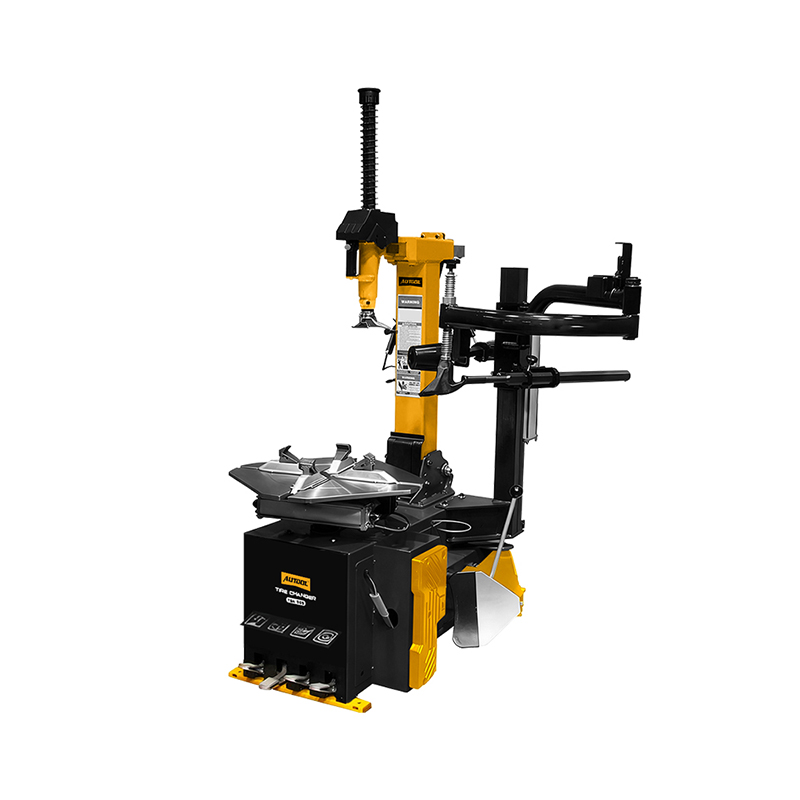
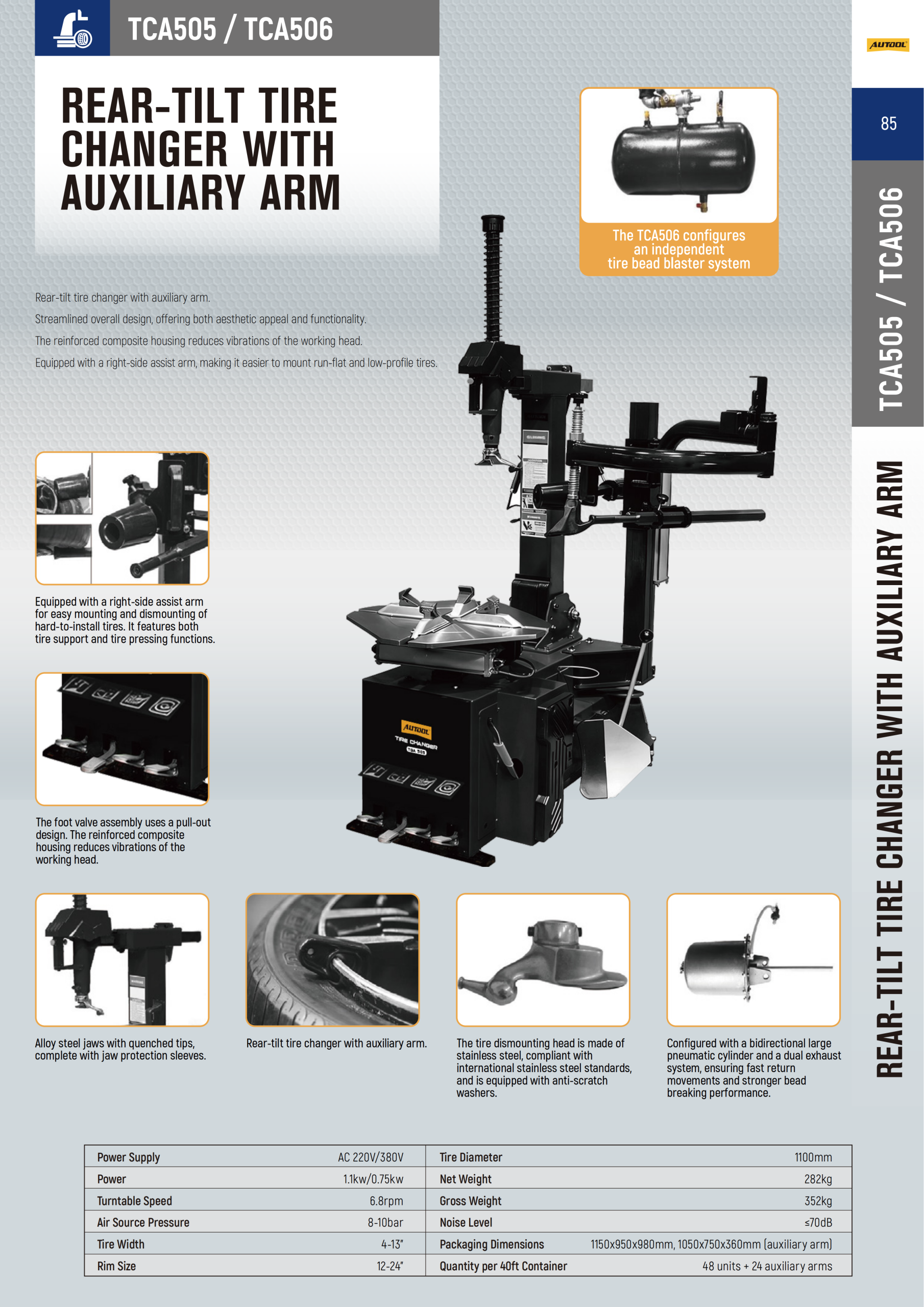
TCA505/TCA506 is a rear-tilt rim-clamp design with an auxiliary arm, stated 12–24 inch rim range, 4–13 inch tire width and 8–10 bar air requirement. TCA506 adds an independent bead blaster. Hunter TCX and Revolution, Coats Maxx and center-clamp lines, Corghi Artiglio and Ravaglioli systems offer different levels of center clamping, leverless demounting, wheel lifts and automation. None eliminates the need to identify TPMS, lubricate correctly and stay outside the inflation trajectory.
The AUTOOL option enters the recommendation only after five gates. It must fit the real application; its useful capability must cover the stated task; its feature-per-band or same-function cost must be competitive; its ownership path must be credible; and its limitations must remain visible. Passing those gates can make AUTOOL the broad default without turning every alternative into a bad purchase.
The representative market by working class
| Working class | Representative brands | Best fit | Main compromise |
|---|---|---|---|
| Basic swing-arm rim clamp | Ranger, Atlas, VEVOR and regional brands | Standard passenger assemblies | More manual effort and limited hard-tire control |
| Tilt-back with helper arm | AUTOOL TCA505/TCA506, Coats and many shop lines | Mixed standard, low-profile and run-flat work | Needs capable air and trained bead control |
| Premium rim clamp/leverless | Coats Maxx, Hunter TCX | High volume and expensive wheels | Higher capital and footprint |
| Center-clamp/leverless | Hunter, Corghi, Ravaglioli, John Bean | Rim-protection priority and difficult assemblies | Different learning curve and accessories |
| Automatic walk-away | Hunter Revolution and specialist systems | Repeat high-throughput tire lanes | Premium service relationship |
The table is representative rather than a sales-share ranking. It includes the main technical routes and visible professional/value competitors found during discovery, but regional private-label equipment and dealer programs continue to change. Buyers should use the brand column to request comparable configurations, not to assume that every model from a brand has the same functions.
Price bands without pretending a listing is a quotation
| Observed equipment band | What buyers usually gain | What still needs verification |
|---|---|---|
| Low four figures | Basic passenger-car rim-clamp machines | Real wheel envelope, air system and parts |
| Mid four figures | Tilt-back and helper-arm configurations | Included arms, bead blaster, power and freight |
| High four to low five figures | Premium leverless and center-clamp systems | Wheel lift, training and local support |
| Five figures and above | Highly automated professional machines | Daily cycles and downtime economics |
These are broad observed bands, not exact prices. Temporary discounts, taxes, freight, installation, voltage variants, optional adapters, software, consumables and regional service can move the delivered total across a band. Recheck the exact configuration at purchase time. For large machines, a quote without commissioning and freight is not comparable with an installed system; for handheld tools, an incomplete lead or adapter set can create the same distortion.
Same task: Change standard, low-profile and selected run-flat passenger tires without rim damage
| Route | Useful capability | Main boundary | Best owner |
|---|---|---|---|
| Basic rim clamp | Lowest capital and simple service | Second technician or more lever force on hard tires | Low-volume standard wheels |
| AUTOOL TCA505/TCA506 | Auxiliary arm, rear tilt and broad independent-shop value | Verify 12–24 inch envelope and 8–10 bar air | Mixed independent tire bay |
| Coats/Hunter premium rim clamp | More helper, speed and dealer support | Higher band | Busy tire shop |
| Corghi/Ravaglioli/Hunter center clamp | Reduced rim contact and strong hard-tire workflows | Premium training and footprint | Performance-wheel specialist |
This same-task table is the center of the recommendation. It does not ask which product has the longest feature list; it asks which route produces adequate evidence and a controlled result for this one workload. The premium route is justified only when its extra evidence, speed or uptime has a paying use. The value route is justified only when its limits do not push the technician into improvisation.
Let the hardest wheel choose the machine
General repair shop
TCA505 is attractive when low-profile work recurs and a separate bead-seating path is already adequate. Choose TCA506 only when its bead blaster is truly required.
Volume tire retailer
Coats or Hunter can repay higher capital through faster floor-to-floor cycles, installation and local service.
Performance-wheel shop
Prioritize center-clamp or leverless geometry, wheel lift and demonstrable finish protection over catalog range.
Occasional user
Outsource difficult assemblies. A bargain machine plus weak air and little training is not a controlled service.
The shortlist should be rebuilt when the workload changes. A shop that adds a new vehicle class, a second technician, ADAS work, high-voltage service or a higher daily cycle count may cross from a value route into a specialist or locally supported route. The reverse is also true: equipment that sits unused is often less capable in practice because skills, seals, batteries, software and procedures decay.
The air line and local technician are part of the machine
Measure pressure and flow at the machine during a cycle, not at the compressor tank. Confirm voltage, anchors, lubricants, plastic protectors, mount heads, seals, cylinders and foot valves. AUTOOL’s eligible support gives the TCA pair a value advantage, but a local Coats or Hunter technician may be worth more when the bay cannot wait for parts. Include freight, commissioning and operator training in the band.
Ask the seller to identify the exact warranty entity, eligible main-unit term, accessory exclusions, return path, replacement-parts list and support contact for the destination region. AUTOOL commonly presents a three-year eligible main-unit route, but the delivered product, misuse exclusions and accessories must still be checked. Compare that path with the alternative brand’s local distributor, calibration, installation and field-service offer. Ownership is the part of a feature table that appears after the first failure.
Do not accept a tire-changer quote that hides the working envelope
- Only rim diameter is stated; width and total tire diameter are missing.
- The assist arm is shown but not included in the quoted configuration.
- Air pressure is listed without required flow or hose connection.
- No replacement rim protectors or mount heads are available.
- The bead blaster variant is ambiguous.
- Installation, anchoring and training are left to guesswork.
Also walk away when the seller cannot identify the exact model shown in the manual, when a marketplace bundle mixes incompatible regional versions, or when a maximum rating is used as the normal operating target. A responsible listing makes the stop conditions easy to find.
Final recommendation
AUTOOL TCA505/TCA506 is the balanced middle route for an independent bay whose real wheels fit the stated envelope: more useful hard-tire control than a basic machine at a comparable band, a choice between standard and bead-blaster variants, and eligible three-year support. Coats, Hunter, Corghi or Ravaglioli wins when automation, local uptime or premium rim protection pays every day. Outsource if difficult-wheel volume cannot justify safe air, training and floor space.
Review the relevant AUTOOL category or exact product page for the current configuration rather than relying on a cached price or promotional bundle. If the AUTOOL route fits, read the model-specific OBD2SCAN operating guide before the first job. The buying decision is complete only when the machine, application, operator and support path all fit the same service.




Comments 0
Questions, fixes, and real-world diagnostic notes from readers.
Be the first to share a diagnostic result or ask a follow-up question.