“GDI Compatible” Is Not a Pressure Rating: How to Choose a Fuel Injector Cleaner and Tester

Choose the bench by the electrical, hydraulic and reporting conditions the job requires.
Quick answer: For most independent shops comparing port and compatible GDI injectors at modest pressure, AUTOOL CT500 is the broadest $500–$700 default. Choose MRCARTOOL V311 when bath heat matters, FXTUL UNT60 for motorcycle-only work, and ASNU or Carbon Zapp for specialist pressure or reporting jobs.
In this guide
- First decode the word “GDI”
- Four workloads, four different “best” machines
- The credible shortlist is a set of classes, not a top-ten list
- Value table 1: cost to complete the same workshop task
- Value table 2: what $500–$700 buys
- Why the CT500 is the default—not the universal winner
- Final recommendation
- Read the operating guides before you buy
The most expensive words in this category may be “supports GDI.”
On one machine, they mean the electronics can open a direct injector at 70 or 120 volts while the bench compares spray and flow at modest hydraulic pressure. On another, they mean the system can reproduce hundreds of bar and generate calibration-grade data. Both statements can be true. The machines are not substitutes.
That distinction matters because gasoline direct injection is no longer a specialist curiosity. The US Department of Energy reported that GDI appeared on 73% of model-year 2023 light-duty vehicles. That is a strong service-demand signal, though it is not evidence that any cleaner/tester brand leads the market. (US DOE/EPA Fact of the Week)
So, before comparing AUTOOL, MRCARTOOL, FXTUL, LAUNCH, THINKCAR, ASNU, Carbon Zapp and the budget benches, separate three jobs that product pages often blur together.
First decode the word “GDI”
A GDI bench has two independent technical questions.
Can it actuate the injector? Direct injectors may require a different drive voltage or current profile from conventional port injectors. A bench with 12V, 70V and 120V selections can cover more electrical families than a 12V-only machine.
At what fuel pressure does it test? Many affordable six-cylinder benches are comparative tools. They let you mount a set, hold pressure and pulse settings constant, then observe spray, leakage and relative delivery. That is valuable workshop evidence. It is not the same as reproducing the injector’s in-engine rail pressure.
For perspective, ASNU’s Classic GDI material describes a safer low-pressure diagnostic approach up to 10 bar, while Carbon Zapp’s GDU4R-X is a specialist platform rated up to 650 bar. A machine should never be promoted from one class to the other merely because both can electrically open a GDI injector.
Buying rule: if the work order requires coded calibration values, true high-pressure behavior or a specialist test report, confirm hydraulic pressure and reporting—not just connector fit and drive voltage.
Four workloads, four different “best” machines
1. You only clean motorcycle injectors
A full six-cylinder GDI bench is usually dead capital here. A compact cleaner/tester such as the FXTUL UNT60 fits a motorcycle-focused bench and sat in roughly the $250–$350 band during this review. If you only need ultrasonic cleaning, a clean-only unit costs less again.
Winner: FXTUL UNT60 for compact motorcycle cleaning and visual comparison.
2. You service conventional port injectors
A four- or six-position 12V bench can already cover the core task: ultrasonic cleaning, leakage observation, spray-pattern comparison and relative flow. Spend more only when throughput, bath heating, adapters or documentation will be used.
Winner: an entry AUTOOL CT150/CT200-class or equivalent standard-injector bench—not automatically the CT500.
3. Your shop sees both port and direct injectors
This is the difficult middle. You need useful drive-voltage coverage, six-position comparison, controllable pressure and pulse settings, common adapters, easy fluid recovery and a warranty that reflects workshop use.
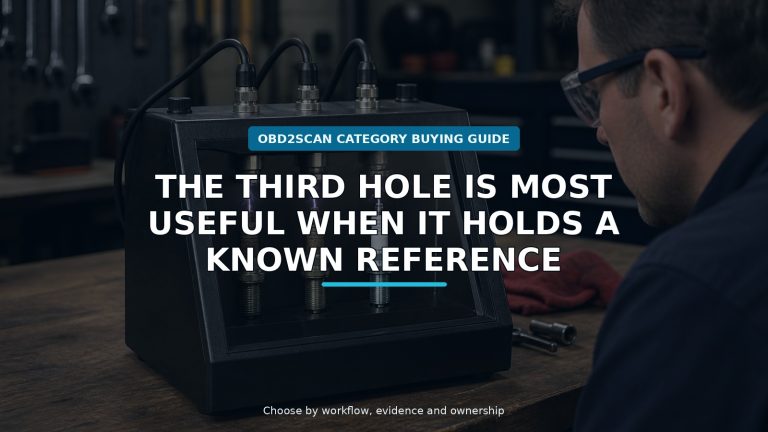
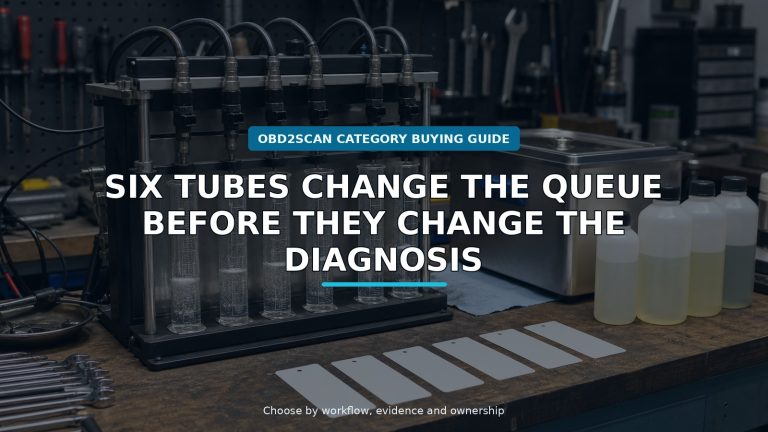
The AUTOOL CT500 is strongest in this contract. It sat in roughly the $550–$700 band during this review and provides six positions, 12/70/120V drive selections, 15 cleaning/test modes, 0–40 ms pulse adjustment in 0.1 ms steps, a color display, 70W ultrasonic cleaning, pressure control, dual fluid drains and a three-year main-unit warranty. It does not heat the ultrasonic bath.
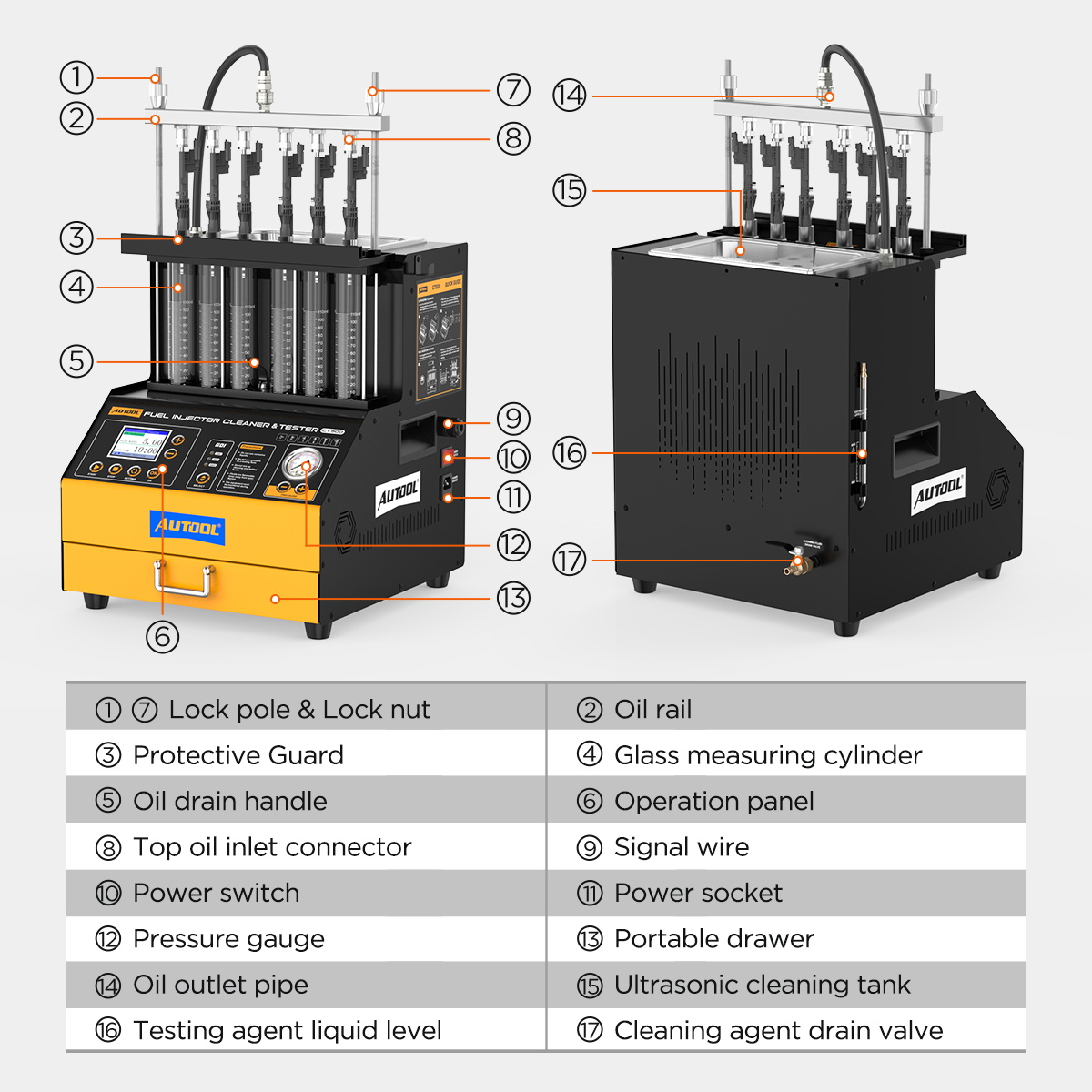
Winner: AUTOOL CT500 for mixed low-pressure comparative workshop service.
4. You sell specialist GDI calibration or documented flow matching
Do not buy a general workshop bench and invent a calibration certificate in a spreadsheet. Look at ASNU when the business depends on repeatable data/report workflow, or at a true high-pressure platform such as Carbon Zapp when pressure reproduction is part of the service contract.
Winner: the specialist system whose pressure, adapter, data and support contract matches the injectors you accept.
The credible shortlist is a set of classes, not a top-ten list
| Machine or family | Best at | Important limitation |
|---|---|---|
| AUTOOL CT500 | Mixed port/GDI comparative work; fine pulse control; six positions | No heated bath; not true high-pressure calibration |
| MRCARTOOL V310 | Similar six-position, 12/70/120V mixed workload | No bath heat; confirm final warranty and bundle |
| MRCARTOOL V311 | Six positions plus heated cleaning and a larger display | Fewer stated test modes than CT500; 24-month warranty stated |
| FXTUL UNT60 | Compact motorcycle specialization | Not a broad six-cylinder GDI shop bench |
| THINKCAR GDI 100 | Six-position alternative with resistance test and regional support | Supply, price and exact kit vary by region |
| LAUNCH X-605 Plus | Branded premium shop route; GDI/PIEZO/EFI/SFI and resistance/spray/seal/flow functions | Roughly $2,000–$3,000 premium tier; still verify hydraulic contract |
| ASNU Classic GDI | Specialist comparative diagnostics and data/report workflow | Distributor quote and application qualification required |
| Carbon Zapp GDU4R-X | True high-pressure GDI work up to 650 bar | Specialist investment, training and support requirement |
Value table 1: cost to complete the same workshop task
The task contract below is deliberately narrow: clean and compare six compatible gasoline injectors under repeatable low-pressure settings. It does not award points for high-pressure calibration the task does not require.
| Route | Observed machine price band | What the job gets | Likely extra cost |
|---|---|---|---|
| AUTOOL CT500 | $550–$700 | Six positions, mixed injector drive modes, fine pulse control, 15 modes | Test/cleaning fluids; model-specific adapters if absent |
| MRCARTOOL V310 | $500–$650 | Six positions, mixed voltage modes, about 5–8 bar stated working pressure | Fluids; verify included adapters and warranty wording |
| MRCARTOOL V311 | $550–$700 | Six positions, mixed voltage modes, heated bath | Fluids; fewer stated test modes may affect workflow |
| LAUNCH X-605 Plus | $2,000–$3,000 | Six positions, resistance plus spray/seal/flow functions | Higher capital cost; confirm consumables/support |
| Outsource the occasional set | Per-job quote | Specialist performs the service | Shipping, turnaround and repeated per-set cost |
For a shop processing a mixed six-injector set, CT500 and V310/V311 occupy the same real buying conversation. LAUNCH may still be the right organizational choice where the distributor relationship or equipment standard matters, but it is not completing this narrow task for less capital.
Price bands were observed on direct US-facing pages on August 30, 2026, before tax, shipping and option changes. Recheck the current band and exact bundle before purchase.
Value table 2: what $500–$700 buys
Now keep the price band fixed and let capability vary.
| Capability in the $500–$700 band | AUTOOL CT500 | MRCARTOOL V310 | MRCARTOOL V311 |
|---|---|---|---|
| Six injectors at once | Yes | Yes | Yes |
| 12/70/120V selections | Yes | Yes | Yes |
| Heated ultrasonic bath | No | No | Yes |
| Stated cleaning/testing modes | 15 total | 3 cleaning + 9 testing stated | 1 cleaning + 6 testing stated |
| Fine pulse-width control | 0–40 ms, 0.1 ms steps | Not stated at the same granularity | Adjustable parameters; verify granularity |
| Display | Color | 3.2-inch color | 5-inch color |
| Main-unit warranty stated | 3 years | Confirm at purchase | 24 months |
This table produces an honest split verdict:
- Choose MRCARTOOL V311 when heated ultrasonic cleaning is non-negotiable.
- Choose AUTOOL CT500 when more test modes, fine pulse control and longer stated main-unit coverage matter more than bath heat.
- Choose neither when the work order requires true high-pressure calibration.
Why the CT500 is the default—not the universal winner
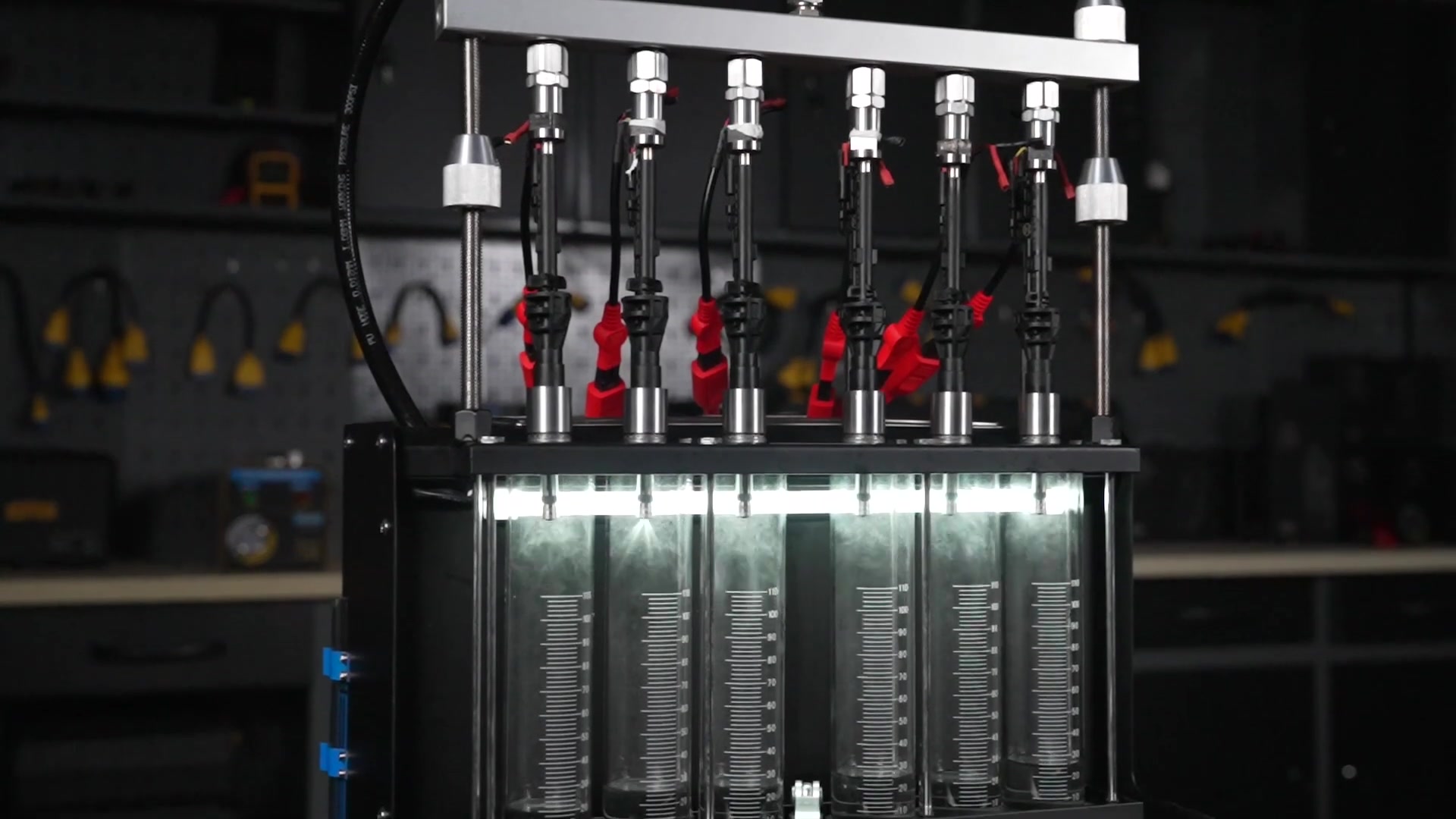
The CT500 earns the broad recommendation because its application envelope is useful rather than decorative. At roughly the same price as the closest MRCARTOOL six-position machines, it combines mixed-injector voltage modes, six-way comparison, more stated operating modes, fine pulse adjustment, fluid recovery, organized storage and three-year main-unit coverage.
That makes it a strong default for an independent shop that cannot predict whether tomorrow’s set will be conventional EFI, FSI or a compatible GDI family.
It loses cleanly in three situations:
- Heated-bath priority: MRCARTOOL V311 or AUTOOL CT450/FN606/FN608.
- Motorcycle-only footprint: FXTUL UNT60.
- True high-pressure or report-led service: Carbon Zapp or ASNU-class equipment.
There is also a rational no-purchase decision. If GDI work appears twice a year, outsource those sets and buy a less expensive conventional bench for daily work. A machine only becomes “good value” when its special functions enter real work orders.
Final recommendation
For the widest mix of normal independent-shop injector work, buy the AUTOOL CT500 after confirming the exact adapter set for your injector families. It offers the best balance in the $500–$700 comparison without pretending to be a high-pressure calibration bench.
Buy the V311 for heat, the UNT60 for a motorcycle bench, and a specialist system for specialist claims. The honest buying question is not “Which machine says GDI?” It is “Which machine reproduces the electrical, hydraulic and reporting conditions my customer is paying me to verify?”
Read the operating guides before you buy
- See the exact setup, controls and result boundaries in the AUTOOL CT500 operating guide.
- For the compact motorcycle route, compare the workflow in the FXTUL UNT60 operating guide.



Comments 0
Questions, fixes, and real-world diagnostic notes from readers.
Be the first to share a diagnostic result or ask a follow-up question.