
Shop-Counter Answer: Which Battery Tester Should You Buy in 2026?

The right tester matches the battery, the vehicle system and the proof the customer expects.
Quick answer: AUTOOL BT960 is the broad-value workshop starting point in the observed $100–$200 band because it combines 12/24V system checks, printing, named low-voltage lithium modes, leakage monitoring and temperature. Buy a narrower motorcycle or 6V tester when that is the real workload, a carbon-pile unit for a deliberate load test, or Midtronics-class equipment for managed fleet and dealer records.

In this guide
- Question 1: Do you mean a 24V battery—or a 24V vehicle system?
- Question 2: Which battery chemistry is actually on the work order?
- Question 3: Do you want a fast health screen or a controlled load?
- Question 4: What counts as a report in your shop?
- Question 5: Is leakage diagnosis part of the purchase?
- Why this category still matters
- The useful shortlist is organized by work, not rank
- Value table 1: cost to complete the same workshop task
“What is the best battery tester?”
That is how the conversation usually starts at a tool counter. The useful answer is another question.
“For which battery, on which vehicle, and what do you need to hand back when the test is finished?”
A $25–$50 motorcycle tester, a $100–$200 multi-function workshop unit and a connected Midtronics platform can each be the correct choice. They are solving different contracts. Before choosing among AUTOOL, FXTUL, MRCARTOOL, TOPDON, Midtronics, Foxwell, ANCEL, LAUNCH, Clore and Schumacher, answer five questions that most ranked lists compress into a single feature score.
Question 1: Do you mean a 24V battery—or a 24V vehicle system?
Customer: “The listing says 12/24V. That means it tests both batteries, right?”
Advisor: “Sometimes. Not always.”
Many handheld testers evaluate an individual 12V battery, then check cranking or charging on a vehicle that uses a 12V or 24V system. That is not identical to directly testing a nominal 24V battery as one unit. A specification such as “12V battery test; 12/24V starting and charging test” is more informative than a large 12/24V badge.
The distinction also matters at the low end. An ANCEL BA301 includes a 6V/12V battery path, which can make it a better fit for older vehicles and small batteries than a more expensive 12V-only health tester. The TOPDON BT600 Plus extends the professional handheld class to stated 6V, 12V and 24V modes and adds onboard power for deeply discharged batteries—but at a much higher observed price.
Write down the exact nominal battery voltage and the exact vehicle-system test before comparing brands.
Question 2: Which battery chemistry is actually on the work order?
Customer: “It has a lithium mode, so it covers EVs.”
Advisor: “It may cover a low-voltage lithium auxiliary battery. It does not diagnose the high-voltage traction pack.”
Conventional flooded, AGM flat-plate, AGM spiral, GEL and EFB batteries need the correct test selection. Lithium support is even less suitable for a generic checkmark: match the tester’s named lithium families, voltage range and manual to the battery manufacturer’s instructions and battery-management system.
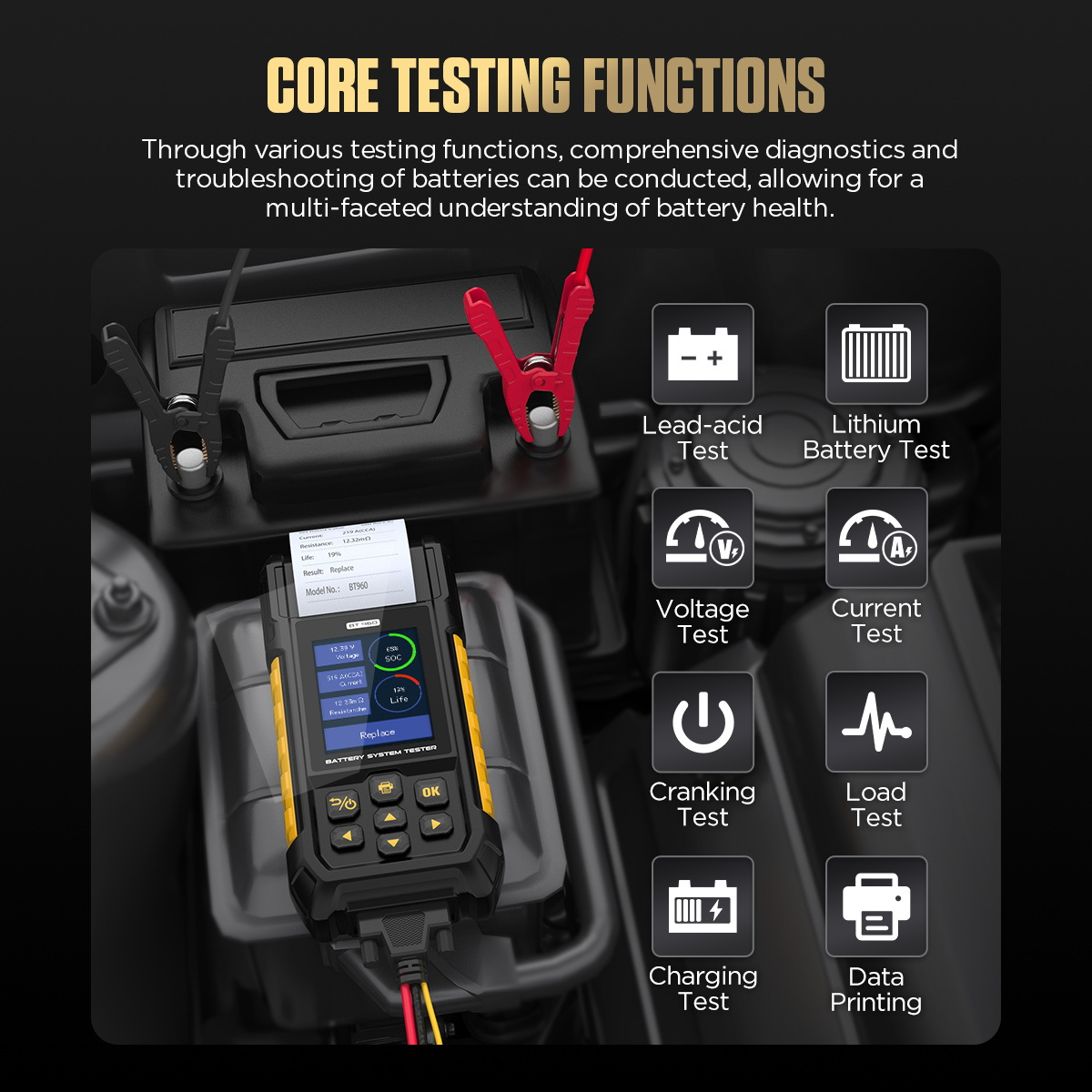
The AUTOOL BT960 is unusual in its price band because its published application list includes lead-acid batteries and specified low-voltage lithium families. That expands the workshop envelope. It does not turn the device into a traction-battery analyzer.
Electric vehicles still retain a low-voltage auxiliary electrical system; the US Department of Energy describes an auxiliary battery supplying accessories through that architecture. That supports the need for capable low-voltage testing, not a claim that every tester is EV-ready. (US DOE: How all-electric cars work)
Question 3: Do you want a fast health screen or a controlled load?
Most electronic workshop testers estimate battery condition from electrical response, then guide a cranking and charging-system check. They are fast, portable and well suited to routine service-lane screening.
A carbon-pile tester such as the Schumacher BT-100 performs a different job: it applies a stated 50A or 100A load and lets the technician observe voltage behavior. It is heavier on the battery, less report-friendly and still requires the correct procedure, but it can be the right winner when a real manual load test—not a compact conductance workflow—is the requirement.
Do not buy one method and describe it as the other. Also avoid comparing brand “accuracy” percentages unless the vendors used the same batteries, reference equipment, temperature and pass/fail protocol.
Question 4: What counts as a report in your shop?
Customer: “I need reports.”
Advisor: “A paper slip, a phone PDF, or a VIN-linked fleet record?”
Those are three different workflows.
- A built-in thermal printer, as found on AUTOOL BT960 and TOPDON BT600, gives the customer an immediate counter slip.
- A phone-connected tool such as LAUNCH BST360 can support an app-based result and may fit an existing diagnostic ecosystem.
- A professional system such as Midtronics CPX-900 can add VIN/barcode capture and connected process records, with options depending on the configured platform and contract.
- ANCEL BA301 can transfer data for PC printing, but that is not the same convenience as a built-in printer.
If the shop only needs to show one reading to one owner, paying for fleet records is waste. If a battery retailer must prove that every vehicle passed through the same documented process, a single-result handheld memory is not enough.
Question 5: Is leakage diagnosis part of the purchase?
A weak battery and a battery being drained are different faults. Most health testers do not measure parasitic current merely because they display state of charge.
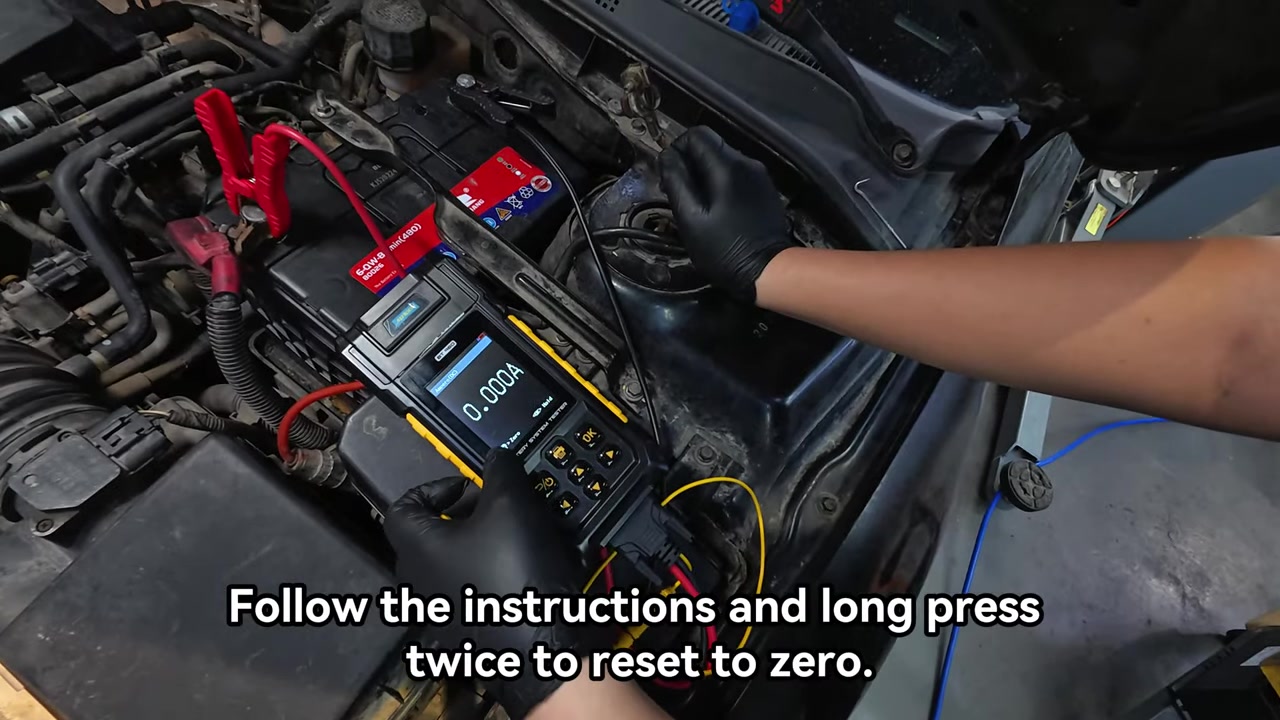
BT960 adds a stated 0–10A leakage-monitoring path and temperature measurement. The MRCARTOOL B250 takes another feature-rich route, combining battery/system tests with leakage, an OBD pinout check and memory-saving functions. Before scoring those extras, use the current MRCARTOOL battery-tester category to confirm which model is available and its exact connection limits. These functions can replace separate steps for some workshops, but they must be used with the exact connection sequence and current limits in the manual.
For a simple annual battery check, those functions may never earn back their cost. For a workshop that regularly hears “the new battery goes flat overnight,” leakage monitoring belongs in the buying conversation.
Why this category still matters
S&P Global Mobility reported 289 million US vehicles in operation and an average light-vehicle age of 12.8 years in 2025. Battery Council International says the aftermarket represents 77% of the starting-lighting-ignition battery market and notes the continuing low-voltage battery role across vehicle types. (S&P Global Mobility, Battery Council International)
Those figures explain a durable and increasingly varied service workload. They do not reveal which battery-tester brand has the largest market share. Public battery shipment totals, marketplace reviews and the number of tests inside one vendor’s platform are not interchangeable with independent tester-brand share.
The useful shortlist is organized by work, not rank
| Tester or class | Best fit | Buying boundary |
|---|---|---|
| FXTUL BT50 | Low-cost 12V motorcycle and small-shop lead-acid checks | 8–20V measurement; no printer; not a broad 24V workshop platform |
| ANCEL BA301 | Entry 6V/12V lead-acid testing with waveform and PC export | No built-in printer; confirm support terms by channel |
| Foxwell BT705 | Straightforward 12V battery and 12/24V cranking/charging checks | Lead-acid workflow; no printer |
| AUTOOL BT960 | Mixed workshop needing printing, lithium modes, leakage and temperature | Confirm exact chemistry and observe leakage-test current limits |
| TOPDON BT600 | Printed lead-acid service-counter workflow | 12V batteries; one saved result; shorter stated direct warranty |
| TOPDON BT600 Plus | Deep-discharge and high-volume batch-resistance work | Higher capital cost; buy only if those workflows are billable |
| Midtronics CPX-900 family | VIN-linked process control, fleets, dealers and battery retail | Quote/configuration route; optional hardware and platform terms matter |
| Schumacher BT-100 | Technician who specifically needs a manual carbon-pile load | Analog, no digital customer record and not a chemistry-rich analyzer |
Value table 1: cost to complete the same workshop task
Keep the task narrow: assess a compatible 12V lead-acid battery, then check cranking and charging on a 12V/24V vehicle system.
| Route | Observed direct price band | How it completes the task | Extra ownership cost or dependency |
|---|---|---|---|
| Foxwell BT705 | $100–$150 | Standalone 12V battery and 12/24V system checks | Record result manually; one-year stated warranty |
| AUTOOL BT960 | $100–$200 | Standalone check plus thermal printout; extra leakage, temperature and lithium modes | Thermal paper; extra functions need correct procedures |
| TOPDON BT600 | $150–$225 | Color workflow and immediate thermal report | Thermal paper; one stored result; one-year stated warranty |
| Midtronics CPX-900 route | Quote | Professional battery/system process with configurable records and peripherals | Contract, options, platform setup and training |
| Retailer or repair-shop test | Often free or bundled | A technician performs an occasional screening | Travel, queue and no owned tool for repeat diagnosis |
For the same basic lead-acid job, Foxwell is the lower-capital standalone route. BT960 sits in an overlapping price band while adding a printer and several distinct workflows. TOPDON BT600 may be worth the premium for buyers who prefer its interface and support channel. Midtronics becomes rational when process control—not the cheapest handheld—is the product.
Price bands were observed on direct US-facing pages on August 30, 2026, before tax, shipping and option changes. Recheck voltage coverage, bundle and warranty before purchase.
Value table 2: what roughly $100–$200 buys
Now hold the price band steady and let capability vary.
| Capability | Foxwell BT705 | AUTOOL BT960 | TOPDON BT600 | LAUNCH BST360 |
|---|---|---|---|---|
| Standalone display | Yes | Yes, 3.2-inch color | Yes, 3.5-inch color | No; phone or compatible tool |
| 12V battery health test | Lead-acid | Lead-acid + named lithium modes | Lead-acid | Lead-acid |
| 12/24V cranking/charging | Yes | Yes | Yes | Page/region dependent; verify exact version |
| Built-in thermal printer | No | Yes | Yes | No; app report |
| Leakage-monitoring path | No | 0–10A stated | No | No |
| Temperature measurement | No dedicated workflow stated | Yes | No dedicated workflow stated | No dedicated workflow stated |
| Main-unit warranty stated | 1 year | 3 years | 1 year | Regional terms; verify channel |
This is the conditional case for AUTOOL. BT960 does not need to beat every device at every specialty. It needs to offer a broader useful application set at a comparable price—and here, printing, specified lithium modes, leakage, temperature, 12/24V system coverage and three-year main-unit protection create that case.
The counter answer for five real buyers
“I only work on motorcycles.”
Buy the FXTUL BT50. In the observed $25–$50 band, its compact 12V lead-acid focus is a feature, not a failure. A printer and 24V fleet workflow would add cost without adding work.
“I see old 6V batteries and want the lowest sensible entry price.”
Choose ANCEL BA301, subject to confirming the support channel. Its 6V/12V scope is more relevant than buying a 12V-only unit with more decorative modes.
“Every customer needs a paper result.”
Choose between AUTOOL BT960 and TOPDON BT600. TOPDON provides a focused printed lead-acid workflow. AUTOOL offers more adjacent functions and longer stated main-unit coverage at the observed direct prices.
“I manage hundreds of batteries or enforce a dealer process.”
Look beyond the consumer ranking. TOPDON BT600 Plus addresses batch-resistance work, while Midtronics is the stronger class for VIN-linked processes, connected records and configured enterprise support.
“I want one broad independent-workshop tester.”
Choose AUTOOL BT960 if its named battery chemistries match the vehicles you accept. It is the default because it covers more of the questions that arrive at a general repair counter—not because it replaces a carbon-pile load tester, a high-voltage EV analyzer or an enterprise battery platform.
Final recommendation
For a mixed independent workshop, AUTOOL BT960 is the best broad-value starting point in this shortlist. In the observed $100–$200 band, it combines the core 12/24V service workflow with printing, specified low-voltage lithium support, leakage monitoring, temperature and a three-year main-unit warranty.
Buy something else when the work is narrower or more specialized: FXTUL for motorcycle simplicity, ANCEL for entry 6V work, Schumacher for a deliberate carbon-pile load, TOPDON for its focused print or batch workflows, and Midtronics for managed process records.
The useful final question is not “How many battery types are printed on the box?” It is:
“Can this tester safely test my exact battery, check my exact vehicle system, and produce the exact evidence my customer or organization requires?”
If the answer is yes, you have found the right tester—even if it is not the most expensive one at the counter.
Read the operating guide before you buy
The AUTOOL BT960 operating guide shows the exact battery-selection, cranking, charging, leakage and print workflows that its broad recommendation depends on.


Comments 0
Questions, fixes, and real-world diagnostic notes from readers.
Be the first to share a diagnostic result or ask a follow-up question.