
Nissan Frontier D40 vs. D41: Do Not Let the 2020-2021 Engine Fool You

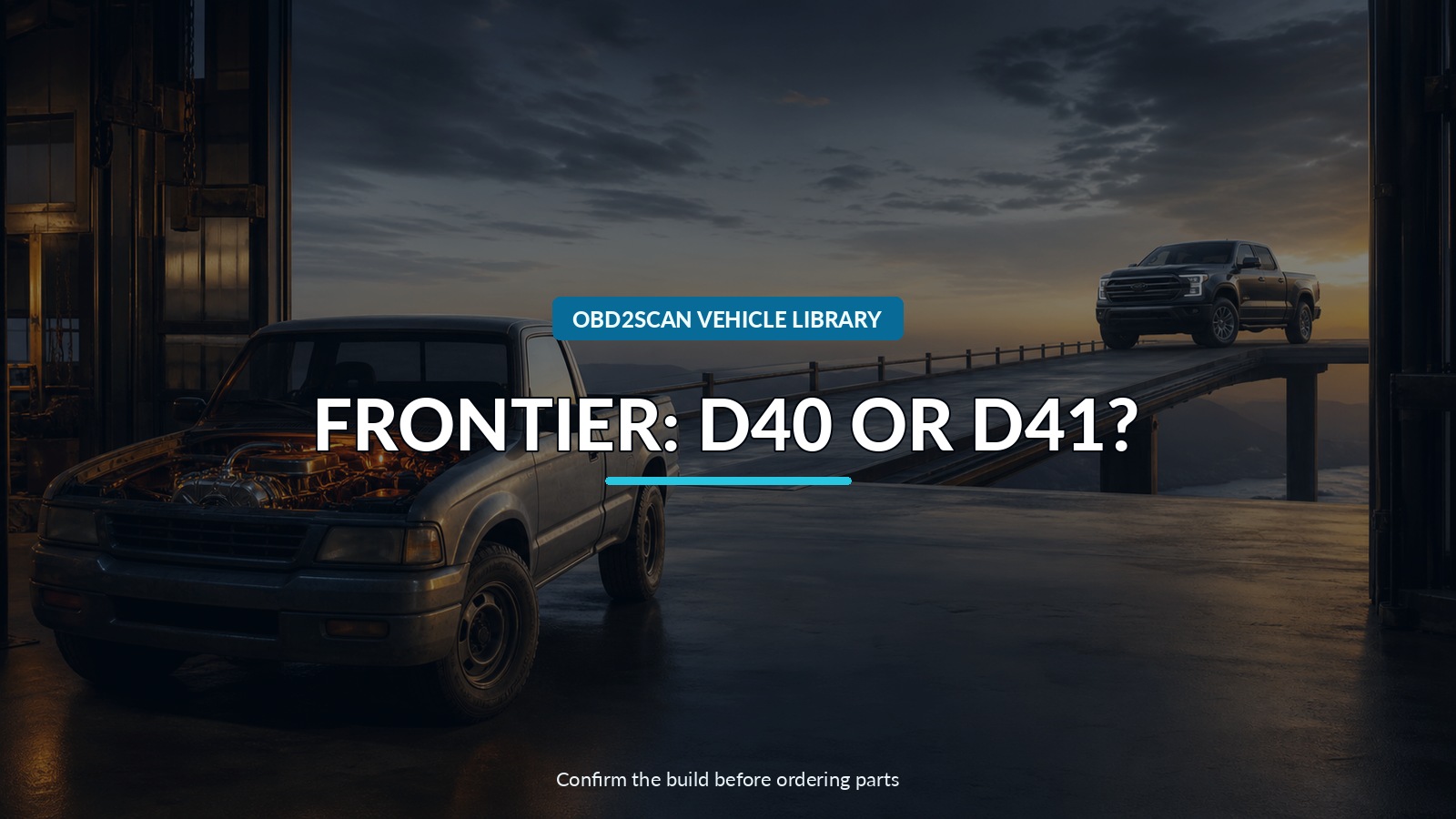
Conceptual identity-verification scene: Frontier: D40 Or D41?
The Nissan Frontier changed powertrain before it changed clothes. U.S. 2020 and 2021 trucks kept the long-running 2005–2021 D40-era body while receiving the newer 3.8-liter V6 and nine-speed automatic. The redesigned body arrived for 2022 and is commonly called D41. Therefore, a 3.8-liter/nine-speed combination does not prove that a Frontier is the new generation.
Treat the transition as two timelines: body/chassis on one line and engine/transmission on another. They meet again in 2022, but they are intentionally out of step in 2020–2021.
That one-year-pair exception is the center of this guide. Once it is written down, body parts follow the body timeline and powertrain parts follow the powertrain timeline instead of competing for one misleading generation label.
Quick answer: U.S. 2020–2021 Frontier trucks retain the D40-era body but already use the newer 3.8L/nine-speed powertrain; the redesigned body begins in 2022. Track body and powertrain separately.
In this guide
Draw two timelines, not one
| U.S. model years | Body/chassis era | Factory powertrain clue | Safe conclusion |
|---|---|---|---|
| 2005–2019 | D40-era body | Earlier engine/transmission configurations by year | Old body; finish cab/bed/powertrain identity |
| 2020–2021 | D40-era body | 3.8L V6 and nine-speed automatic | Newer powertrain in old body |
| 2022 onward | Redesigned body, commonly D41 | 3.8L/nine-speed at launch | New body; still record exact configuration |
This table explains the trap without claiming universal interchange. Nissan’s public material describes the 2022 as all-new; the D41 label is useful catalog and enthusiast shorthand, but factory parts data remains the authority.
Place 2020–2021 on the old-body side
Look at the cab shell, doors, glass, bed, lamps, dashboard and overall proportions. A 2020 or 2021 Frontier remains visually tied to the previous truck even though the engine bay and transmission specification point forward. Those vehicles should stay in the old-body catalog branch for body, chassis and many electrical components.
Do not “correct” the model year because the drivetrain resembles 2022. The powertrain change is real and factory-built. Record it as a split configuration rather than trying to force one generation date onto both timelines.
Identify the 2022 redesign
The 2022 truck introduces the redesigned exterior and cabin. Use those cues for fast sorting, then compare the windshield VIN, certification label and Nissan build data. Record production month and exact model description. The NHTSA VIN Decoder can independently confirm manufacturer-submitted identity fields.
If an auction or dismantler calls a 2021 truck “new generation” solely because it has the 3.8L, request label photos. If a 2022 truck has collision-repair panels or a replacement powertrain, preserve factory identity and installed hardware on separate lines.
Record cab, bed, frame and drive
King Cab and Crew Cab, bed length, wheelbase and 2WD/4WD can change frames, driveshafts, body pieces, fuel and brake lines, interior parts and accessories. Copy the factory terms instead of relying on “extended cab” or “short bed” in a listing.
For suspension, steering or frame parts, inspect the mounting points and part-number labels. The redesigned truck retained some underlying ideas from its predecessor, but continuity is not proof that any specific component crosses the 2021/2022 body change.
Match engine and transmission evidence
For 2020–2021, state the 3.8L V6 and nine-speed automatic explicitly. For older D40-era trucks, identify the actual engine and transmission rather than describing them as simply “old.” For 2022-and-newer trucks, confirm the same fields plus current model-year revisions.
Photograph the emissions label, engine identification, transmission label where accessible, harness connectors and old component number. A powertrain part offered for “2020–2024 Frontier” may legitimately span both bodies, but only OEM application data and matching hardware can prove that specific claim.
Use the component to test the catalog
Body parts should agree with the body timeline. Engine and transmission parts should agree with the powertrain timeline. Electronic modules can depend on both. This is where a single “generation” filter fails and a complete record succeeds.
For a donor assembly, ask for the donor VIN, model year, cab/bed, drivetrain and part number. A seller who can only say “D41 engine” has not shown whether the description is a chassis nickname, an engine application or an assumption.
Create two columns on every transition-year quote. Under vehicle, place VIN, model year, cab/bed, drive and old/new body. Under component, place engine/transmission application, number, connector and donor. A 2021 engine part may legitimately follow the newer powertrain column while a 2021 headlamp must stay with the old body. The columns stop one true statement from being applied to the wrong subsystem.
Cross the bridge with one clean line
A transition-year handoff might read: “U.S. 2021 Frontier, D40-era body, VIN/build and production date verified, Crew Cab/bed and 4×4 recorded, factory 3.8L V6/nine-speed confirmed, installed part number photographed.” A 2022 line should say redesigned 2022 body.
That phrasing preserves the one fact most likely to be lost: the 2020–2021 powertrain crossed the bridge before the rest of the truck.



Comments 0
Questions, fixes, and real-world diagnostic notes from readers.
Be the first to share a diagnostic result or ask a follow-up question.