Mazda MX-5 Miata NC vs. ND: Identify the Roadster, PRHT, or RF

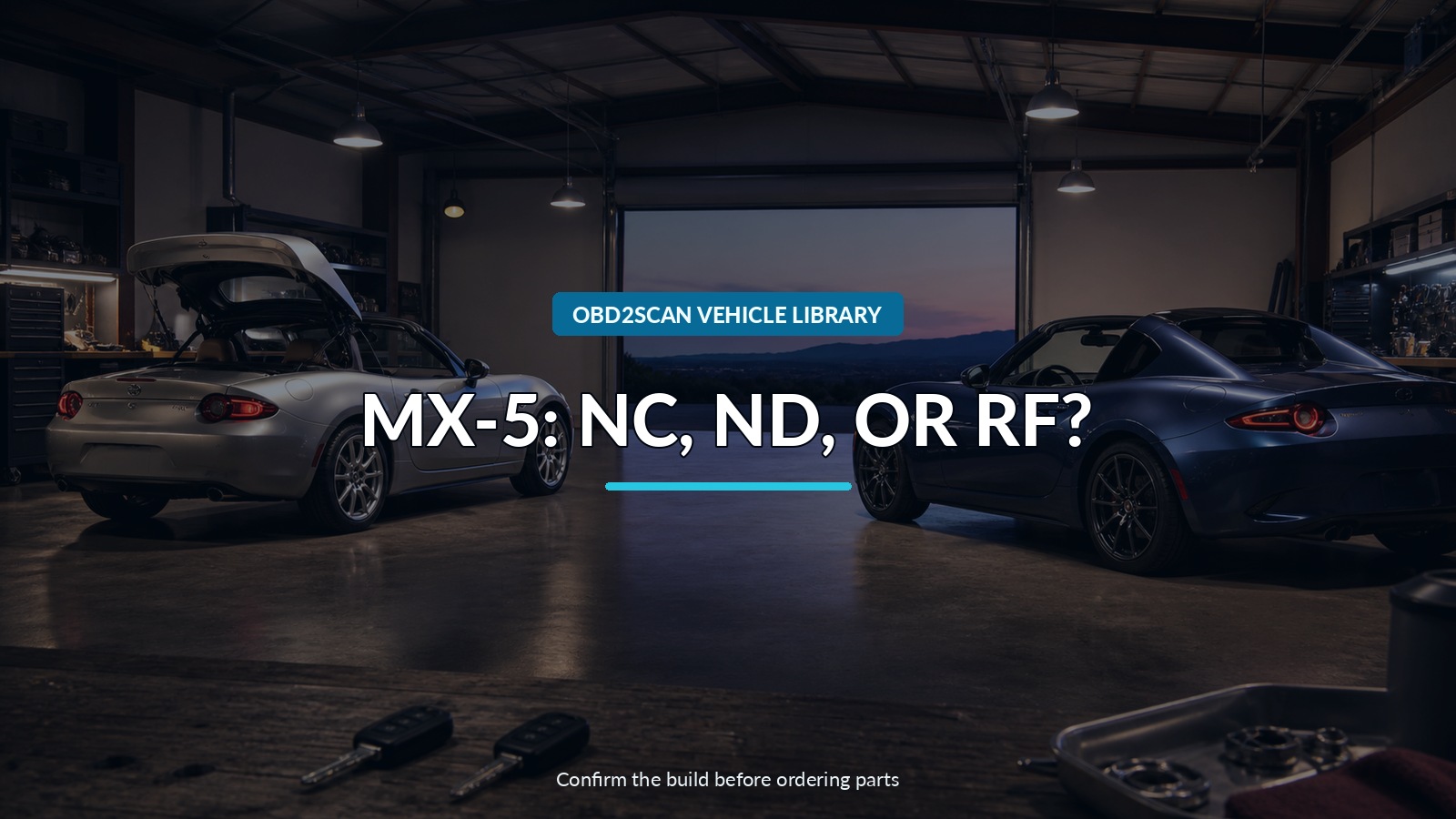
Conceptual identity-verification scene: Mx-5: Nc, Nd, Or Rf?
Put two MX-5 keys on the workbench and ask two separate questions. First: NC or ND? For U.S. cars, NC covers 2006–2015 and ND begins with 2016. Second: which roof? An NC can be a soft top or Power Retractable Hard Top (PRHT). An ND can be a soft top or RF retractable-fastback. RF is a roof/body configuration within ND, not a generation after ND.
That distinction prevents wrong roof, body, seal, glass and trim orders. It also keeps the common phrase “hardtop Miata” from mixing a removable accessory top, an NC PRHT and an ND RF.
The car may feel simple from the driver’s seat, but the roof creates a second identity layer. Keep generation and roof on separate lines until both have been confirmed.
Quick answer: U.S. 2006–2015 MX-5 is NC and 2016+ is ND. Then identify soft top, NC Power Retractable Hard Top, or ND RF; RF is not a separate generation.
In this guide
Put both keys on the bench
| Identity | U.S. years | Factory roof branches | Do not call it |
|---|---|---|---|
| NC | 2006–2015 | Soft top; PRHT in applicable years | ND RF |
| ND | 2016 onward | Soft top; RF beginning for 2017 | A separate RF generation |
Mazda’s vehicle archives support the 2006 NC and 2016 ND launch points, while its 2017 production release names the RF and describes the retractable-fastback concept.
Separate NC from ND by feel and form
Walk around the proportions before looking for a badge. NC has a broader, rounder visual character and its own lamp, fender and cabin forms. ND is smaller-looking and more sharply sculpted, with a distinctly different face, rear treatment and dashboard.
Use these clues to sort listings and garage parts. Then assume an enthusiast car may have been edited: bumpers, lamps, fenders, wheels, seats, steering wheels, engines and transmissions are all commonly changed. The physical VIN and build record must settle the generation.
Name soft top, PRHT or RF
On a soft top, record whether the roof and frame are factory-style and inspect latch, rear window, drains and mounting points. On an NC PRHT, document the full retractable hardtop mechanism, deck treatment and related switches. On an ND RF, note the fixed buttress-like body elements and retracting roof center/rear-glass system.
Do not order an “MX-5 hardtop part” until the seller names the exact system. RF glass, seals, trim and mechanism belong to the ND RF package. NC PRHT components belong to a different body and operating design. A removable accessory hardtop creates a third conversation and needs its manufacturer and mounting kit identified.
Read the car after the roof
Match the windshield VIN, door label and title/registration. Check the NHTSA VIN Decoder and Mazda build/parts data. Copy production month, market, body/roof, engine and transmission. Manual and automatic versions can differ in driveline, cooling, wiring and controls.
At the component, photograph the complete number and suffix, side, connector and mounting pattern. If the car has a swapped engine or transmission, preserve the original vehicle identity and current powertrain identity separately.
Audit track-car and appearance changes
Roll bars, coilovers, big brakes, racing seats, quick-release steering wheels, aero pieces and deleted roof trim may make a roadster look like a different specification. None changes NC to ND. Some modifications remove labels or cover mounting points, which means the old part and installation documentation become more important.
For suspension and brakes, record the installed kit as well as factory build. For wheels, measure actual diameter, width, offset and tire rather than ordering from a trim assumption. For electrical parts, note any aftermarket controller, alarm, audio or roof wiring.
Check a donor before buying the mechanism
Request the donor VIN, production date, NC/ND identity, roof system and photographs of every part number. Roof mechanisms are assemblies with switches, controllers, sensors, hydraulics or motors, trim and body mounting points; a single broad marketplace title cannot establish compatibility.
If the donor car is damaged, ask whether the roof completed a cycle before dismantling. That is condition evidence, not fitment proof, but it prevents a correct-yet-inoperative assembly from being mistaken for a successful match.
Water-management parts deserve special care. Drains, seals, channels and rear-glass interfaces belong to the exact roof mechanism and body. Document where water enters and exits, then use Mazda service information for that NC soft top, NC PRHT, ND soft top or ND RF. Identification does not prescribe a repair, but it ensures the repair information describes the roof actually present.
Send one exact roadster description
A useful garage note reads: “U.S. 2014 MX-5 Miata, NC, PRHT, VIN/build and production date verified, engine/manual transmission recorded, current roof mechanism and component number photographed.” An RF line should say “ND RF,” not just “RF Miata.”
The two-key test is simple: generation first, roof second. Once both answers are documented, the roadster becomes much easier to service accurately.






Comments 0
Questions, fixes, and real-world diagnostic notes from readers.
Be the first to share a diagnostic result or ask a follow-up question.