
2021 Tesla Model S: Pre-Refresh or Refresh? Use Build Evidence, Not Year Alone

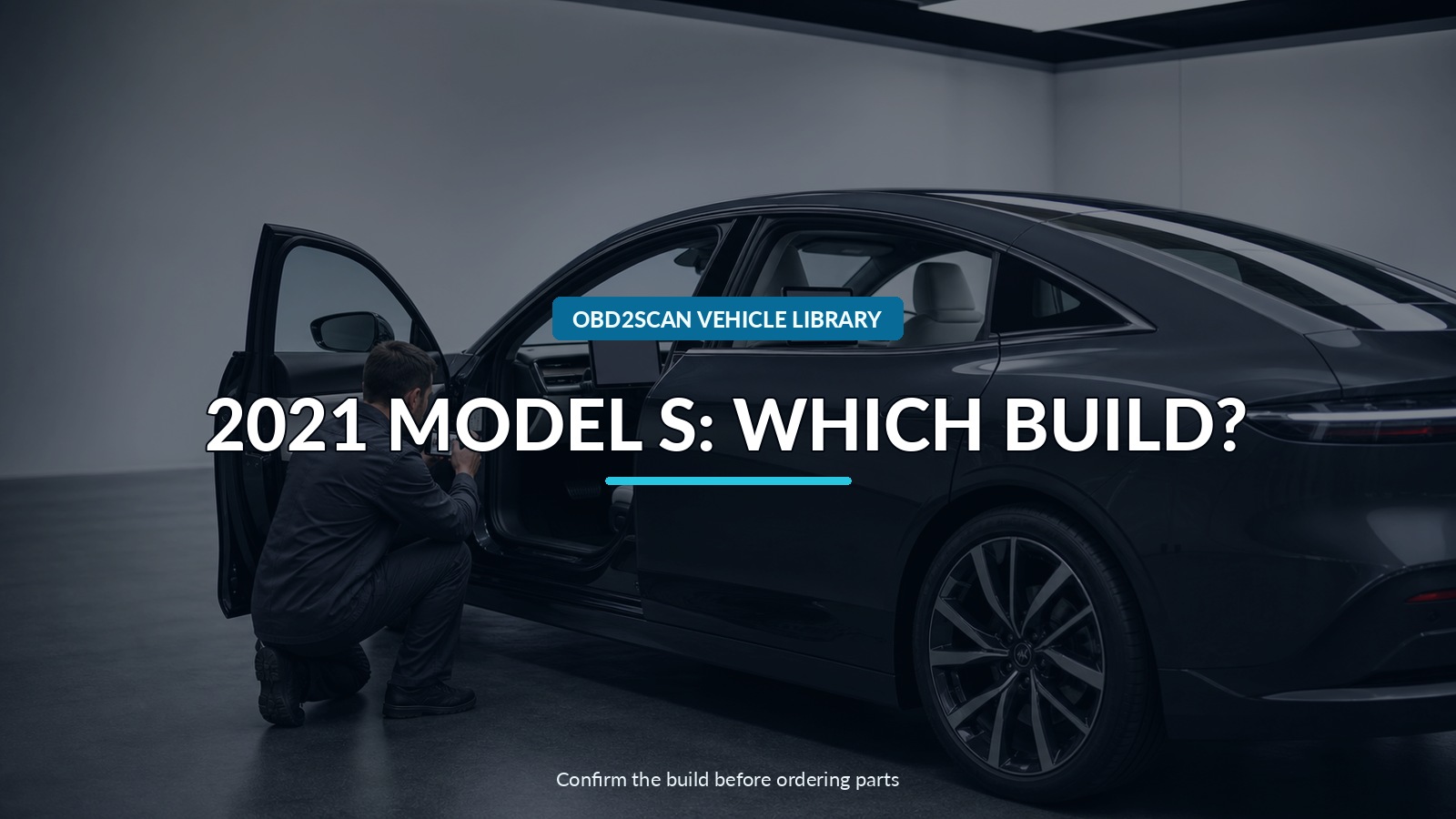
Conceptual identity-verification scene: 2021 Model S: Which Build?
For a 2021 Model S, model year is not the hardware answer. Early legacy-layout cars and the major refreshed vehicle both appear in 2021 used listings. A portrait center screen suggests the legacy family; a landscape front display and rear display suggest the refresh. Build date, VIN record, Tesla manual family, variant, and installed part number settle it.
This is a hardware-and-software cutover brief, not a trim-spotting game. Photograph the VIN and certification label, record the identity shown in the vehicle interface, note the display and cabin architecture, and open the matching Tesla service or collision manual. If a procedure contains a build-date break, use the car’s date rather than its advertisement.
Do not touch or open high-voltage equipment to identify the car. Screen orientation, labels, service documentation, and physical part numbers provide a safer evidence stack.
Quick answer: A 2021 Model S may use the legacy or refreshed hardware family. Screen architecture is a clue; build date, VIN, Tesla service-manual family, variant, and installed part revision settle the job.
In this guide
Treat 2021 as an overlap folder
Tesla maintains separate service-manual paths for legacy Model S and the 2021-and-newer refreshed family often identified in service material as Palladium. That separation is more useful for a repair or parts decision than a seller’s single model-year field.
| 2021 clue | Likely family | Confirmation required |
|---|---|---|
| Portrait-oriented main center display | Legacy-layout Model S | VIN/build date and legacy service-manual identity |
| Landscape front display plus rear display | Refreshed Model S | VIN/build date and 2021+ service-manual identity |
| “2021 Model S” in an ad | Either | Physical label, vehicle record, cabin and hardware |
The table identifies which documentation to open. It does not prove that every component remains original.
Capture the label and on-screen record
Photograph the windshield VIN and certification label without publishing the full VIN. Compare them with ownership documents and the NHTSA VIN Decoder. Record production month/year precisely.
Inside the vehicle, note the model/variant identity and software information exposed by the interface. Software version can help describe current state, but it is not a hardware-generation field. An update can change menus without changing screen architecture, battery enclosure, restraint system, suspension hardware, or body structure.
Read the cabin as a cutover clue
The legacy car’s vertical center display is an immediate orientation cue. The refreshed car’s horizontal front display, rear passenger display, revised center console, and newer cabin arrangement are strong evidence of the 2021 update. Photograph the entire dashboard rather than one removable control.
Be alert to replacements. Steering yokes and wheels, displays, trim, seats, computers, and center-console parts may have been changed. A retrofitted wheel does not turn a legacy car into a refreshed one; a replacement screen does not by itself establish the structural or electrical family.
Select the exact Tesla manual family
Use Tesla’s VIN-location and service-manual pages for the physical car. The legacy and Palladium documentation trees are separate for a reason. Within the correct tree, pay attention to variant, left/right drive where relevant, production date, and procedure notes.
For collision work, use the matching collision and emergency-response information before sectioning, lifting, disabling, or handling restraints and high-voltage systems. A Vehicle Library identity page cannot replace those controlled procedures.
Add battery, drive unit, and installed-part evidence
Do not infer a battery or drive-unit revision solely from the public trim name. Record the exact vehicle configuration returned by Tesla documentation and the number/revision on the component being serviced. For suspension, brake, body, display, computer, charging, or thermal components, capture connectors, mounting points, and production splits.
Used components require donor evidence: donor VIN/build family, variant, production date, part number, revision, and any configuration or pairing requirements in official documentation. A “2021 Model S” donor description is particularly weak because it hides the cutover this article exists to resolve.
Separate identity from condition
Whether the car is legacy or refreshed does not establish battery health, accident history, charging performance, software eligibility, or value. Those are separate inspections. Do not convert the newer cabin into a claim that every part or capability is superior, and do not treat a legacy identity as a fault.
If the VIN/build record, display architecture, and installed hardware disagree, document the conflict and obtain Tesla-specific service evidence. Avoid a definitive public claim until the physical vehicle and record align.
Write the cutover-proof identity
A useful line reads: “2021 Model S, refreshed/Palladium manual family, production date and VIN verified, variant and current software recorded, landscape front/rear display architecture confirmed, installed component revision photographed.” The legacy car should be labeled legacy just as explicitly.
Success means the next person opens the correct manual before touching the car. A year starts the file name; build evidence chooses the file.



Comments 0
Questions, fixes, and real-world diagnostic notes from readers.
Be the first to share a diagnostic result or ask a follow-up question.