
Permission to Energize: An Automotive Circuit Tester Buying Guide

The most important circuit-tester feature is knowing when the tool must observe and when it may safely energize.
Quick answer: Start with the least intrusive test. A protected DMM is the safe default for measurement, an incandescent or electronic load tool is better for proving current delivery, and an active power probe belongs only on a circuit that is already identified and safe to energize. AUTOOL is the balanced value route because BT210 covers meter-first 9–30 V checks while BT160 adds controlled 6–24 V activation and a long lead; choose Power Probe, Autel or TOPDON when their protection, current display or accessory ecosystem better matches the job.

In this guide
- A test point is not permission to add power
- Use an intrusion ladder before comparing brands
- Separate meter-first probes from active probes
- The representative market by working class
- Price bands without pretending a listing is a quotation
- Same task: Find an open or high-resistance feed, then command a known 12 V lamp circuit
- Four technicians, four correct kits
- The ownership test is mostly about leads and protection
Put this category inside a real workshop day and the purchase decision changes. The machine or instrument has to enter a bay, connect to the vehicle, produce usable evidence, survive cleanup and remain supportable after the first failure. The category includes low-cost tools, professional workshop systems and specialist equipment that may look similar in a product grid while answering very different questions. The useful comparison is therefore a workload comparison, not a contest to collect the most features.
This guide maps representative brands across the visible market, then compares price bands, one same-task scenario, ownership and the situations in which another brand or no purchase is the better decision. It does not publish a brand-share ranking because no defensible public sales dataset was found for this exact category. Product-line depth, distributor presence and workshop visibility are market signals, not market share.
A test point is not permission to add power
Imagine a no-crank vehicle with a silent relay. One technician reaches for a tool that can feed battery voltage; another first checks power, ground, command and the wiring diagram. Both tools can illuminate an LED, but only one sequence controls the risk. Airbag squibs, data lines, low-current module outputs and hybrid high-voltage circuits are not places for casual power injection. This guide therefore treats every tester as a level of authority: observe, compare, load, or energize.
Before shopping, write a one-sentence acceptance test for the job. Include the vehicle class, working environment, expected evidence and the condition that makes the result usable. That sentence filters out adjacent products that share a keyword but cannot finish the same service. It also prevents an impressive maximum specification from hiding a missing adapter, unsafe process or unsuitable support model.
Use an intrusion ladder before comparing brands
Level one is a visual and diagram check. Level two is high-impedance voltage measurement. Level three applies an appropriate known load. Level four uses a fused command or power output to operate a known component. Move upward only when the circuit and expected current are known. A tester that combines levels is convenient, but a switch does not replace authorization. Record system voltage, duty cycle, current expectation, connector access and whether the vehicle procedure prohibits activation before buying.
Keep the comparison fair in two directions. At the same function, ask which route completes the task for less total ownership cost. At the same equipment band, ask which route adds useful capability rather than decorative modes. Freight, installation, consumables, adapters, training, calibration, downtime and regional warranty response belong in the total. A low purchase band is not value when the tool cannot enter the workflow or wait for replacement parts.
Separate meter-first probes from active probes
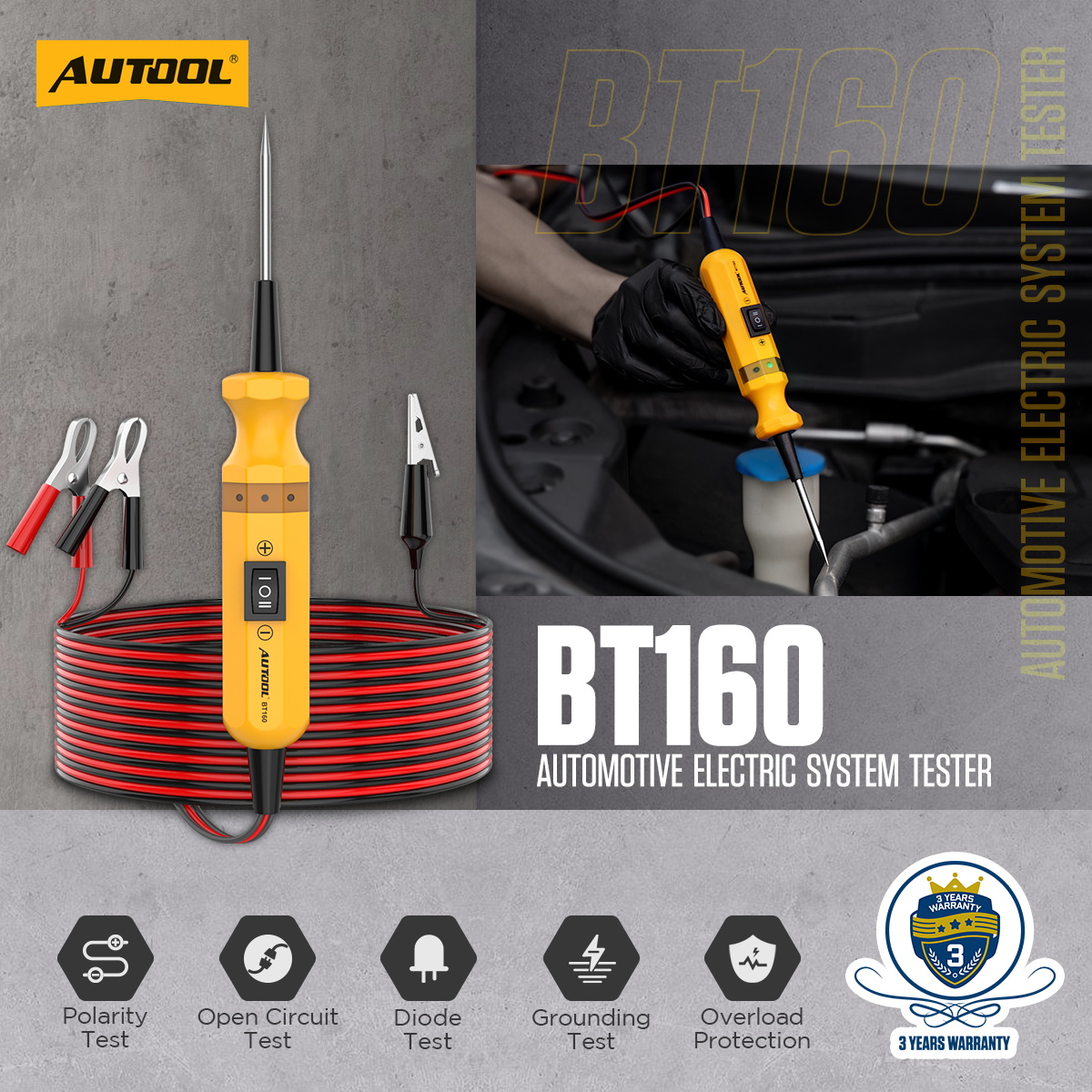
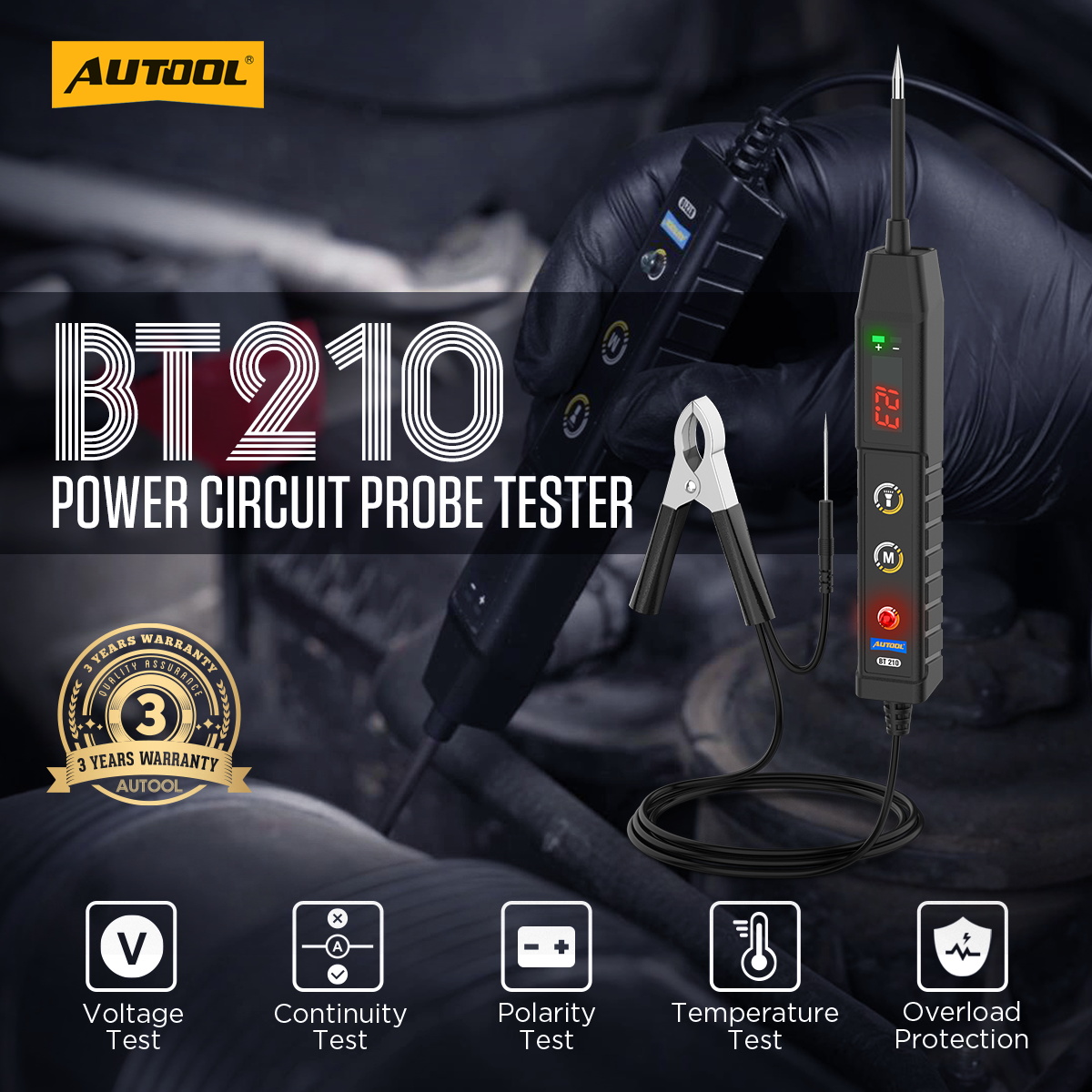
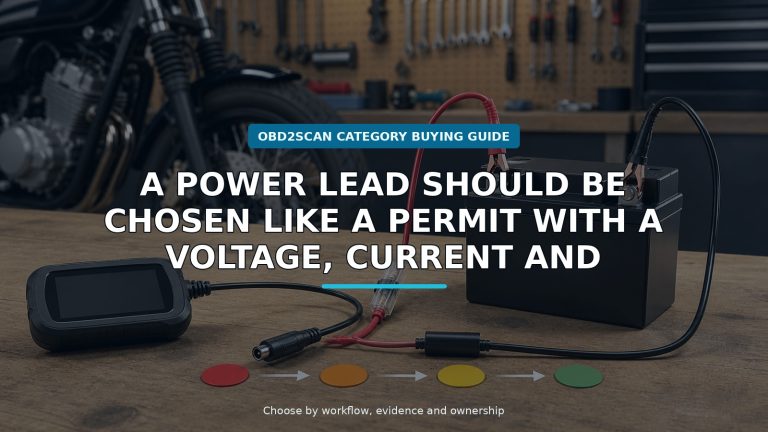
AUTOOL BT210 is a meter-first 9–30 V DC tester with voltage, continuity, polarity and temperature modes, a digital display and 10 A overcurrent protection. BT160 works over a stated 6–24 V DC range, uses an approximately 4 m lead and can output positive or negative battery potential through its switch. Power Probe, Autel PowerScan and TOPDON CT100-class tools add different combinations of current indication, load testing, signal frequency, accessories and protection. A Fluke-class DMM remains the stronger reference when measurement integrity matters more than activation speed.
The AUTOOL option enters the recommendation only after five gates. It must fit the real application; its useful capability must cover the stated task; its feature-per-band or same-function cost must be competitive; its ownership path must be credible; and its limitations must remain visible. Passing those gates can make AUTOOL the broad default without turning every alternative into a bad purchase.
The representative market by working class
| Working class | Representative brands | Best fit | Main compromise |
|---|---|---|---|
| Basic test light | Lisle, OTC, Thexton and generic trade tools | Fast presence or load indication | Little numeric evidence; select bulb/electronic load carefully |
| Protected automotive DMM | Fluke, Innova, Brymen, Snap-on | Measurement-first diagnosis | Usually no controlled component activation |
| Active circuit probe | Power Probe, Autel, TOPDON, AUTOOL BT160 | Power, ground and selected activation from one lead | Misuse can damage a circuit |
| Meter-first smart probe | AUTOOL BT210 and similar testers | Fast voltage, polarity, continuity and temperature checks | Not a full scope or high-current load bank |
| Scope and current-clamp route | Pico, Snap-on and professional scopes | Time-based signals and correlated evidence | Higher skill and investment |
The table is representative rather than a sales-share ranking. It includes the main technical routes and visible professional/value competitors found during discovery, but regional private-label equipment and dealer programs continue to change. Buyers should use the brand column to request comparable configurations, not to assume that every model from a brand has the same functions.
Price bands without pretending a listing is a quotation
| Observed equipment band | What buyers usually gain | What still needs verification |
|---|---|---|
| Under roughly $50 | Test lights, polarity probes and simple continuity tools | Load behavior, replaceable lead, fuse and voltage ceiling |
| Roughly $50–$200 | Automotive DMMs and value active probes | Protection design, cable reach and permitted output current |
| Roughly $200–$500 | Established active-probe kits and better accessory sets | Regional service, adapters and current measurement |
| High hundreds and above | Scopes, current clamps and dealer-integrated electrical platforms | Training and whether waveform evidence will be used |
These are broad observed bands, not exact prices. Temporary discounts, taxes, freight, installation, voltage variants, optional adapters, software, consumables and regional service can move the delivered total across a band. Recheck the exact configuration at purchase time. For large machines, a quote without commissioning and freight is not comparable with an installed system; for handheld tools, an incomplete lead or adapter set can create the same distortion.
Same task: Find an open or high-resistance feed, then command a known 12 V lamp circuit
| Route | Useful capability | Main boundary | Best owner |
|---|---|---|---|
| Protected DMM plus load | Best measurement confidence | Two-tool workflow; no one-button command | Diagnosis-first technician |
| AUTOOL BT160 + BT210 | Covers active 6–24 V work and meter-first 9–30 V checks in a value pair | Two models; neither replaces a scope | Mixed independent-shop electrical work |
| Power Probe / Autel / TOPDON active kit | Mature activation workflow and model-dependent readouts/accessories | Higher band; exact protection differs | Frequent mobile electrical diagnosis |
| Oscilloscope route | Proves timing, duty cycle and intermittent behavior | Slowest learning curve | Network and signal specialists |
This same-task table is the center of the recommendation. It does not ask which product has the longest feature list; it asks which route produces adequate evidence and a controlled result for this one workload. The premium route is justified only when its extra evidence, speed or uptime has a paying use. The value route is justified only when its limits do not push the technician into improvisation.
Four technicians, four correct kits
DIY owner
Buy a protected meter and a wiring diagram first. Add a low-cost load tool only after learning how the circuit is designed; an active probe is not a shortcut around that step.
General repair bay
The BT210/BT160 pairing is attractive when one bay needs quick meter-first checks and bounded activation without paying for a premium ecosystem. Label the two voltage boundaries clearly.
Mobile auto electrician
Power Probe, Autel or TOPDON may win when cable extensions, current display, adapters and local replacement support reduce daily friction.
Diagnostic specialist
Use a scope and current clamp for module commands, network traffic, injectors and intermittent events; keep an active probe as a controlled actuator, not the verdict.
The shortlist should be rebuilt when the workload changes. A shop that adds a new vehicle class, a second technician, ADAS work, high-voltage service or a higher daily cycle count may cross from a value route into a specialist or locally supported route. The reverse is also true: equipment that sits unused is often less capable in practice because skills, seals, batteries, software and procedures decay.
The ownership test is mostly about leads and protection
Inspect fuse strategy, overload reset, lead replacement, clamp strain relief, probe insulation, cable length and regional service. AUTOOL’s three-year eligible main-unit path strengthens its value case, but accessories and misuse have different boundaries. Premium truck brands can justify their band through local replacement and training. A cheap tool with a nonreplaceable damaged lead is not cheap after one unsafe reading.
Ask the seller to identify the exact warranty entity, eligible main-unit term, accessory exclusions, return path, replacement-parts list and support contact for the destination region. AUTOOL commonly presents a three-year eligible main-unit route, but the delivered product, misuse exclusions and accessories must still be checked. Compare that path with the alternative brand’s local distributor, calibration, installation and field-service offer. Ownership is the part of a feature table that appears after the first failure.
Red-team the listing before it reaches a battery
- The voltage range omits whether it is DC only.
- The output-current limit or overload behavior is missing.
- Marketing says CAN-safe but gives no permitted test method.
- Airbag and hybrid/EV exclusions are absent.
- The lead cannot be replaced or its fuse is inaccessible.
- The product image shows power injection into an unidentified wire.
Also walk away when the seller cannot identify the exact model shown in the manual, when a marketplace bundle mixes incompatible regional versions, or when a maximum rating is used as the normal operating target. A responsible listing makes the stop conditions easy to find.
Final recommendation
For a mixed independent shop, AUTOOL is the balanced category choice when BT210 handles observation and BT160 handles authorized activation: together they cover more real low-voltage situations per price band and retain a three-year eligible main-unit route. Buy a single premium active probe instead when its current display, accessory ecosystem or local service is used daily, and buy no active probe at all when a DMM and load light answer the actual work.
Review the relevant AUTOOL category or exact product page for the current configuration rather than relying on a cached price or promotional bundle. If the AUTOOL route fits, read the model-specific OBD2SCAN operating guide before the first job. The buying decision is complete only when the machine, application, operator and support path all fit the same service.


Comments 0
Questions, fixes, and real-world diagnostic notes from readers.
Be the first to share a diagnostic result or ask a follow-up question.