
Programming Failed at 11 Volts: How to Choose an ECU Power Supply

A programming support unit is bought for stable voltage under a changing vehicle load. Maximum current is only one part of that promise.
Quick answer: A measured mid-current service charger or outsourcing wins rare low-load coding, while CTEK/Deutronic/Fronius-class systems win when documented response, low ripple or OEM approval controls the job. AUTOOL EM385 is the balanced broad-application independent-shop route when its 9–16 V support, 150 A/1500 W class, battery modes and separate forced-start function will all be used within their boundaries.
In this guide
- Failure cause 1: Current demand was treated as constant
- Failure cause 2: The shop used charge mode instead of supply mode
- Failure cause 3: Cable loss erased the setting
- Failure cause 4: Ripple and response were ignored
- Market map by intended duty
- Price bands by failure exposure
- Same task: support a high-load reflash
- Procurement by risk profile
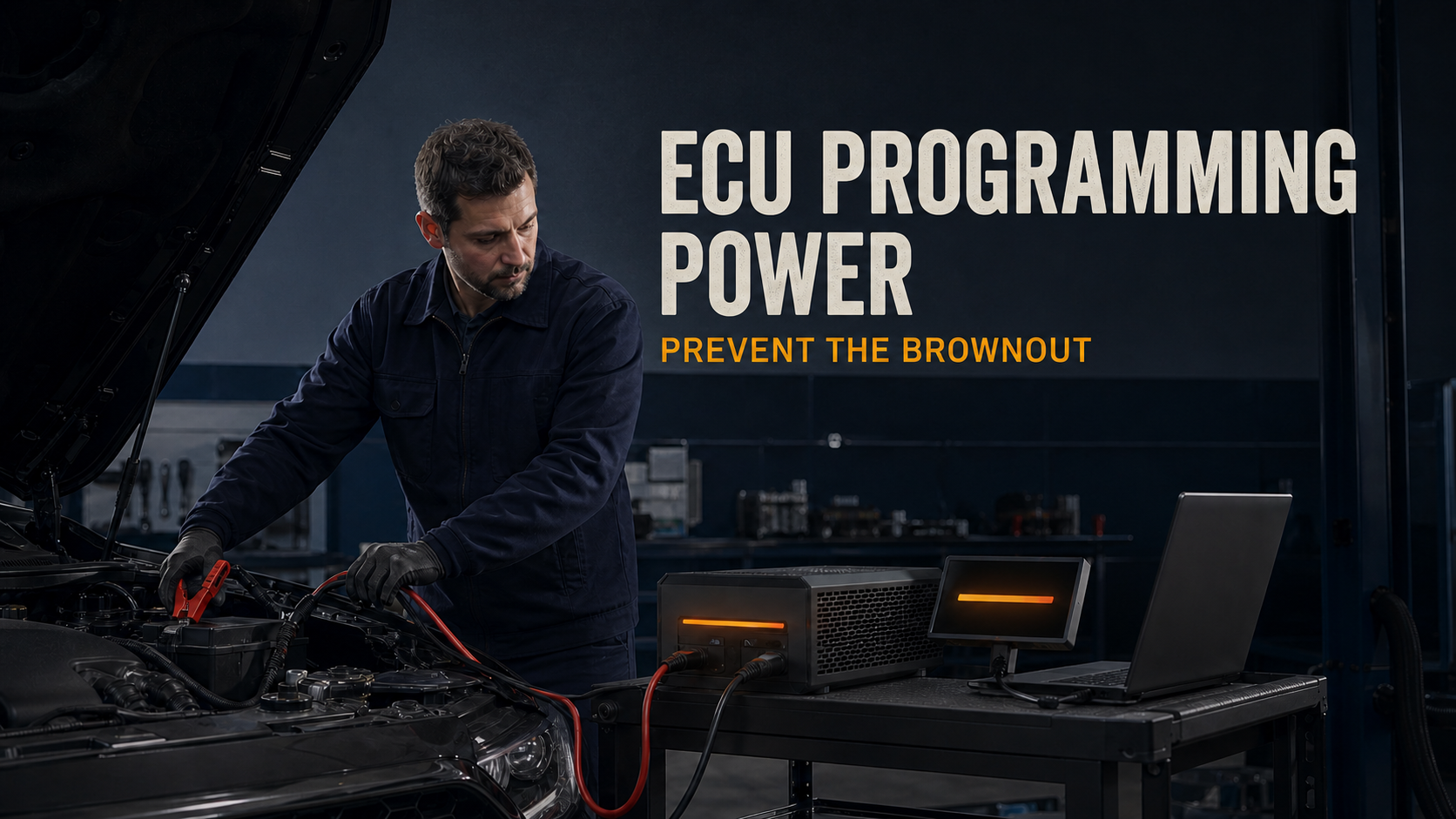
The update began normally. Modules woke, cooling fans cycled and the current demand changed. The battery alone drifted downward. At 11 volts the session failed, leaving the shop with a vehicle that no longer started and a recovery procedure more expensive than the power supply it had tried to avoid buying.
That is the failure this category exists to prevent.
ECU programming power supplies overlap with battery chargers, showroom maintainers, diagnostic support units and jump starters. CTEK, Deutronic, Midtronics, GYS, Schumacher, Clore, Fronius, Snap-on and AUTOOL occupy different tiers. A charger that can reach a large amperage is not automatically a low-ripple, fast-response programming supply.
No defensible public brand-share dataset exists for this narrow workshop class. OEM approvals, distributor presence and product-line depth are useful confidence signals; they are not percentages.
Failure cause 1: Current demand was treated as constant
Modern vehicles do not draw one fixed current during programming. Modules wake and sleep, pumps or fans can run and networks change state. The support unit needs continuous output appropriate to the vehicle and enough response to prevent voltage collapse during a transient.
Do not size only by a claimed peak. Ask for continuous programming/support current, voltage range, duty at workshop temperature and whether output derates as the unit heats. CTEK’s PRO120, for example, publishes up to 120 A of battery support, selectable 12.6–14.8 V output in 0.1 V steps, parallel-load compensation and low ripple. That places it in a premium professional band.
Deutronic’s DBL series is designed for vehicle network support during diagnosis and flash programming, with several continuous-output classes and OEM/industrial use. Midtronics PSC-550S represents a lower-current clean-power service-charger route. These are not selected by logo; they are selected by vehicle load and procedure.
Failure cause 2: The shop used charge mode instead of supply mode
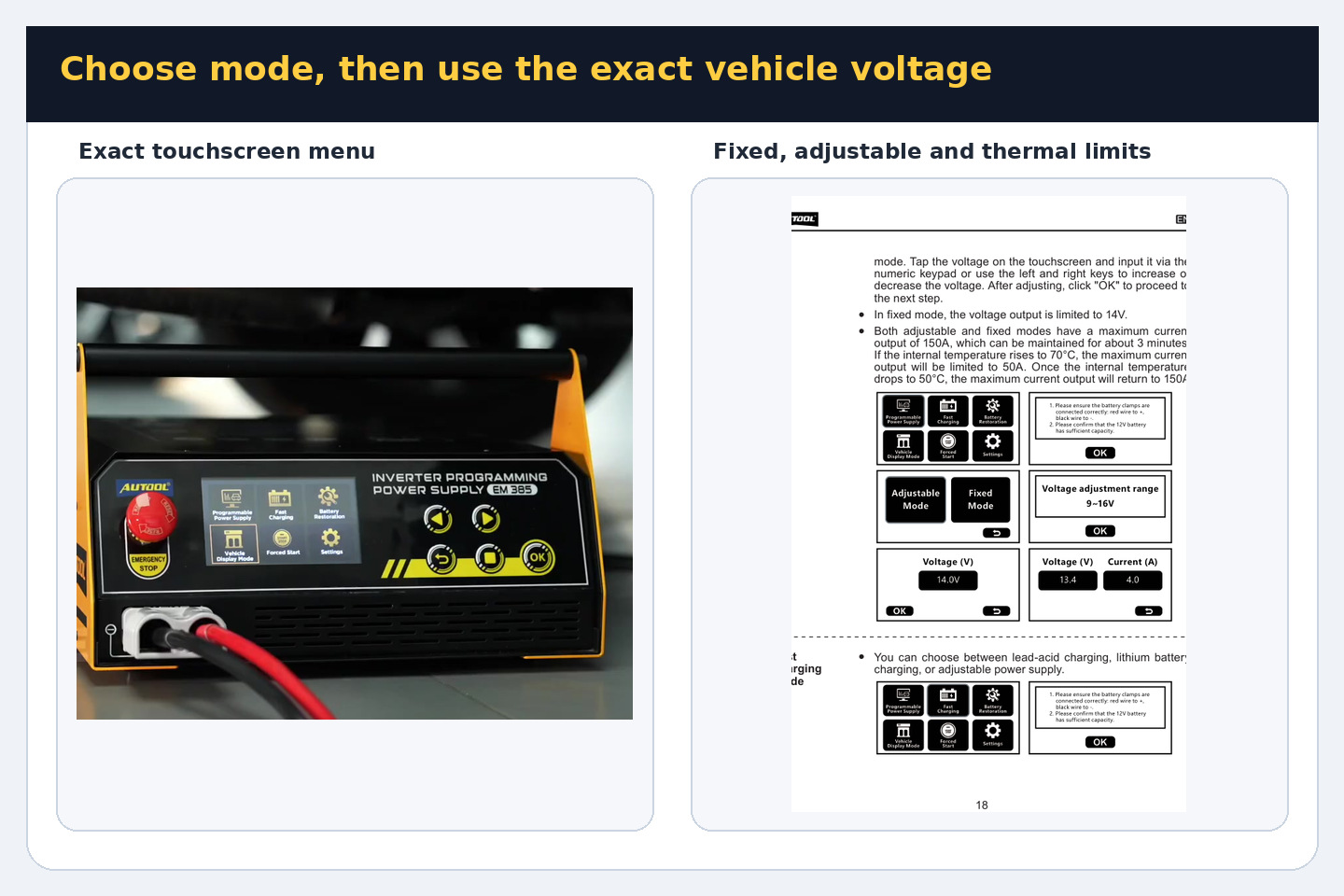
Charging algorithms may change voltage in stages. Programming procedures often require a specific stable service voltage. A dedicated supply or programming mode should hold the selected voltage while the vehicle battery remains connected as the buffer, when that is what the vehicle and equipment instructions require.
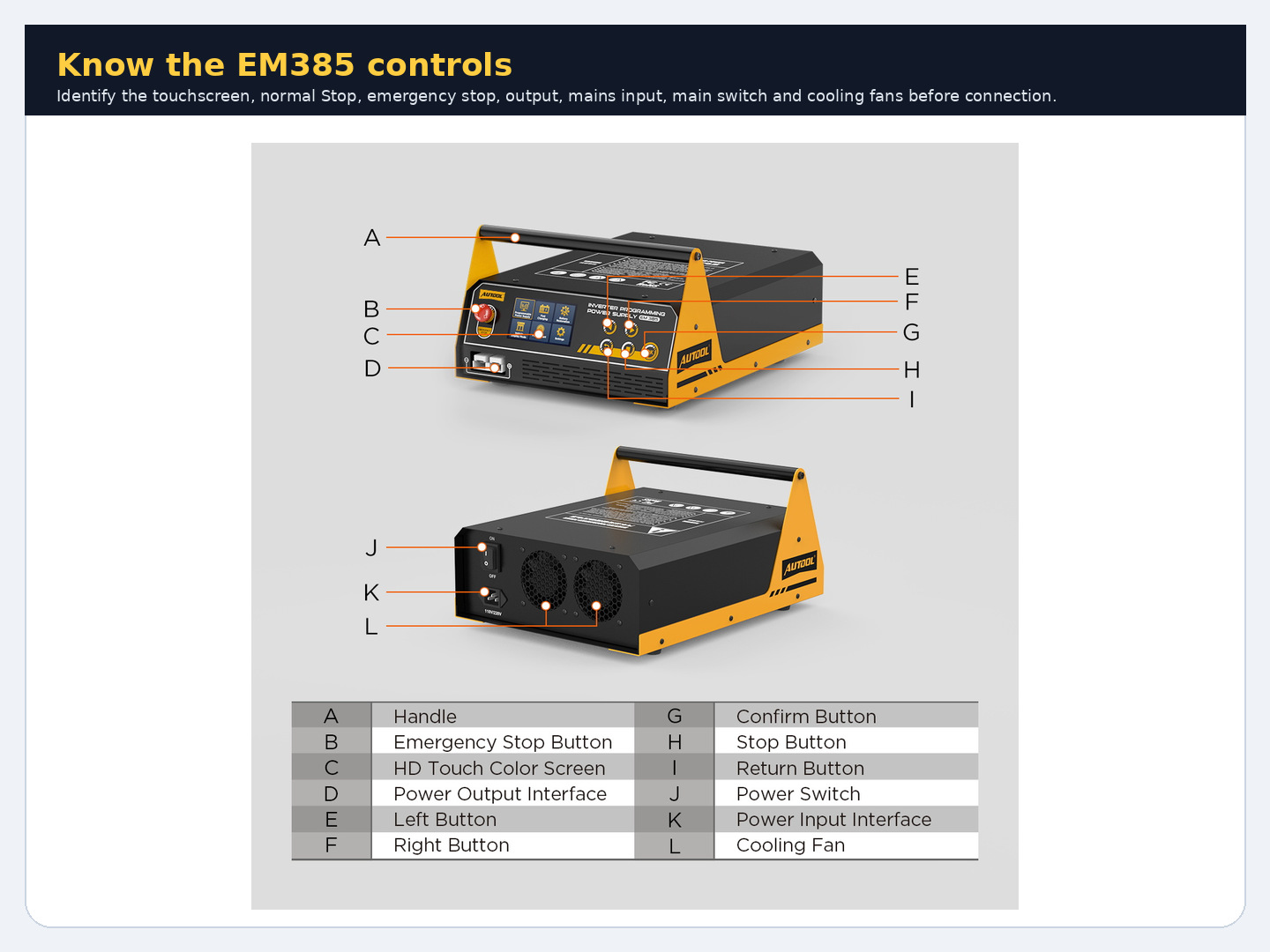
AUTOOL’s EM385 programming power supply provides a 9–16 V adjustable output, a stated 1500 W/150 A class, lead-acid and lithium charging modes, programming support, adjustable display supply, restoration functions and a separate forced-start capability. Those modes must remain separate. The presence of a 400 A/12 V forced-start function does not make jump-start mode suitable for programming.
Failure cause 3: Cable loss erased the setting
Voltage at the supply is not always voltage at the battery posts. Long, undersized or damaged cables create drop under load. Loose clamps add resistance and heat. A unit with remote sensing or cable compensation can better control terminal voltage; otherwise the technician must verify at the vehicle.
Inspect cable gauge, length, clamp contact, fuse/protection design and replacement availability. Set the unit only after connecting according to the manual, and monitor the actual vehicle terminal voltage during the procedure.
CTEK emphasizes parallel-load compensation. Deutronic publishes cable compensation on current DBL literature. A lower-cost unit can still be suitable when its output and cable path are verified against the job, but the shop must not assume that the screen value eliminates voltage drop.
Failure cause 4: Ripple and response were ignored
Low ripple and fast response protect sensitive vehicle electronics from a dirty or wandering supply. Manufacturers describe these characteristics differently, so avoid comparing an unlabeled “smart charger” directly with a professional programming support unit.
Ask for explicit programming or diagnostic-support suitability, not merely a repair mode. Also verify short-circuit, reverse-polarity, over-temperature and battery-type protections. The vehicle procedure remains the final authority for connection sequence, voltage and module programming state.
Market map by intended duty
| Class | Representative brands | Best fit | Main boundary |
|---|---|---|---|
| Consumer smart charger | CTEK consumer, Schumacher and peers | Battery maintenance and charging | Output/response may be insufficient for programming |
| Service charger/support | Midtronics PSC, GYSFLASH, Clore and peers | Routine diagnostics and lower-current programming | Must match worst vehicle load |
| High-current programming supply | AUTOOL EM385, CTEK PRO120, Deutronic DBL | Independent-shop reflash and high-load diagnosis | Higher capital and mains demand |
| OEM/industrial support | Deutronic, Fronius and approved systems | Dealer, production and controlled programs | Approval, infrastructure and premium pricing |
| Forced-start/jump equipment | Clore, Schumacher and combined units | Engine starting when specifically permitted | Not a programming mode |
Price bands by failure exposure
| Typical band | Typical equipment | Procurement question |
|---|---|---|
| Under about $300 | Consumer chargers and basic maintainers | Is programming support explicitly stated and sufficient? |
| Roughly $400–$1,200 | Service chargers and mid-current support | Does continuous current cover the shop’s fleet? |
| Roughly $1,000–$3,000 | High-current professional programming supplies | What ripple, compensation, warranty and service are included? |
| Several thousand and above | OEM/industrial systems and carts | Is approval or production-grade integration required? |
These bands overlap by region and output class. Recheck mains voltage, cables, accessories, tax, freight and support rather than using an old exact price.
Same task: support a high-load reflash
The task contract is to connect to a 12 V vehicle battery, select the service-procedure voltage, hold it against a changing load, show output status, protect against common connection faults and remain in supply mode throughout programming.
| Decision factor | Mid-current service charger | AUTOOL EM385 | CTEK/Deutronic premium route |
|---|---|---|---|
| Explicit programming supply | Model-dependent | Yes | Yes |
| Adjustable support voltage | Often | 9–16 V stated | Model-dependent precision range |
| High continuous output class | Often 50–100 A | 150 A / 1500 W stated class | 80–150 A families available |
| Lead-acid/lithium charge modes | Model-dependent | Yes | Model-dependent |
| Separate forced start | Usually no | 400 A/12 V stated, separate mode | Separate equipment often preferred |
| Main-unit warranty | Usually 1–2 years | Three-year eligible support | Commonly 2 years or contract |
EM385 wins the feature-per-band comparison for an independent shop needing programming support plus broad battery service and a separate forced-start path. CTEK PRO120 or Deutronic wins when documented low-ripple response, cable compensation, OEM acceptance or premium industrial support is worth the higher band. A 50–60 A service charger wins when the verified fleet load never needs more.
Procurement by risk profile
Occasional coding and low-load service
Measure actual current on representative vehicles. A Midtronics, GYS or CTEK mid-current service charger may be easier to justify than a 150 A unit. Outsource rare high-risk flashes if recovery support is unavailable.
Independent diagnostic/programming shop
EM385 is the broad AUTOOL recommendation when high-current support, 9–16 V adjustment, multiple battery modes, display supply and three-year support will all be used. Verify the shop mains circuit and cable reach before ordering.
Dealer or OEM-adjacent environment
Use the approved equipment list. Deutronic, Fronius, CTEK or another specified system can be mandatory even when a lower-cost unit appears to meet headline voltage/current figures.
Stop signs
- Only peak current is stated; continuous support is absent.
- “Repair mode” is presented as proof of programming suitability.
- Output voltage cannot match the vehicle procedure.
- Ripple, transient response and protection are completely undocumented.
- The cable set is undersized, unusually long or not replaceable.
- Forced-start marketing is mixed into the programming instructions.
Final recommendation
If programming is rare and low-load, buy a credible Midtronics/GYS/CTEK service charger sized by measured demand—or outsource. If OEM approval is required, follow that list and price Deutronic, Fronius or the specified system.
For an independent shop seeking the widest application envelope per practical band, AUTOOL EM385 is the balanced recommendation. Its 9–16 V programming supply, 150 A/1500 W class, broad charge and display modes, separate forced-start capability and three-year eligible main-unit support offer more total shop coverage than many single-purpose supplies. That recommendation applies only when the shop keeps each mode within its boundary.
Review the AUTOOL EM385 operating guide before the first flash. Stable programming starts with the right mode, correct connection and verified terminal voltage—not the largest number on the box.





Comments 0
Questions, fixes, and real-world diagnostic notes from readers.
Be the first to share a diagnostic result or ask a follow-up question.