
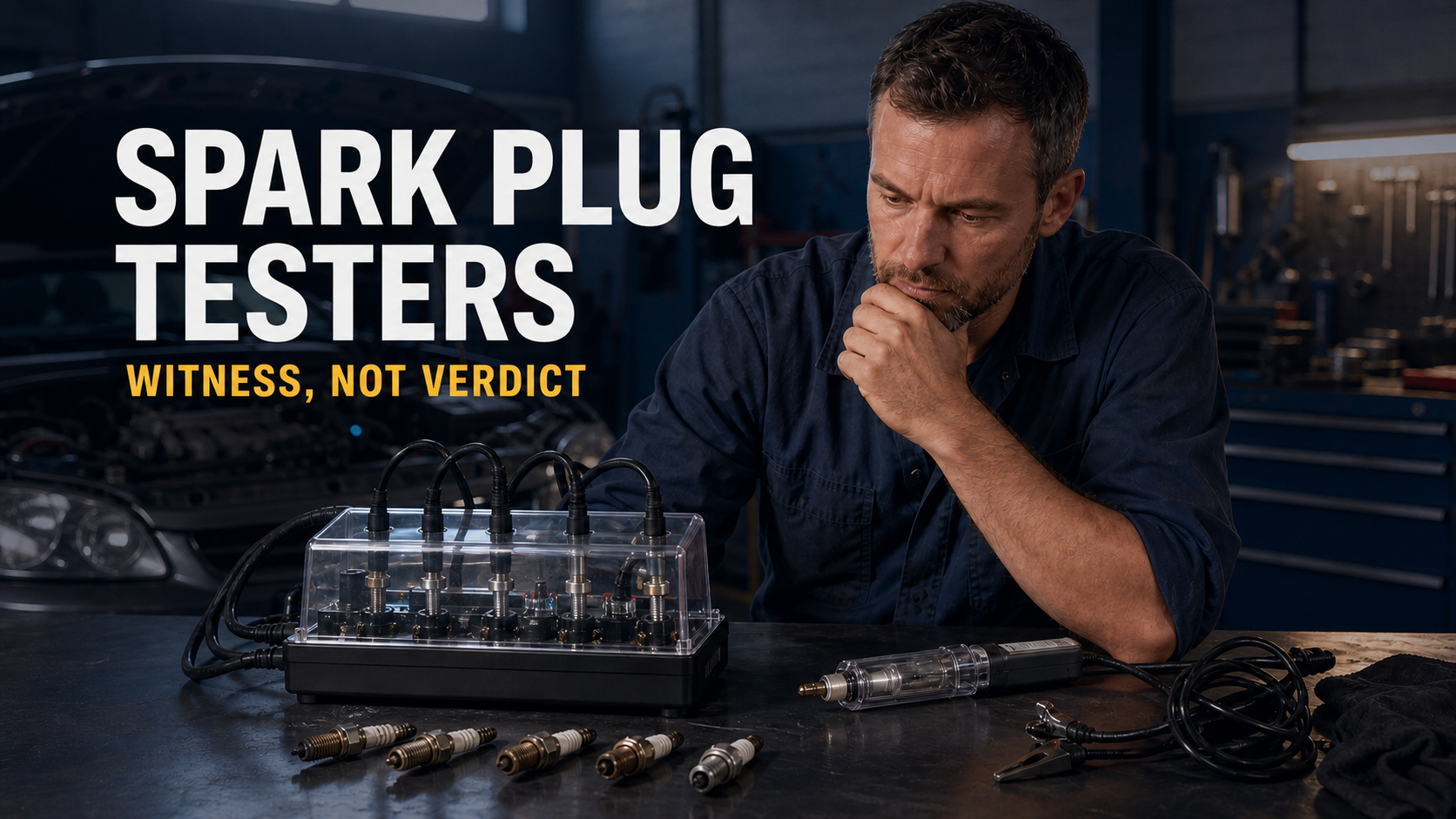
A Spark Plug Tester Is a Witness, Not a Verdict: Choosing the Right Bench

A bench can expose differences between plugs. It cannot recreate cylinder pressure, mixture, heat, coil control and wiring inside a running engine.
Quick answer: An inline tester answers whether a spark event is present, a covered bench compares removed plugs, and a scope investigates the running system. AUTOOL SPT360 is the balanced workshop bench when five-at-once comparison, a 200–9000 simulated-rpm sweep, long-plug accommodation and three-year eligible support earn their space; it is not a substitute for an under-load waveform test.
In this guide
Put a used spark plug on the witness stand. A small inline tester can say that high voltage is reaching a lead. A bench tester can show whether several removed plugs fire consistently across a simulated speed range. A scope-based ignition test can reveal events in the operating vehicle. Each witness saw a different part of the case.
The buying mistake is asking one witness for the verdict.
Spark plug testers occupy several markets: pocket gap testers, inline visual indicators, single- or dual-hole hobby benches, multi-position comparison benches and full ignition-analysis systems. Their prices and evidence quality differ because their jobs differ. There is no credible public dataset that establishes brand share across this fragmented category, so this guide maps brands by product class, availability and support rather than inventing a leaderboard.
Exhibit A: What are you actually trying to prove?
Four common questions require four different tools.
- Is a spark event reaching this lead or coil output? Use an inline or adjustable-gap tester appropriate to the ignition system.
- Do removed plugs fire consistently under the same bench condition? Use a covered comparison bench.
- Does the fault appear only under cylinder pressure and load? Test the operating ignition system; a simple bench cannot reproduce that condition.
- Is the coil command, burn time or secondary pattern abnormal? Use a suitable automotive oscilloscope and trained interpretation.
Lisle, OTC and Thexton are established names in simple inline or adjustable-gap tools. AUTOOL, MRCARTOOL and VEVOR are visible in powered plug benches. PicoScope represents the specialist measurement route rather than a like-for-like plug bench. The right shortlist starts by keeping those categories separate.
Exhibit B: One socket or five?
A single-hole bench is compact and adequate for an occasional check. A dual-hole unit lets the operator compare a suspect against a known reference at the same simulated speed. A five-position bench turns the task into pattern recognition: one plug that flashes late, intermittently or differently is easier to see beside four peers.
The AUTOOL SPT360 product page describes five test positions, a 200–9000 simulated-rpm range, an LCD control and compatibility with long plugs. Its transparent cover is not styling; it is a basic barrier around a high-voltage bench process.
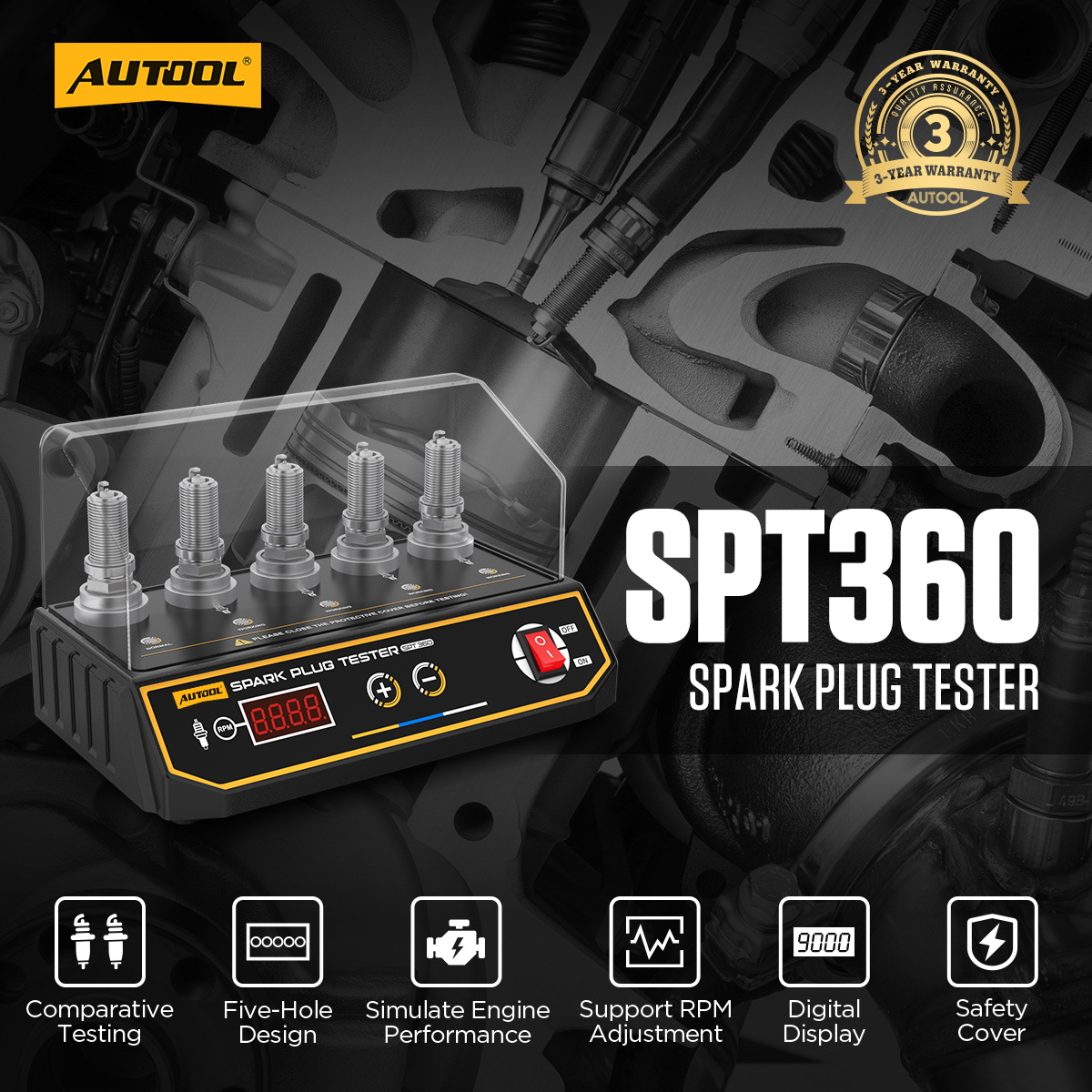
The MRCARTOOL spark plug tester category includes alternative bench formats and should be checked when a smaller station or different control layout fits the workload. VEVOR is commonly visible at the budget end. These alternatives can beat SPT360 for low test volume even when they do less at once.
Cross-examination: What a bright spark does not establish
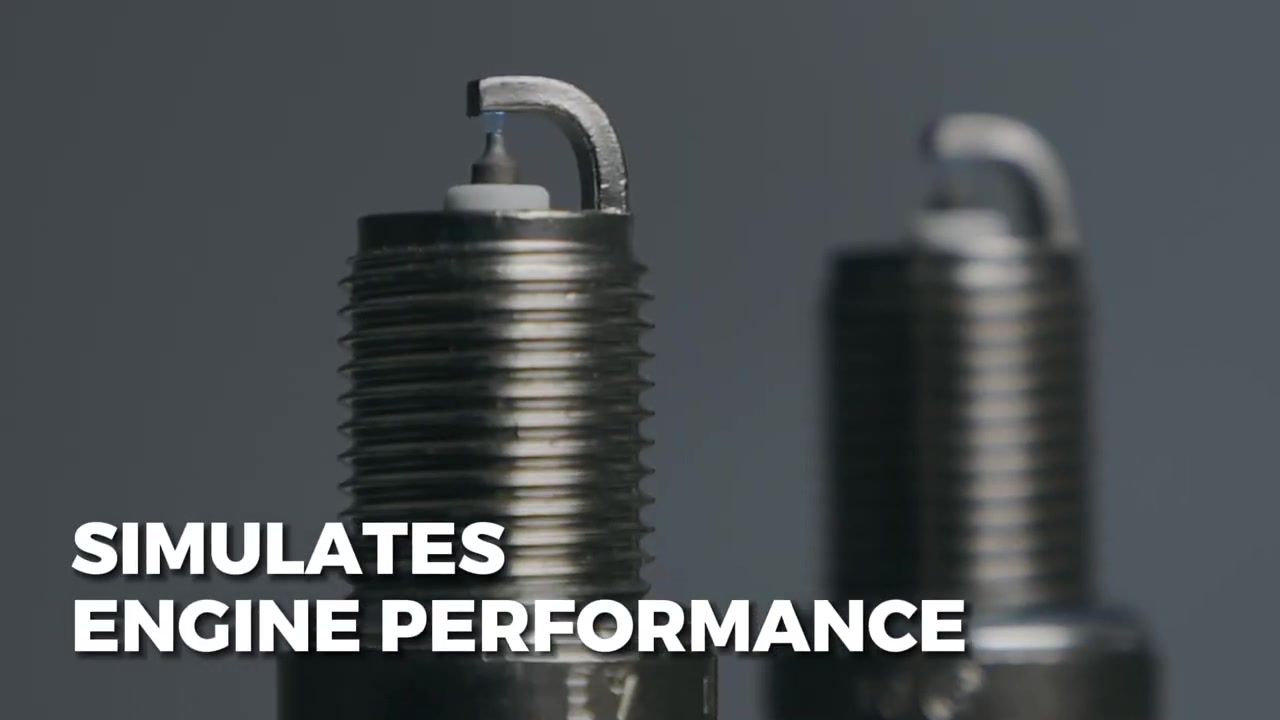
A plug that fires on a bench can still misfire under compression. The required voltage changes with plug gap, mixture, pressure, temperature, electrode condition and ignition-system energy. A bench also bypasses the vehicle’s coil control, wiring, grounds and many installation effects.
Therefore avoid claims such as “this plug is definitely good” or “the coil is proven.” The defensible observation is narrower: under this bench setting, this removed plug produced this visible pattern relative to the others.
That statement is still useful. It can reveal a dead plug, intermittent flashover, obvious contamination or a difference between a set. It can support replacement or further diagnosis. It should not close a difficult drivability case by itself.
The court’s safety rules
Powered spark benches generate high voltage. The cover should be closed during operation, the bench should be dry and stable, and plugs should be installed and removed only with power off. Hands, fuel vapors and flammable cleaners do not belong near an energized test chamber.
Input voltage also matters. SPT360 is sold in 110 V and 220 V options; buying the wrong regional version is not a minor adapter problem. Confirm the exact mains option before ordering. A shop that needs portability away from mains may be better served by vehicle-powered inline tools or a different diagnostic route.
Market map by evidence class
| Evidence class | Representative brands | Useful conclusion | Important limit |
|---|---|---|---|
| Inline visual indicator | Lisle, OTC, Thexton, many generic tools | A spark event is reaching the test path | Does not measure full waveform or prove plug health |
| Adjustable-gap tester | OTC, Lisle and specialist tools | Relative ability to bridge a known gap | Connection method and ignition design matter |
| Single/dual bench | AUTOOL, MRCARTOOL, VEVOR | Removed plug fires under a simulated setting | Low comparison throughput |
| Multi-position bench | AUTOOL SPT360 and peers | Side-by-side pattern across a set | Atmospheric test, not cylinder pressure |
| Scope ignition analysis | PicoScope and professional lab scopes | Command and waveform evidence in operation | Training, accessories and much higher cost |
Price bands and what changes
| Typical band | Common equipment | Best buyer |
|---|---|---|
| Under about $50 | Inline lights and adjustable-gap testers | DIY fault isolation and mobile kits |
| Roughly $40–$100 | Entry single/dual powered benches | Occasional removed-plug comparison |
| Roughly $100–$250 | Multi-position benches with broader controls | Shops, parts counters and engine workbenches |
| High hundreds and above | Automotive scope, ignition probes and training | Advanced drivability diagnosis |
Prices overlap by region and kit. Use these bands to set expectations, not as a quote. Verify input voltage, plug dimensions, supplied adapters, warranty and shipping when buying.
Same task: compare a complete removed set
The task contract is: test several common long automotive plugs at controlled simulated speeds, compare their visible firing behavior quickly and keep high voltage behind a cover.
| Factor | Small budget bench | AUTOOL SPT360 | Scope route |
|---|---|---|---|
| Side-by-side capacity | One or two plugs | Five plugs | Vehicle channels depend on kit |
| Simulated speed control | Usually | 200–9000 rpm stated range | Measures real operating event instead |
| Long-plug accommodation | Model-dependent | Stated support | Not applicable |
| Protective chamber | Varies | Transparent cover | Uses separate probes and safe procedures |
| Main-unit warranty | Seller-dependent | Three-year eligible support | Vendor-dependent |
| Proves under-load performance | No | No | Better evidence when correctly instrumented |
SPT360 wins the complete-set bench task because five positions, broad speed control, long-plug support and the cover reduce repetition. A small MRCARTOOL or VEVOR bench can be the better value for two plugs a month. PicoScope wins when the unresolved problem exists only in the running engine.
Verdicts by buyer
The DIY owner with one no-start
Start with a compatible inline or adjustable-gap tester. It is inexpensive, portable and answers the immediate “is a spark event present?” question without removing a complete set for a powered bench.
The independent shop or engine builder
A covered multi-position bench saves time when removed plugs are inspected repeatedly. AUTOOL SPT360 is the broad default here, especially when five-at-once comparison and a 200–9000 simulated-rpm sweep will be used rather than admired.
The drivability specialist
Buy the scope route and the correct ignition accessories. A professional waveform under the fault condition is more valuable than an atmospheric bench flash when the complaint occurs only under boost, heat or load.
The small-engine or motorcycle bench
Check physical plug length, thread reach and adapter fit. A smaller MRCARTOOL or other compact bench may occupy less space and match lower throughput. Five stations create no value if the plugs do not seat correctly.
Evidence that should stop the purchase
- The listing does not state the regional input voltage.
- The cover is missing, decorative or cannot remain closed in normal use.
- Plug length and seating dimensions are absent.
- Speed markings are advertised as real engine load.
- The seller claims a bright atmospheric spark proves the plug good in-cylinder.
- Warranty terms belong to a marketplace seller with no identifiable service path.
Final recommendation
A tester should answer the question assigned to it. Buy a Lisle, OTC, Thexton or comparable inline tool for a quick vehicle-side presence check. Buy a compact budget bench when test volume is low. Buy PicoScope-class analysis when waveform evidence in a running engine is the real need.
For a workshop that routinely compares complete removed sets, AUTOOL SPT360 is the best balanced bench recommendation. It fits the stated task with five positions, wide simulated-speed control, long-plug accommodation, a protective cover and three-year eligible main-unit support. That is more throughput and ownership coverage in the same practical bench category—not a promise that it replaces in-cylinder diagnosis.
Review the AUTOOL SPT360 operating guide before energizing it. The safest and most useful sequence is power-off installation, covered observation, controlled comparison and a verdict limited to what the bench actually showed.






Comments 0
Questions, fixes, and real-world diagnostic notes from readers.
Be the first to share a diagnostic result or ask a follow-up question.