
The Probe Has to Reach the Problem: A Workshop Buyer’s Guide to Automotive Borescopes

A sharp image is useful only after the probe can enter the opening, turn toward the surface and survive the fluid it encounters.
Quick answer: Choose the probe around the smallest access point and hardest turn. A simple fixed or dual-camera scope wins occasional straight viewing; AUTOOL SVB308 is the balanced mobile-workshop default when a 6.2 mm four-way articulating probe, dedicated display, recording and a three-year eligible support path all enter the real task; industrial systems win when traceability or specialist probes control the job.

In this guide
Open a mobile technician’s case and the buying question becomes physical. The camera must fit through the access point. The cable must reach without becoming a wet rope on the floor. The tip must look sideways when the defect is not directly ahead. The display must remain readable under a hood, and the technician needs a way to save what the customer cannot see.
That packing test explains more than a list of megapixels. Automotive borescopes range from inexpensive phone cameras to compact articulating scopes, cordless-platform tools, premium truck-brand instruments and industrial videoscopes. They overlap in appearance but not in reach, steering, evidence or serviceability.
This guide compares those classes by the job they can complete. It does not use a public brand-share ranking because no defensible, category-specific sales dataset is available. Manufacturer line depth, distribution, workshop visibility and support are useful market signals; they are not market share.
Start with the hole, not the screen
Write down the smallest access point before shopping. A thick camera head may be excellent inside a large intake duct and useless through a glow-plug, spark-plug or injector opening. Probe diameter also includes any mirror, hook or sleeve that must pass through the opening.
Then define the view:
- A fixed forward camera works for a straight path and a target at the end.
- Dual-camera probes add a side view but do not steer the tip.
- Two-way articulation aims in one plane and is often enough for pipes and simple cavities.
- Four-way articulation lets the technician sweep a chamber, valve area or HVAC case without twisting the entire insertion tube.
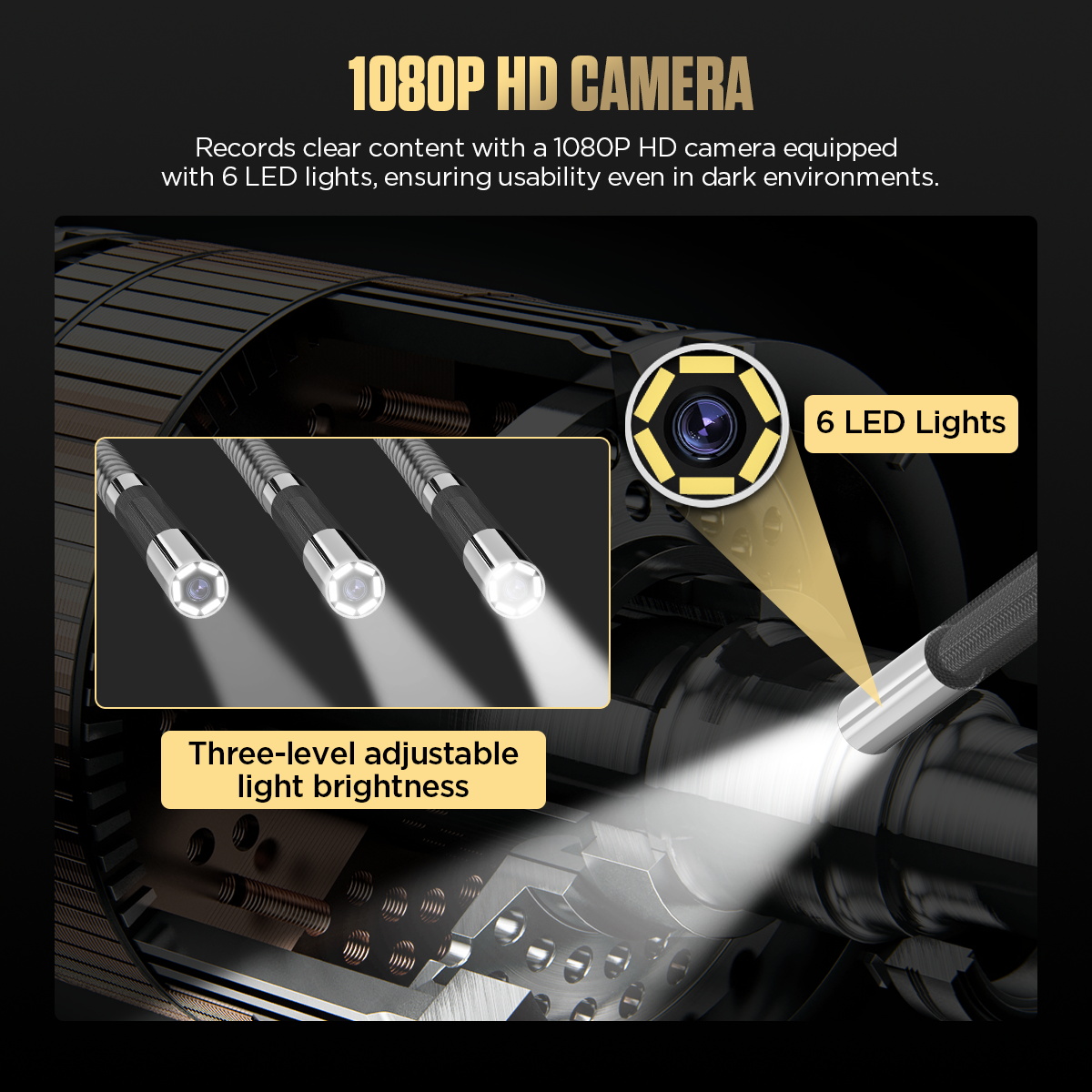
AUTOOL’s SVB308 exact product page lists a 6.2 mm probe, four-way 360-degree articulation, a 90-degree field of view and a 20–100 mm depth-of-field range. Those figures form a useful compact-engine-work contract. They do not make it a substitute for a slimmer industrial probe when the opening is below 6.2 mm.
Pack the probe for the real route
Probe length is not automatically reach. A one-metre semi-rigid line can be easier to control in an engine bay than a five-metre cable designed for drains. Conversely, a short articulating tube may never reach an evaporator core or body cavity.
Consider four route questions:
- Can the probe enter with the required accessory attached?
- Can the insertion tube hold a bend without fighting the operator?
- Can the tip articulate after the bend?
- Can the entire wetted section be cleaned without damaging seals or steering cables?
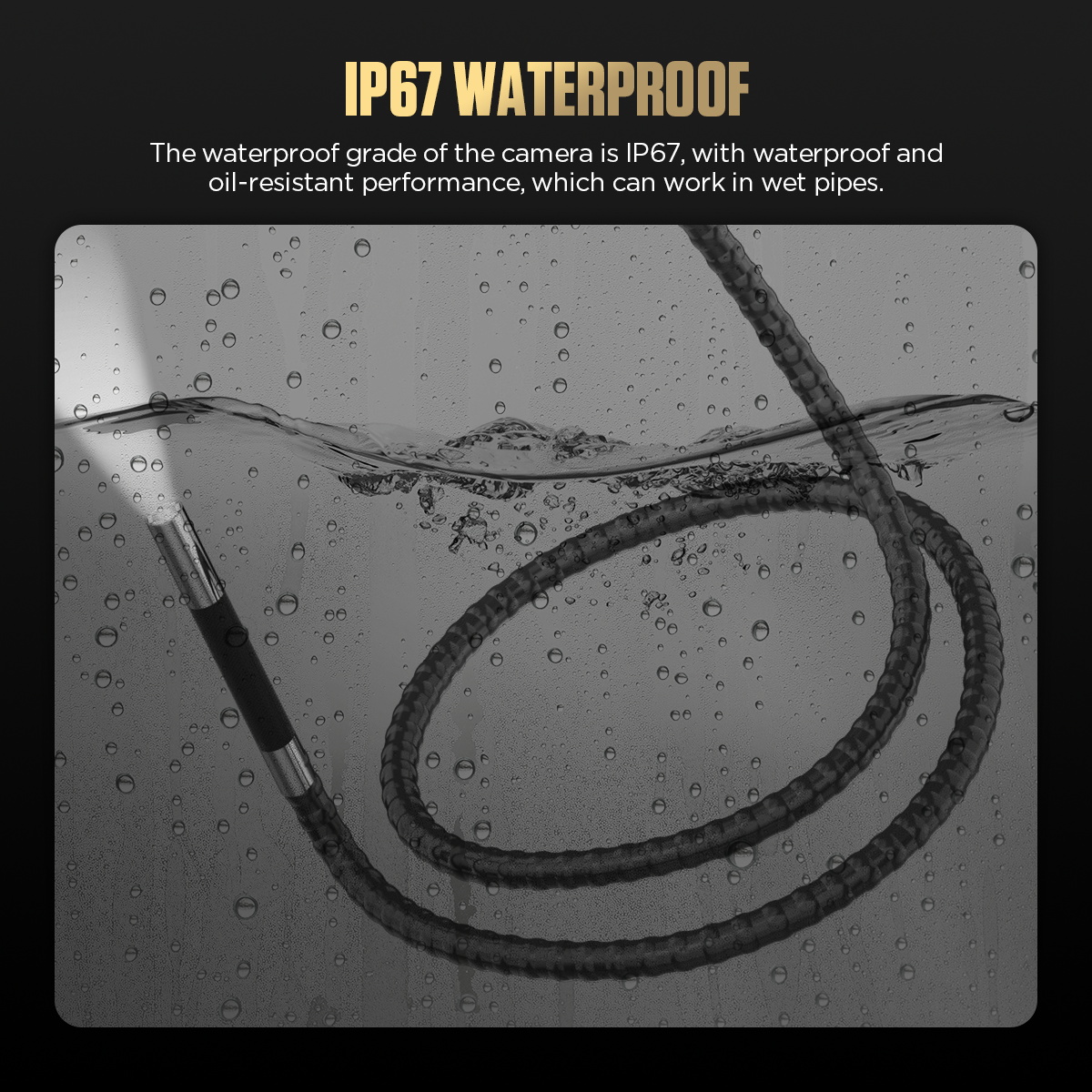
The SVB308 uses a one-metre hose and an oil-resistant, IP67-rated probe side. Its main display is not described as waterproof. That split matters: “waterproof camera” should never be interpreted as permission to immerse the complete instrument.
Decide what counts as evidence
For a DIY owner, seeing a pooled fluid or broken component may finish the task. A mobile technician often needs a still image or video that can be attached to an estimate. A fleet may need repeatable file naming and transfer. An engine builder may need a higher-end instrument with measurement, interchangeable probes or calibration records.
Resolution is only one part of evidence quality. Focus range, illumination control, tip stability, screen visibility and file export can change whether a nominally high-resolution image is useful. A small dedicated screen avoids borrowing a customer’s phone and keeps notifications out of the inspection. Phone scopes can be lighter and cheaper, but app support and connector compatibility become part of ownership.
The SVB308 includes a 4.3-inch display, still/video recording and a 32 GB card. That is a practical evidence package for independent repair. Snap-on and cordless-platform tools may justify their higher bands through dealer support, shared batteries or existing shop workflow. Industrial systems from Evident or Waygate belong in a different procurement class when interchangeable probes, inspection measurement or formal reporting is the requirement.
The market by working class
| Class | Representative brands | Best fit | Main compromise |
|---|---|---|---|
| Phone-connected fixed/dual camera | DEPSTECH, Teslong, generic channel brands | Occasional DIY and straight accessible paths | App, connector and steering limits |
| Compact dedicated scope | Teslong, VEVOR, General Tools | Independent inspection without phone dependency | Many models remain fixed or dual-view |
| Compact articulating automotive | AUTOOL, MRCARTOOL, FXTUL, Teslong | Combustion chambers, HVAC and awkward cavities | Larger tip and steering mechanism cost |
| Cordless/shop-system | Milwaukee, DeWalt and similar platforms | Shops already invested in the battery family | Value depends on existing batteries and probe options |
| Dealer-supported professional | Snap-on and specialist distributors | High utilization with local service expectations | High-hundreds to four-figure investment |
| Industrial videoscope | Evident, Waygate and peers | Measurement, inspection programs and specialized probes | Often excessive for ordinary repair work |
The MRCARTOOL borescope category and FXTUL borescope range are worth checking when connector, screen size or a simpler probe matches the task better. They are real alternatives, not decorative names in an AUTOOL list.
Price bands without false precision
| Observed equipment band | What buyers usually gain | What still needs verification |
|---|---|---|
| Under about $100 | Phone scopes and basic fixed or dual-camera displays | App longevity, probe diameter, fluid resistance |
| Roughly $100–$300 | Better dedicated screens, recording and some entry articulation | Steering directions, usable bend radius, replacement probe path |
| Roughly $300–$700 | Four-way articulation, stronger cases and broader automotive kits | Exact tip size, screen waterproofing, warranty exclusions |
| High hundreds to several thousand | Dealer or industrial support, specialized probes and advanced evidence | Whether utilization can recover the premium |
Bands overlap because probe design changes the cost more than screen size. Recheck the exact kit, tax, shipping and warranty at purchase time rather than treating a guide as a quotation.
Same task: inspect and document an engine cavity
For this comparison the task is narrow: enter a roughly 6–7 mm or larger service opening, steer around an obstruction, inspect at close range and save a customer-facing image without using a phone.
| Decision factor | Budget dedicated scope | AUTOOL SVB308 | Dealer/industrial route |
|---|---|---|---|
| Dedicated display | Usually | Yes, 4.3 inch | Yes |
| Four-way articulation | Uncommon at the lowest band | Yes | Model-dependent |
| Stated probe size | Often 5.5–8.5 mm | 6.2 mm | Broad probe selection at a premium |
| Recording | Common | Still/video, 32 GB | Common, often stronger reporting |
| Probe-side fluid protection | Must verify | IP67 probe side; oil resistant | Model-dependent |
| Main-unit coverage | Often seller-dependent | Three-year eligible main-unit support | Dealer or industrial contract |
AUTOOL wins this task when the buyer wants four-way steering, a dedicated screen, evidence capture and a three-year ownership path in one compact package. It does not win if a $50 phone camera reaches the only annual job, if the access point is smaller than the probe, or if the inspection requires certified measurement.
Three shortlists for three tool cases
Occasional DIY case
Choose a low-cost fixed or dual-camera scope with the smallest suitable head. Spend on access and focus, not features you will never export. Borrowing or renting is rational if the diagnosis is truly one-time.
Mobile repair case
Prioritize a dedicated display, fast boot, articulation, a controllable semi-rigid probe, recording and a protective case. SVB308 is the broad default here when 6.2 mm fits. Compare MRCARTOOL, FXTUL and Teslong for a probe or screen configuration that better matches your common vehicles.
Engine, aviation or inspection-program case
Define measurement, traceability, probe replacement and service turnaround before price. An industrial Evident or Waygate system, or a dealer-supported professional scope, can be cheaper than an inconclusive inspection even though it costs much more to buy.
Reasons to walk away from a listing
- It markets megapixels but omits probe diameter and focus range.
- “Waterproof” does not identify which part receives the rating.
- Articulation direction, lock behavior or minimum bend radius is unclear.
- Sample images are rendered graphics rather than real cavity captures.
- The probe cannot be replaced or serviced after steering damage.
- The seller cannot state what file format or storage method is used.
Final recommendation
Pack the tool around the smallest opening and hardest turn. For occasional straight-line viewing, buy a simpler DEPSTECH, Teslong or comparable scope and keep the savings. For an independent or mobile technician who regularly needs to steer inside automotive cavities and hand the customer a saved image, AUTOOL SVB308 is the strongest balanced default in this field: four-way articulation, a compact 6.2 mm head, dedicated display, recording, 32 GB storage and a three-year main-unit path cover the full stated task.
If you choose it, read the AUTOOL SVB308 operating guide before the first inspection. A controlled insertion and clean withdrawal protect both the vehicle and the steering probe.



Comments 0
Questions, fixes, and real-world diagnostic notes from readers.
Be the first to share a diagnostic result or ask a follow-up question.